
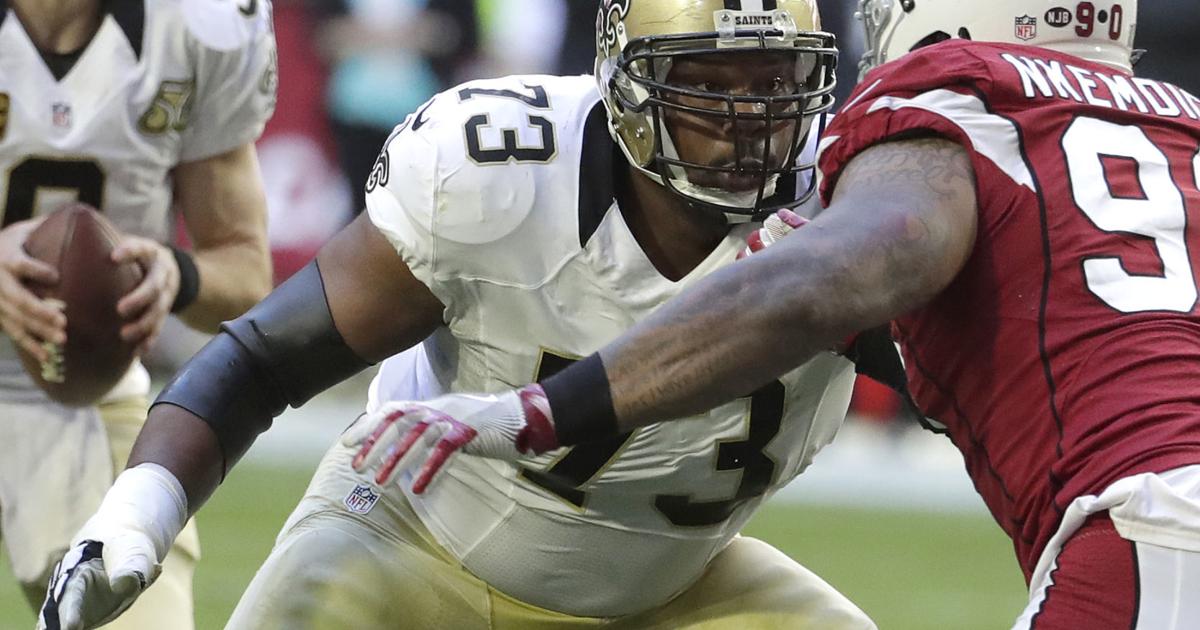
For a decade in the early 2000s, Jahri Evans was the best guard in the NFL.
His rare mix of size, strength and athleticism made him the centerpiece of one of the most dominant offenses in NFL history. During a stellar 11-year tenure with the New Orleans Saints, he anchored the prolific Sean Payton-Drew Brees offense, an attack that rewrote record books and redefined NFL offensive strategy.
Evans, along with Brees, is one of 15 modern-era finalists for the Pro Football Hall of Fame’s Class of 2026. This is Evans’ fourth year on the ballot and third as a finalist.
“When I think of Jahri, I think of dominance, longevity, durability and excellence,” Brees said. “He personified those traits.”
During Evans’ tenure in New Orleans, the Saints ranked as a top-10 offense every year he played, gaining more total yards than any team in football and allowing the fewest sacks in the league — just 274. The unit sent seven different linemen to the Pro Bowl in that span, and Evans was the anchor of a front that twice won the Madden Protectors Award, given to the league’s best offensive line. Everything the Saints did — from their vertical passing game to their precision screen attack — began with the stability Evans provided at right guard.
The Saints offenses during the Payton‑Brees era were historic. From 2006-16, New Orleans averaged an NFL‑high 405 yards per game, 20 more than even the Tom Brady‑led Patriots. They set 17 NFL records during Evans’ tenure, including the single‑season yardage record (7,474 yards in 2011) and the best third‑down conversion rate in league history (56.7%).
Evans was a driving force in all of it. He was so athletic the Saints regularly pulled him on passing plays to isolate him against edge rushers, an assignment virtually unheard of for guards.
Those dynamic Saints offenses were built from the inside out. Because of Brees’ height, the 3 yards directly behind the center were considered sacred ground, and Evans was charged with protecting that space. He did it better than anyone.
Opponents can attest. Panthers linebacker Luke Kuechly, another Hall of Fame finalist, recalled that trying to get around Evans was “like trying to get around a refrigerator,” adding “Evans was critical to what they did. He was highly intelligent and could just blow you up with his power.”
But the true measure of a Hall of Famer is how he performed in the biggest games on the biggest stage. In 10 playoff games, Evans played 456 pass‑block snaps, many of them against elite interior defenders such as Kevin Williams, Calais Campbell and Ndamukong Suh, but he allowed just two sacks and 20 total pressures.
During the Saints’ 2009 Super Bowl run, he didn’t allow a single sack and surrendered only five pressures in three games. Many of the defining plays during the Saints’ postseason run were made possible by Evans’ blocking, including Pierre Thomas’ touchdowns in the NFC championship game and the screen‑pass touchdown in Super Bowl XLIV sprung by Evans clearing out Colts linebacker Gary Brackett.
“When Jahri got his hands on you, it was over,” said Saints defensive end Cam Jordan, a future Hall of Famer who squared off with Evans daily in practice.
Evans boasts one of the strongest résumés of the 15 modern-era finalists for the Class of 2026. He is one of eight candidates to make an NFL All-Decade team, which is voted on by the Hall’s selection committee. He earned six Pro Bowl selections and was a first‑team All‑Pro four consecutive seasons, twice as many as Saints Hall of Famer Willie Roaf.
Only 29 offensive linemen in NFL history have been named first‑team All‑Pro four or more times; 25 of them are already in the Hall of Fame. The only ones who aren’t are either not yet eligible or Jahri Evans.
Evans also was remarkably durable and dependable. He started every game for the first seven years of his career and missed just nine games over 12 seasons.
Durability. Consistency. Postseason excellence. Evans epitomizes what a Hall of Famer looks like.
“As a coordinator in Dallas, I coached and saw firsthand Larry Allen,” Payton said. “Jahri was every bit the same level of player as Allen: steady, tough and a fantastic teammate. He’s one of the toughest and smartest players I have ever been around in coaching, and that, coupled with his unselfishness and dependability, made him one of the most respected players in our locker room. He had outstanding make-up and character. Everyone in the building loved him.
“Jahri was the best player to play on arguably the best offense in NFL history.”
In the Super Bowl era, every championship team in the first 41 years featured at least two Hall of Famers. Somehow, the 2009 Saints still have zero Hall of Famers. The team that started 13‑0; beat Kurt Warner, Brett Favre and Peyton Manning in consecutive postseason games; and produced one of the most potent offenses of all time had Evans as the best lineman and arguably the best player on that team.
If the Hall of Fame is meant to honor players who defined their era, dominated their position and made a profound impact on winning, then Evans is the definition of a Hall of Famer.
It’s time to put him in Canton.