
CLEVELAND, Ohio — It’s rare this time of year to get much honesty from football people and even rarer to think the Browns would offer up much about their expectations for the 2026 season.
If your eyes aren’t showing you what’s going on with this team and its plan, the team’s leadership has been telling you in bits and pieces over the last year.
You can go back to last July, when Dee and Jimmy Haslam spoke during training camp.
“We made the decision last year to take a step back after last year’s disaster,” Jimmy Haslam said, “and looking at our roster, and knowing that we needed a quarterback, to do this over a two- or three-year period.”
You can go back even before that, to when Browns GM Andrew Berry traded the No. 2 pick to move back, acquire additional draft capital in last year’s draft and, most importantly, acquire a second first-round pick in the 2026 draft.
“We just felt like it was a fantastic opportunity for our organization to move down three spots, still get a top-notch prospect in the trenches, adding a pick in what we view as really the sweet spot for this year’s draft class, and then adding a first-round pick (in 2026) in a class that quite frankly we think will be a bit stronger in the first 30 picks,” Berry explained the night the Browns made the deal.
Then, go back to that July press conference when Haslam discussed a multi-year window of player acquisition and development.
“We talk about it openly,” Haslam said. “Now could we take a big jump in one year? Yes. But we talk about we’re not going to panic, we’re going to draft good players, we’re going to build through the draft and (in 2026) we have nine picks including two (first-round picks).”
The Browns are up to 10 picks now in this coming draft, by the way.
GM Andrew Berry actually dared to use the word rebuild when talking about the roster the day the team fired head coach Kevin Stefanski.
“I think when people hear the term rebuild, and probably specifically here, really their thought is tear down, the idea that you’re trading away a number of prime players or veterans and you’re accumulating resources and things of that nature,” Berry said. “When we think about where we are in our transition, it really is about building up the offense. Many of the trades that we’ve made are really about maybe players who won’t be a part of the future core and getting future value for when we’re in our prime window with this roster.”
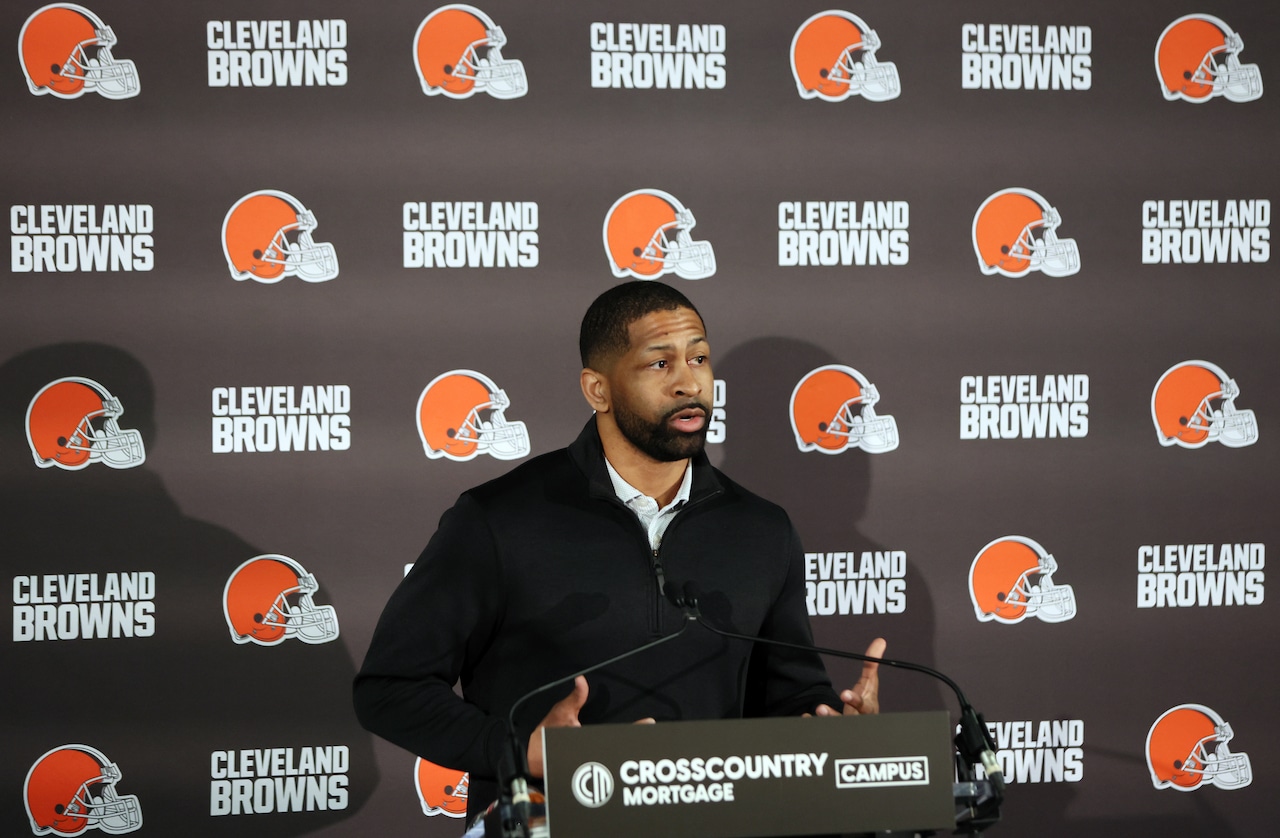
Then, when introducing Todd Monken as the team’s new head coach on Tuesday, Berry emphasized a key point.
“As we looked at everything and we thought about what we needed from our head coach, particularly in this phase, the first thing we actually looked at is, we wanted someone who could lead, develop and grow a young team,” Berry said. “Because quite frankly, we’re probably going to be, if not the youngest, one of the youngest teams in football in 2026.”
How does Berry arrive at that projection?
“That’s just where we’re projecting based on the amount of draft resources we have and then probably just anticipated activity in free agency,” Berry said. “That combined with having a very young defense, we would anticipate that we’d be a very young team. We’re not necessarily going to be in the phase where we’re going to sign a bunch of mid-30s veterans to put us over the top so to speak.”
The Browns top decision makers have spent the better part of the last year laying out the plan they’re following and it should serve to set real expectations for the 2026 season.
The biggest fallout from the Deshaun Watson trade goes beyond just the three first-round picks they lost. It’s how old and expensive the roster got in trying to turn that trade into a Super Bowl run.
The minute they acquired Watson they were all-in on trying to win the AFC and make it to the franchise’s first Super Bowl. They never even came close, making the playoffs one time, a loss to Houston in the wild card round.
Since that loss, the Browns have been caught between competing philosophies — trying to win now while also acknowledging the need to rebuild. They tried one last time to salvage the Watson deal by blowing up Kevin Stefanski’s offensive staff. Watson ruptured his Achilles in October and they went 3-14.
Last season, they conducted a mostly quiet free agency and couldn’t quite decide who they were as they handed the offense back to Stefanski and ran a four-man quarterback competition that included veterans Kenny Pickett and Joe Flacco.
Flacco was gone by mid-October and a 1-5 start dictated their path forward. Berry has since talked about the lifecycle of the roster numerous times, painting a bigger picture than just the few months ahead — even if Haslam called the 120 days after firing Stefanski “crucial.”
Part of their process was moving on from Stefanski and choosing a new leader in Monken to take them into their next phase.
Their focus this offseason is reshaping their offense with young players, specifically the offensive line and pass catchers. They’ve found two building blocks in tight end Harold Fannin Jr. and running back Quinshon Judkins. Jerry Jeudy is still young enough that they can get him back to being a positive contributor.
Quarterback is a major question mark. Right now their choices are hoping for a leap from Shedeur Sanders or a return to form by Deshaun Watson, but they will have opportunities to add in free agency, the trade market or the draft — or two of the three.
The Browns aren’t selling a complete rebuild or a tank job. The NFL is a league where teams regularly exceed expectations, especially if the schedule is favorable and injury luck holds.
The Browns aren’t counting on a stroke of good luck, though. They’ll take it, but in the process, they’re laying out a road map to move the franchise past one failed phase and into another.
It will take plenty of work, and if Berry fails to follow up last year’s draft with an equally strong draft — he has struggled to draft both offensive linemen and wide receivers — the plan could falter. They need one of their quarterbacks to surprise, or they need to find one who can do the job at a winning level. Nothing on this road map is a given. There’s no guarantee Berry is the right person to lead it.
They also owe it to veterans like Myles Garrett, Denzel Ward and, if he returns, Joel Bitonio, to try to compete at the highest level possible in 2026.
In the past, however, the Browns have been driven by that urgency. They’ve tried to skip steps. They’ve panicked when patience was required and doubled down when pulling back might have been smarter.
This time, at least by their own words, they’re done with that.
The expectations for 2026 and beyond have been clear for a while now.
Football Insider newsletter free trial: Take a minute and sign up for a free trial of our Football Insider newsletter, featuring exclusive content from cleveland.com’s Browns reporters.