
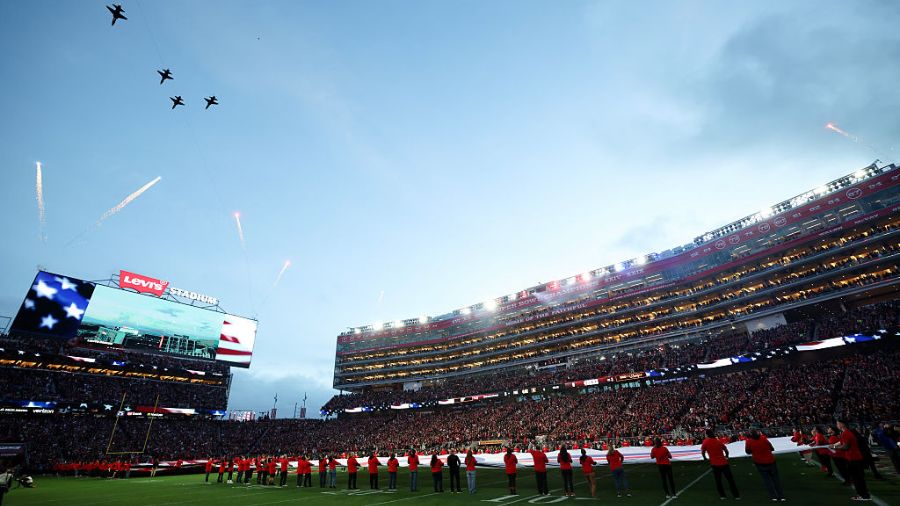
The 60th Super Bowl between the Seattle Seahawks and the New England Patriots kicks off shortly after 3:30 p.m. on Sunday, Feb. 8 in Santa Clara, California. Here is an in-depth look at the expected weather for the big game.
Super Bowl kickoff conditions
The southern end of the Pacific weather system, expected to swing through Western Washington this weekend, will drag through Northern California on Sunday, including the Bay Area. For the game, cloud cover will be thickening with just a small chance of light rain.
Temperatures at kickoff will be mild — in the mid-60s, and cool to the mid-50s by the final whistle.
The cloud cover, small threat of rain, and the temperatures during the game are the basic weather elements. Let’s dig further because they can play a key role in the outcome.
The wind factor
Levi’s Stadium in Santa Clara is oriented from the northwest to the southeast. The wind forecast during the game is for winds from the northwest at five to 10 mph, not particularly strong or significant.
In the Seahawks’ NFC Wild Card Game against the Minnesota Vikings on January 10, 2016, the wind direction with 10 mph wind speeds played a key role in the outcome of the game. For those who remember, that NFL game was also the third coldest ever played. The kickoff temperature was six degrees below zero. So yes, the cold temperatures played a role as well.
Yet, the wind direction in those final seconds of what would be a Seahawks 10-9 victory resulted in a missed 27-yard field goal by kicker Blair Walsh. The kick sailed wide left, preserving the Seattle win in those frigid conditions. Earlier in the game, Walsh had successfully kicked field goals of 25, 28, and 47 yards out, giving the Vikings their 9 points.
The holder on that fateful final field goal also had the football threads facing the wrong direction. The wind caught that error, helping steer the kick wide left.
In the recent AFC Championship Game in Denver, both the Broncos and Patriots missed field goals in the game. Each team missed a pair of field goals with the wind playing a major role, including Denver’s field goal attempt near the end of the game. New England won that game 10-7, moving them to the Super Bowl against the Seattle Seahawks.
The coin flip determines which team kicks off and which team receives the ball on their chosen end of the field to start the game. After each quarter, the teams switch sides of the field of play. What the Seahawks want is in the fourth quarter, to be facing southeast in the stadium with the wind at their back and the Patriots moving northwest into the wind. That was the case in that frozen game in Minnesota.
Sun angle and Levi’s Stadium shadows
There are games where a setting sun can play a role in a football game. The low angle of the sun can be blinding to players and result in dropped and tipped passes, and potential interceptions.
At Levi’s Stadium, the northwest-to-southeast orientation should limit any impact from the sun. First, clouds are expected to be thickening up during the game, yet the sun can beam through cloud cover, creating a bright sky.
Second and most important, at kickoff, the sun angle will be low in the sky at about 18 degrees from the southwest. The stadium structure should shade the entire field since it is perpendicular to the sun’s position. The sun will be setting at about 5:40 p.m. Pacific Time.
Overall, the game weather conditions should be rather ideal with mild temperatures and cloud cover. One key to the outcome of the game, though, will be the decisions made at the coin flip. The Seahawks will hopefully have the wind at their backs in the fourth quarter.
Ted Buehner is the KIRO Newsradio meteorologist. Follow him on X and Bluesky. Read more of his stories here.