
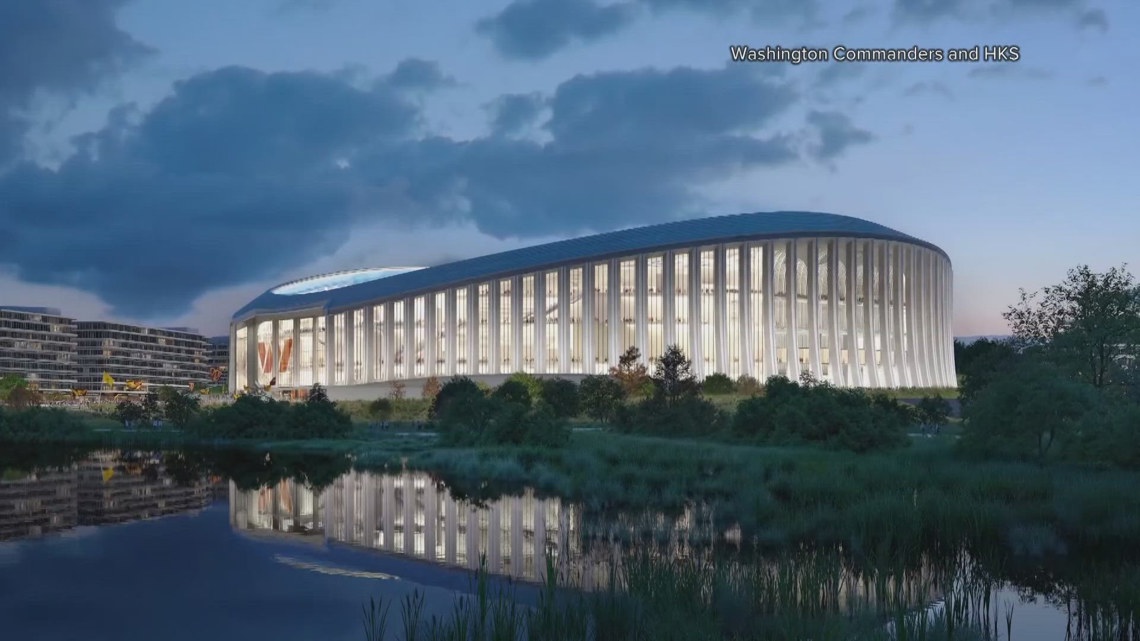
The National Capital Planning Commission approved the proposed design plans but asked the architects team to consider their suggestions surrounding parking, etc.
WASHINGTON — The first design plans for a new RFK Stadium cleared a hurdle Thursday, as the National Capital Planning Commission unanimously approved the project’s initial concept, moving the long-anticipated redevelopment one step forward.
Commissioners praised the proposed design, saying it successfully honors the legacy of RFK Stadium while fitting into Washington’s iconic monumental landscape. Supporters called the vote a significant milestone for the future of the site.
The proposal envisions a modern stadium that pays homage to the original RFK through architectural elements inspired by the city’s historic core. The design includes a colonnade, a raised podium and intentional alignment with both the U.S. Capitol and the Washington Monument.
“It’s not just a stadium,” said Ted Abela, a longtime Commanders fan who attended the meeting. “It’s another monument that we are getting.”
Abela, who said he hasn’t missed a home game in more than two decades, also praised the practicality of the design.
“The fact that there is a roof, I’m happy we’re not going to get rained on,” he said.
The National Capital Planning Commission, the federal agency responsible for reviewing major development projects in the region, emphasized that Thursday’s vote approved only a preliminary concept. Several commissioners raised concerns about traffic, congestion, parking and how the surrounding land would ultimately be used.
The broader campus would span roughly 180 acres, with about 30 percent designated as public space. However, what amenities that space would include remains undecided.
Commissioners also questioned how flexible the stadium could be for non-football events and how the venue would transition between uses such as soccer, tennis or other large gatherings.
Project leaders said the feedback is an essential part of the design process.
“We are in a process now where we listen, we refine, we come back and we engage and continue to improve,” said Brian Hanlon, who is overseeing the project.
Despite the questions, the meeting ended on a strongly positive note, with commissioners expressing relief that the proposal fit the feel of DC.
“I was really worried we were going to end up with some modern garbage that would have destroyed the skyline of DC,” one commissioner said. “Instead, I think we have a really interesting project.”
The design team will now revise the plans based on Thursday’s feedback. The project is expected to return to the National Capital Planning Commission for further review.