
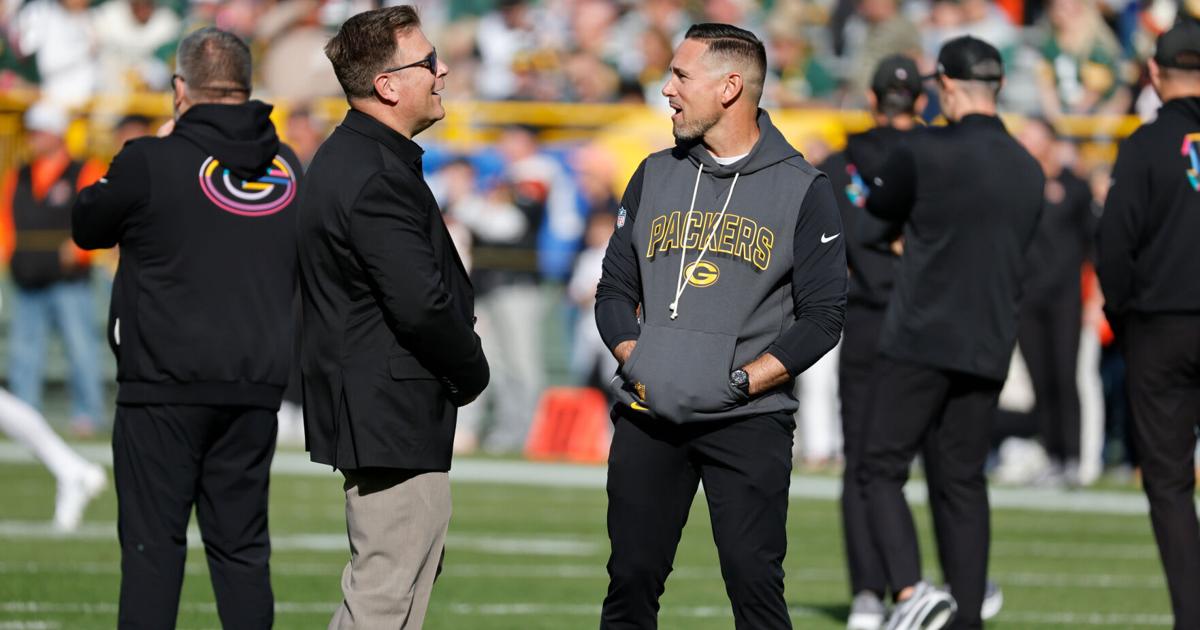
GREEN BAY — Had you snuck into Lambeau Field for general manager Brian Gutekunst’s nearly 40-minute end-of-season Q&A session with reporters, you would have left thinking that the only issue facing the Green Bay Packers as they transition from the disappointment of how the 2025 season ended to the hopes and dreams of the 2026 season was finding a way to close out games.
“In every season, there’s successes, and there’s failures and there’s disappointments,” Gutekunst said. “I was proud of our team in a lot of areas this year, but finishing games is certainly something that we got to concentrate on as we head into 2026.”
The most devastating examples of that, of course, came against the archrival Chicago Bears.
First, the Packers found a way to lose their Dec. 20 regular-season matchup at Soldier Field, 22-16 in overtime, despite having a 16-6 lead at the 2-minute warning. Then, they blew an 18-point halftime lead three weeks later in their 31-27 NFC first-round playoff loss in Chicago, with the defense allowing 25 fourth-quarter points.
After that playoff loss, second-year safety Evan Williams was asked in the losing visitors’ locker room beneath Soldier Field if the Packers had exhibited a measure of immaturity in how they handled both success (like a 21-3 halftime lead in that game) and adversity (like not being able to stanch the bleeding during the fourth quarter) too frequently during the season. He was also asked to set the record straight if the hypothesis was flawed.
“I definitely feel like there can be improvement in just overall maturity as a whole team. I mean, you hit it right on the nail,” Williams replied. “Like, you have to be able to just find a balance. You can never get too high and never get too low. Games are going to be roller coasters, and we understand that. But if you build yourself up too big in the moments when you’re doing good, we know how quickly it can crash.
“We’ve got to be able to stay level-headed, see it for what it is, and just focus on the details and focus on the things that make you win, which is execution. Focus. Out-straining teams. Out-physicaling teams. And when you get too high or get too low and kind of lose grip of those essential things, you can get results like today.
“[I’m] not saying that we’re not a mature team, but yeah, as a whole, I feel like we could definitely improve upon that. And just find ways to just stay level. You know? When we’re when we build big leads, not change anything. Not move with the tide. You got to stay even-keeled, regardless of the situation, and play your game.”
Gutekunst offered no real explanation as to why the Packers struggled in end-of-game situations — and he certainly didn’t want to blame the season-ending knee injuries suffered by defensive end Micah Parsons and tight end Tucker Kraft, the team’s two closers on each side of the ball — but he dismissed the idea Wednesday of it being because the Packers had the NFL’s youngest roster for the third consecutive year.
In fairness, Kraft made a number of late-game plays, including a clutch fourth-down catch to beat Arizona in October, while Parsons was so good at closing out games on defense that then-defensive coordinator Jeff Hafley suggested the Lambeau Field stadium operations people should start playing Metallica’s “Enter Sandman” in the fourth quarter as an homage to Hall of Fame baseball closer Mariano Rivera.
“No,” Gutekunst replied when asked if he thought there was any connection between being young and the Packers’ late-game issues. “I don’t.”
Asked at his end-of-season press conference with reporters the day after the season ended why he thought the Packers had struggled late in games, head coach Matt LaFleur replied, “I think you’re always trying to evaluate and making sure that you’re putting your players in position to make plays. And ultimately it’s going to come down to that. And these games are tight, the margins are small, and when you have those opportunities, you’ve got to take advantage of them. And unfortunately for us, [we haven’t].
“You always look and see when it gets tight, if a guy makes a mistake, why are we making a mistake? And so those are constantly at the forefront of our of our mind.”
Not only did the Packers fail to close out games, but they also have stumbled the last two years at the end of seasons.
As Gutekunst pointed out, during LaFleur’s first five seasons as the Packers’ head coach, the Packers were 25-8 in December and January, including playoffs. In the past two years, they’re 3-9, with back-to-back first-round playoff exits as the No. 7 seed.
“So, we’re looking at that from a lot of different angles, to make sure that we’re playing our best football in December and January,” Gutekunst said. “So I think that hasn’t been the case the last two years, and it’s really imperative that we make sure that we take a long look at that.”
And for a team that Gutekunst had said last year had to be ready to “compete for championships,” that’s not good enough.
“Obviously we’ve got to win the games that matter the most, in December or January, right? That’s kind of been the tale of the last couple of years,” Gutekunst said. “This team’s ready to do that, and we haven’t done that. So that’s kind of the next step. So I think as you evaluate every season, you’re looking at those things. Certainly, that was a strength of ours prior to these last couple of years — how we finished. We were playing our best football at the end of the season. We haven’t done that the last two years.”
COPYRIGHT 2026 BY CHANNEL 3000. ALL RIGHTS RESERVED. THIS MATERIAL MAY NOT BE PUBLISHED, BROADCAST, REWRITTEN OR REDISTRIBUTED.