
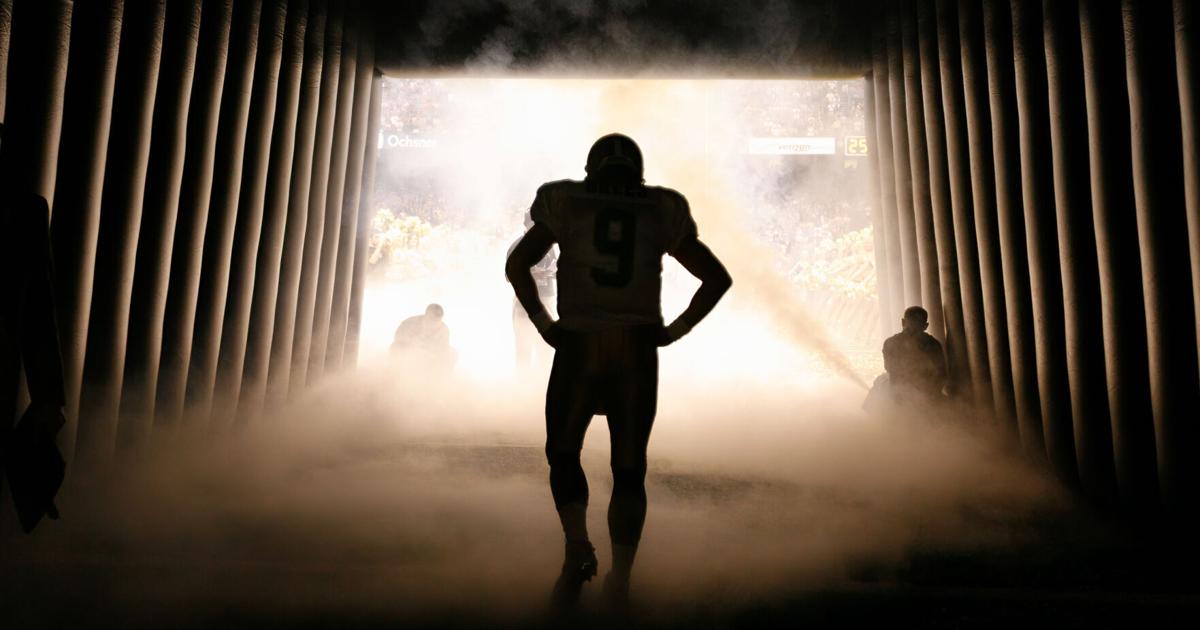
On a quiet Sunday afternoon in December 2019, long after his teammates had left the New Orleans Saints’ indoor practice facility, Drew Brees stood alone at the 10‑yard line.
No football.
No receivers.
No defenders.
Just cadence, choreography and concentration.
He moved through the game plan for the next day’s matchup against the Indianapolis Colts like a conductor leading a symphony no one else could hear. He simulated blitz pickups, adjusted imaginary protections, worked through progressions that existed only in his mind. Between plays, he licked his fingers as if gripping a real ball.
Reggie Bush happened upon the scene, pulled out his phone and started recording.
“This is what greatness looks like,” the former Saints running back whispered to his social media followers. “… There’s nobody in here but one man, preparing himself for greatness.”
The next night, Brees completed an NFL record 29 of 30 passes (96.7%) for 307 yards and four touchdowns in a 34-7 rout of the Colts on Monday Night Football.
It was moments like these that made New Orleans fall in love with Brees.
In Brees, who was selected for the Pro Football Hall of Fame on Thursday, New Orleanians saw a mirror image of themselves — someone who endured crises and fought back from adversity.
On the field, he was a wizard, a 6-foot Everyman who often had to tiptoe in the pocket and strain his neck to see over his towering linemen on pass plays. He looked and acted like a normal guy. It didn’t take long to realize that Brees was anything but normal. He was like nothing New Orleans had ever seen or experienced. He was a superstar.
He inspired the city with his athletic prowess and heroic accomplishments, leading the Saints to their only Super Bowl championship in 2009. At the same time, he made New Orleans a better place to live through his leadership and charitable endeavors.
Over the years, Brees grew into something more than just an accomplished athlete. He became one of the most beloved and respected New Orleanians in the city’s long, proud history, an example of what relentless excellence looked like.
Leading a transformation
Before Brees arrived, the New Orleans Saints were a franchise known more for paper bags than playoff runs. They won just one postseason game in their first 39 seasons and were widely viewed as an also-ran. The only thing the Saints led the league in were NFL Films follies appearances.
That changed when Brees came to town in 2006.
In the wake of career-threatening shoulder surgery, he was considered damaged goods. Only three teams competed for his services in free agency and one of those — the Miami Dolphins — red-flagged his medical report.
He landed in New Orleans and authored one of the great turnaround stories in NFL history, leading a team that had gone 3-13 in 2005 to a division title and the first NFC championship game in club history.
And that was only the start.
With Brees calling the signals and head coach Sean Payton calling the plays, the Saints took the league by storm and launched an unprecedented run of success and offensive dominance.
The numbers were staggering: In the Brees era, the Saints gained more yards (95,665) than any offense in NFL history during a 15-year period. They led the league in scoring or total offense eight times. They set 17 NFL records, many of which still stand today.
And Brees didn’t just resurrect the Saints. He lifted an entire city at a time when New Orleanians, deep in the throes of recovery from Hurricane Katrina, were desperate for strong leadership.
The city needed hope. It needed guidance. It needed inspiration.
Brees delivered all three.
He was the ultimate leader. Consistent. Reliable. Capable.
During his extraordinary 15-year run, he transformed the Saints into one of the most exciting, high-profile teams in the league. The Saints became prime-time players. The Superdome sold out every game. New Orleans led the nation in NFL television ratings. A once‑irrelevant franchise became one of the league’s premier destinations.
“He gave the city and people hope,” former Saints receiver Michael Thomas said in 2020. “He showed us what it is to be a leader, that we can count on him to deliver at any time.”
In the 39 seasons before Brees arrived, the Saints won 40% of their games, two division titles and one playoff game, while making 43 national television appearances. In Brees’ 15 seasons, the Saints won 63% of their games, seven division titles and nine playoff games, while making 55 prime-time television appearances.
Along the way, the Brees-led Saints became a beacon of hope, pride and competence for New Orleanians. Suddenly, an accomplished, accountable leader was wearing the Fleur de Lis and doing things New Orleans had never seen before. His confident, fearless approach resonated with Gulf Coast residents, who had been accustomed to incompetent, unaccountable leaders over the years.
“If I could define leadership,” Alvin Kamara said after Brees retired in 2020, “it would be Drew Brees.”
The ‘heart and soul’ of the Saints
The list of accomplishments, milestones and records Brees set during his career boggles the mind.
He retired as the NFL’s career leader in passing yards, touchdowns and completions, making him the first and only quarterback to simultaneously hold those milestones since Sammy Baugh (1937-1952). Brees was the fastest quarterback ever to reach the 50,000-, 60,000- and 70,000-yard thresholds. He remains the all-time leader in completion percentage and has the most consecutive seasons of both 4,000 and 5,000 passing yards.
He led the NFL in completion percentage six times, in passing yardage seven times and posted an almost unfathomable 12 consecutive 4,000‑yard seasons. His 53 game-winning drives rank third behind only Tom Brady and Peyton Manning.
Brees passed for 400 or more yards in a game 16 times. No other quarterback has more than 13. He twice had nine-game streaks of 300 or more yards.
In the history of the NFL, there have been 15 5,000-yard passing seasons. Brees has five of them. No other quarterback has more than two.
Brees is the most decorated player in Saints history: 13 Pro Bowl invitations; two NFL Offensive Player of the Year awards; and the Super Bowl XLIV MVP award. He was the NFL’s Comeback Player of the Year in 2004, the Walter Payton Man of the Year in 2006, the Bert Bell Award winner in 2009 and Sports Illustrated’s Sportsman of the Year in 2010. He finished second-leading vote getter for the league’s MVP award four times: 2006; 2009; 2011; and 2018.
“Drew was the heart and soul of this team,” said Taysom Hill, who teamed with Brees for his final four seasons in New Orleans. “He always wanted to be prepared. He was going to do everything he could to allow himself to be successful and his teammates around him to be successful. What he did week in, week out, year in, year out, was really, really special.”
Over the years, Brees produced some of the most unforgettable performances and historic feats in NFL annals. He turned the Superdome into his own personal amphitheater, saving his most memorable moments for the home crowd.
In the Saints’ Super Bowl win over the Colts, he orchestrated the go-ahead drive in the fourth quarter in classic Brees’ fashion, completing passes to seven different receivers without an incompletion. He capped the 59-yard scoring march with a 2-yard TD pass to Jeremy Shockey.
In a 2009 showdown on Monday Night Football, he delivered a historic passing performance in a 38-17 rout of the New England Patriots, completing 18 of 23 passes (78.3%) for 371 yards and five touchdowns for a perfect 158.3 passer rating.
In a 2011 blowout of the Atlanta Falcons, he set the NFL record for passing yards in a season (5,087) on a 9-yard strike to Darren Sproles in the fourth quarter, breaking a mark that Dan Marino held for 27 years.
In a 2012 win over the Chargers on Sunday Night Football, he broke Johnny Unitas’ 52-year-old record for consecutive games with a touchdown pass by hitting Devery Henderson for a 40-yard TD strike in the first quarter. He extended the mark to 54 games, a streak that spanned four seasons.
In 2015, he threw for 511 yards and an NFL-record-tying seven touchdowns in a 52-49 win over the Giants. It was the first time a QB had thrown for 500 yards and seven touchdowns since Y.A. Tittle in 1962. The 13 combined touchdown passes in a single game are the most in NFL history.
In a 2018 win over the Redskins on Monday night, he broke Peyton Manning’s record for career passing yards on an epic 62-yard touchdown pass to Tre’Quan Smith.
Later that year, in a Thanksgiving Day win over the Falcons, he threw touchdown passes to four different undrafted free agents (Tommylee Lewis, Austin Carr, Dan Arnold, and Keith Kirkwood). Another first in NFL history.
And of course, the aforementioned 29-of-30 masterpiece against the Colts in 2019.
“Drew has got to be listed with the all-time greats, if not the guy,” said former NFL assistant and head coach Mike Nolan, who served as the Saints linebackers coach from 2017 to 2019. “And I’m not just saying it because I (was) a Saint. I think he would compete with Tom Brady in the discussion as the best ever.”
The Greg Maddux of football
Brees was often characterized as an overachiever, largely because of his non-prototypical 6-foot height and Everyman size. But the truth is he was tremendous athlete.
Brees possessed one of the most technically refined throwing motions in NFL history. With 10.25‑inch hands, perfect mechanics and a deep understanding of biomechanics honed by throwing coach Tom House, Brees could spin a football with uncanny consistency — the exact launch angle, spin rate and velocity over and over again.
In that way, he was the NFL’s version of Baseball Hall of Famer Greg Maddux, a thrower who succeeded by “painting the black” with his passes rather than overpowering opponents with his fast ball.
Brees established a new standard in completion percentage for quarterbacks. His 67.6 percent career completion rate is the highest in NFL history, and he owns three of the five best single-season completion percentages in league annals.
In April 2009, the TV show “Sports Science” tried to gauge Brees’ accuracy. The show’s hosts had Brees throw footballs at an archery target 20 yards away and compared his accuracy to Olympic archers. Brees astounded the producers by hitting the 4-inch bullseye on 10 out of 10 throws. The secret to his accuracy was his consistent mechanics. Amazingly, Brees threw each of his passes with the same 6-degree launch angle, 600-revolutions-per-minute spin rate and 52 miles-per-hour launch speed.
“The window was that big and he hit it,” House said. “Drew will have a spectacular play or two, but he’s not a spectacular quarterback. He’s just the best who’s ever thrown a football.”
Brees’ teammates marveled at the accuracy and timing of his passes and were awestruck by his ability to compute on the fly and process under pressure. This almost superhuman ability to process and execute in-game conditions is why former Saints tackle Jon Stinchcomb referred to Brees as “the supercomputer.”
“The amount of information that he could take in, process and react to was much more than anyone I’d ever been around,” former Saints quarterbacks coach Joe Lombardi said. “His lens was wide. He saw everything and processed it so quick.”
“It was like watching a surgeon,” said former NFL quarterback Trent Dilfer, who quarterbacked the Baltimore Ravens to the Super Bowl XXXV title in 2001. “He literally looked at every little detail, every minuscule aspect of quarterbacking and perfected it.”
‘Forever grateful for what he did’
And yet, for all the games Brees won and the records he set, he managed to make just one Super Bowl appearance in his illustrious career. He came painfully close to reaching a second Super Bowl but heartbreaking losses to San Francisco 49ers in 2011, the Minnesota Vikings in 2017 — aka the Minneapolis Miracle game — and the Los Angeles Rams in 2018 — the infamous NOLA No-Call game — stopped him short.
“Yes, Super Bowls and wins matter, but when you break down the quarterback position, the No. 1 job is to throw the football to a receiver in the right spot at the right time that gives the receiver the best chance to advance the ball for the offense,” said Luke McCown, who served as Brees’ backup midway through his Saints tenure. “And nobody’s done that single thing better than Drew Brees in all of football.”
In whatever role Brees played — and he played many over the years: quarterback; civic leader; team spokesman; business investor; community activist — he strived to deliver. And invariably he did. Usually in spectacular fashion.
His Brees Dream Foundation contributed millions of dollars toward COVID relief, educational, healthcare and recreational programs across New Orleans and throughout the Gulf Coast region.
As Canton calls, he stands as the most decorated player in Saints history, a Super Bowl MVP and champion, 13-time Pro Bowler, five-time All-Pro and two-time Offensive Player of the Year. He owns a resume stuffed with NFL milestones — second all-time in passing yards (80,358) and touchdown passes (571), plus an NFL-record streak of 54 consecutive games with a touchdown pass.
The journey was an improbable one. Brees had no connection to New Orleans before 2006. But after a while, it almost seemed like he was destined to be here. Almost overnight, he changed the fortunes and profile of the team and city. He helped revive a dormant franchise and restore hope to a region trying to recover from one of the greatest tragedies in American history.
For a decade and a half, Brees gave everything he had to the Saints, and our city and state reaped the rewards of his greatness. He was, as James Carville said, like the river. Always there. Always providing. Always vital.
“He was a magnificent leader both on and off the field,” Payton said. “For all of us that had the chance to coach him, it was our privilege. His approach to business, to every aspect of his life, it was amazing to watch. We are better for it. I am forever grateful for what he did for our team, our community and for me personally.”
His legacy extends beyond the football field. He was a role model for an entire generation, a shining example of how to conduct yourself with class, dignity and grace.
His legacy isn’t in the records. It’s in the standard he set.