
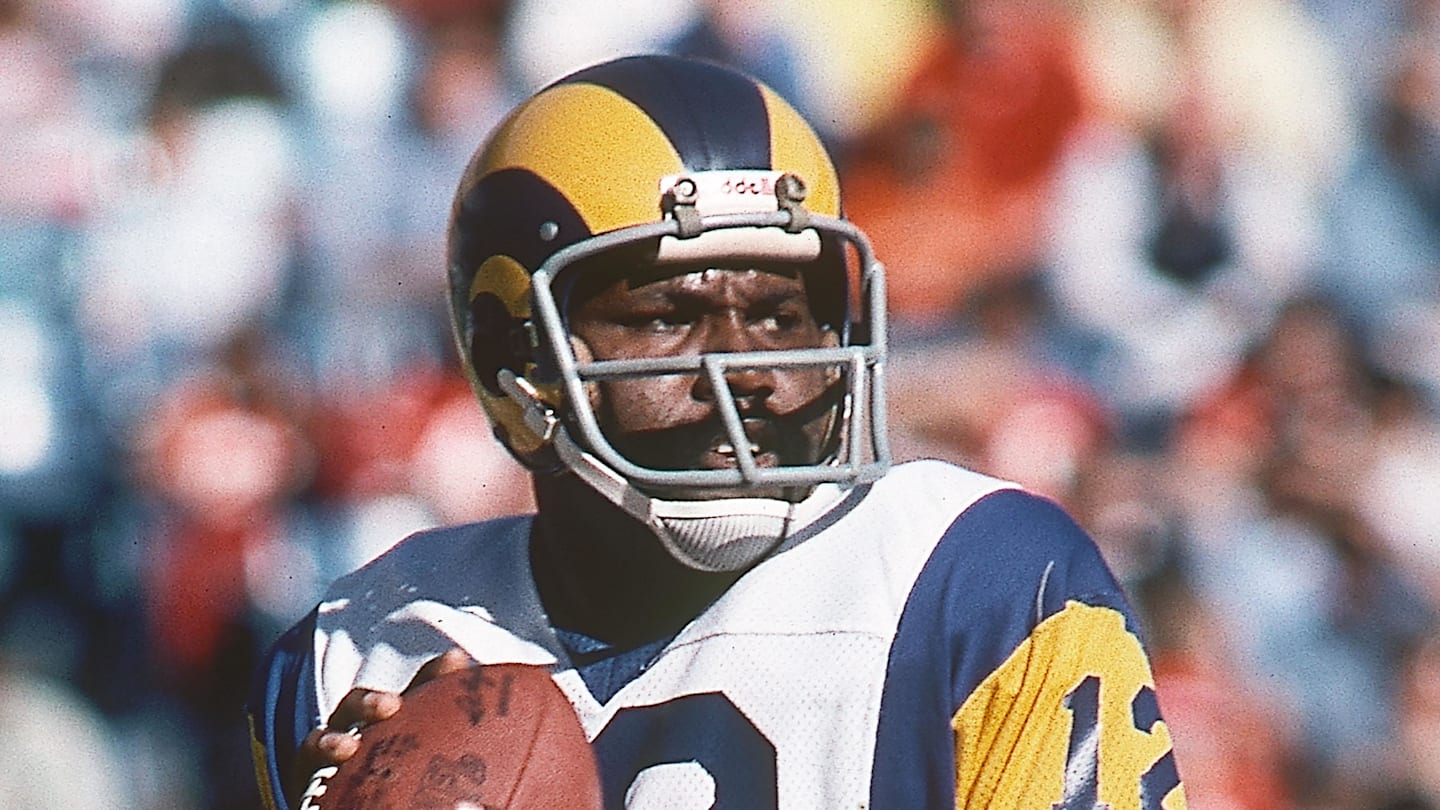
HOUSTON – After this week’s NFL Pro Bowl, it’s worth remembering that long before Steve McNair and Shedeur Sanders played in the event, James “Shack” Harris was breaking barriers that changed how the NFL saw Black quarterbacks and how their achievements are remembered.
In the mid-1970s, Harris became the first quarterback from an HBCU to start a Pro Bowl and win the game’s MVP award. Almost fifty years later, his achievements are still a key but often overlooked part of both NFL and HBCU football history.

James ‘Shack’ Harris football jersey from Grambling State University. | Credit: Grambling State University Athletics
From Grambling State to the NFL
Harris joined the league in 1969 after playing for legendary coach Eddie Robinson at Grambling State. He learned discipline, poise, and precision there. When the Buffalo Bills drafted him, Harris became the first Black quarterback to start a season opener in the AFL or NFL. This was a big milestone, even if it didn’t change league attitudes right away.
While his early years in Buffalo were uneven, his career took a decisive turn after signing with the Los Angeles Rams in 1973. The franchise operated under coach Chuck Knox’s physical, run-first “Ground Chuck” philosophy and was seeking stability at quarterback.
In 1974, Knox promoted Harris from backup to starting quarterback, putting him in charge of the Rams’ offense.

Oct 20, 1974; Los Angeles, CA, USA; FILE PHOTO; Los Angeles Rams quarterback James Harris (12) in action against the San Francisco 49ers at the Coliseum. The Rams defeated the 49ers 37-14. Mandatory Credit: Darryl Norenberg-Imagn Images | Darryl Norenberg-Imagn Images
A Breakthrough Year in Los Angeles
Harris proved Knox’s trust was well-placed by starting nine games in 1974. He led the Rams to seven wins and an NFC West title, and helped the team get its first playoff win since 1951.
Harris made history as the first Black quarterback to start and win an NFL playoff game, taking the Rams to the NFC Championship. His success showed the league that Black quarterbacks could not only play but also win at the highest level.

Jan 31, 1988; San Diego, CA, USA; FILE PHOTO; Washington Redskins quarterback Doug Williams (17) celebrates on the field after defeating the Denver Broncos 42-10 to win Super Bowl XXII at Jack Murphy Stadium. Mandatory Credit: Darr Beiser-Imagn Images | Darr Beiser-Imagn Images
His strong play earned him a spot in the Pro Bowl, where he made history again. Harris started at quarterback for the NFC and was named the game’s Most Valuable Player. He also tied for the NFC’s highest quarterback rating of 89.6, a first for a Black quarterback.
James “Shack” Harris made a statement in both football and culture, paving the way for Black quarterbacks in the Super Bowl like Doug Williams, Russell Wilson, Cam Newton, Patrick Mahomes, Steve McNair, Donovan McNabb, Colin Kaepernick, and Jalen Hurts.

Dec 28, 2025; Cleveland, Ohio, USA; Cleveland Browns quarterback Shedeur Sanders (12) throws in the second quarter against the Pittsburgh Steelers at Huntington Bank Field. Mandatory Credit: Ken Blaze-Imagn Images | Ken Blaze-Imagn Images
A Model for Black Quarterbacks
Harris’ list of achievements is still impressive:
First Black quarterback to start a regular-season NFL gameFirst Black quarterback to start and win an NFL playoff gamePro Bowl starterPro Bowl MVPDivision champion as a starter
Yet today, people often leave his name out of conversations about HBCU quarterbacks.

Tennessee Titans quarterback Steve McNair (9) eludes Jacksonville Jaguars defensive end Jason Gildon (56) on Nov. 21, 2004. The Titans won on the road 18-15. | George Walker IV / The Tennessean / USA TODAY NETWORK via Imagn Images
Instead, most people start the story with Steve McNair, the Alcorn State star who became co-NFL MVP in 2003, or with Shedeur Sanders, who went from Jackson State and Colorado to the NFL and is now one of the most visible HBCU quarterbacks. Sanders also boosts viewership and NFL merchandise sales.
As a new generation applauds Sanders and revisits McNair’s career, Harris’ story remains a critical piece of the lineage, whose impact still resonates across football today.
Both men followed the path that Harris first created. That’s why he’s an HBCU and NFL legend.