
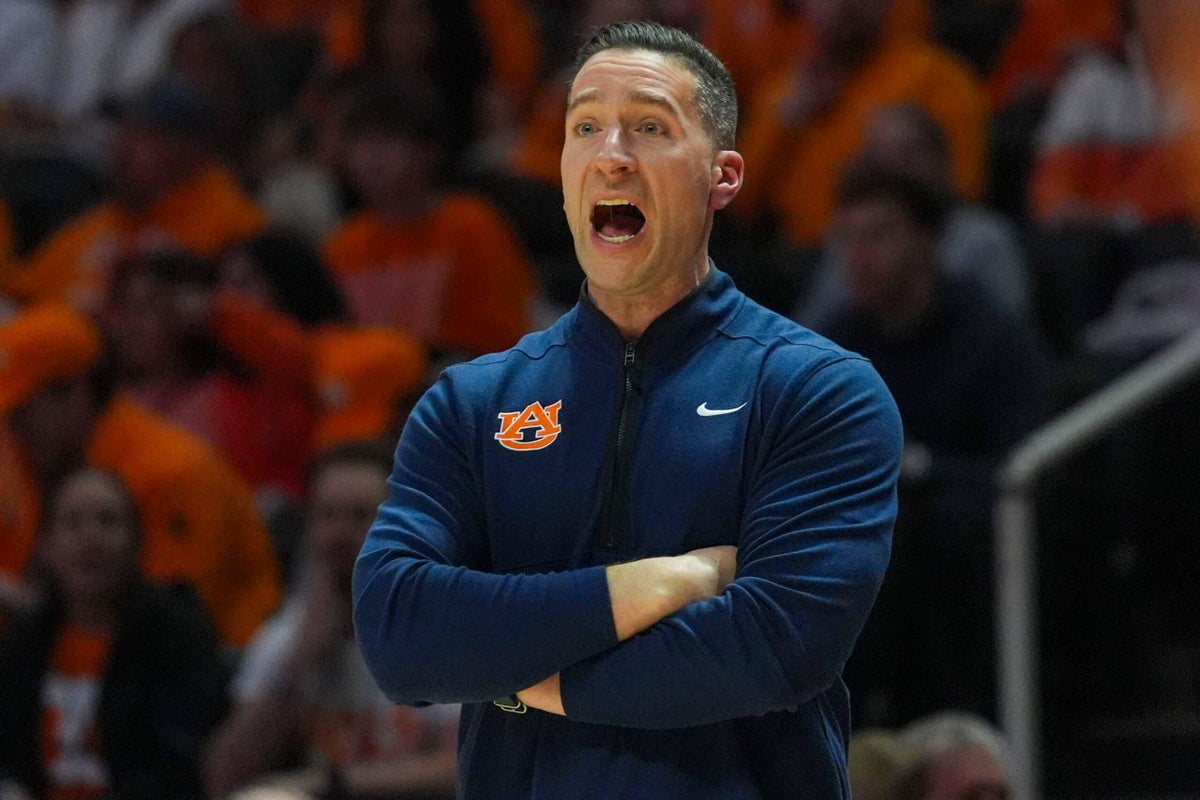
AUBURN, Ala. — Nearly an hour into a film session Thursday in the men’s basketball offices at Auburn’s Neville Arena, Steven Pearl took his eyes away from a large screen playing Alabama cut-ups — the 3-pointers in transition, the 3-pointers after offensive rebounds, the 3-pointers after pump fakes and relocations, the ghost screens, the actual screens, the daring drives to the basket — and put them on his assistant coaches for a moment.
“This is gonna get ugly at times,” Pearl said of his team’s attempts to defend it all. “We just can’t stop.”
It was the first day of full preparation for the biggest game of the first season of the coach who inherited this program from his father and knows he has limited time to prove he deserves it. Pearl, 38, told his wife, Brittany, before the season that it would be two years with no days off because “we have two legitimate years to show recruits and their families, ‘This is still going. You can trust that.’”
Bruce Pearl made Auburn basketball more relevant in his 11 years than it had been in its previous 11 decades of existence, then retired abruptly in September at age 65. This gave Steven the best shot at the job. Auburn athletic director John Cohen gave it to him, a five-year deal, rather than opt for the interim tag and a search. The coaching staff had to make sure the players — 10 of them new, after a mass exodus of mostly seniors from last year’s Final Four team — would stay.
They did. But by late December, with four losses in the books to elite teams, three by an average deficit of 29 points, Steven Pearl’s social media accounts were gone. Or at least dormant. As of Jan. 14, Auburn was 10-7, 1-3 in the SEC and due for a surge in nepotism tweets.
As of Thursday, Auburn was 14-8, 5-4 and in strong NCAA Tournament position despite the second-toughest schedule in the nation — just behind Alabama — and a roster featuring 11 freshmen and sophomores, the second-youngest in the SEC behind Arkansas. The Tigers were a win over their rivals away from starting to make people notice the coaching job being done on The Plains.
The party was already going on outside Neville, about 200 students in tents at the north entrance ensuring their spots in the 9,121-seat arena for Saturday’s game. Tickets on secondary markets were pushing into the thousands. A pair with access to the catered Arena Club section were past $10,000 apiece.
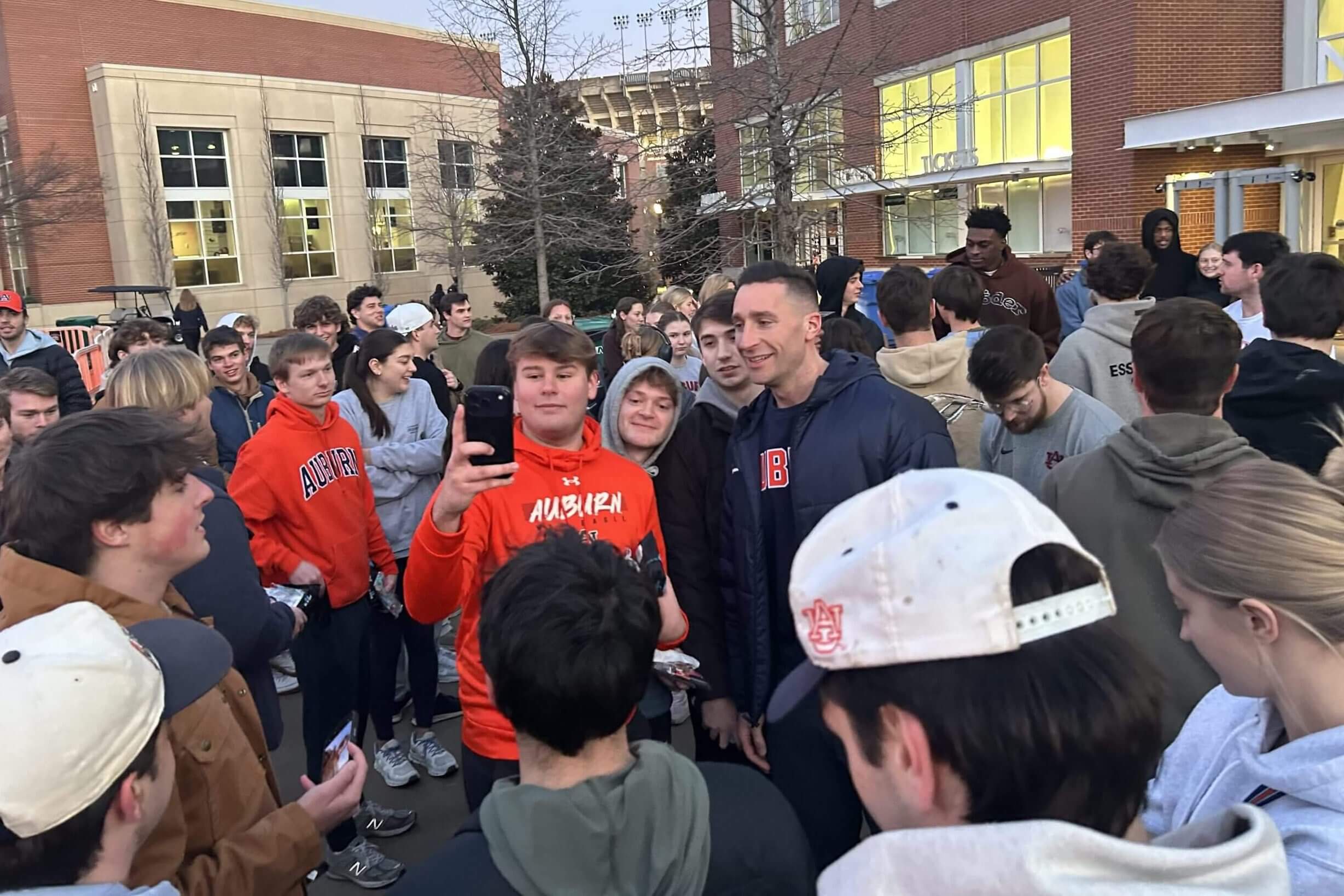
Auburn coach Steven Pearl talks with students on Friday afternoon, the day before the Alabama game. (Joe Rexrode)
This wasn’t quite last year, when the rivals split two top-10 matchups and the “Iron Bowl of Basketball” reached unprecedented importance. But it’s a game that matters in college basketball now. This episode came with extra attention because of the eligibility case of Alabama center/recent G League center Charles Bediako.
And as Auburn coaches gathered to scrutinize Nate Oats’ Alabama team and devise practice plans for their players, the shared activity these two schools are most known for came to mind. Auburn needed this to resemble a football game.
“The teams that have beaten them, historically,” Auburn assistant coach Mike Burgomaster said to Pearl in the conference room, “are the teams that have punked them.”
Two days later, Pearl stood in front of his team in the Auburn locker room after early punking success and a 10-point lead dissolved into a 96-92 loss to the Tide and told his players: “What are we gonna do? Are we gonna be a bunch of front runners? It can’t just be good when we’re winning, guys. It can’t just be good when we’re scoring the ball.”
In between, The Athletic was granted full access to the Auburn program for a behind-the-scenes look at Alabama preparations and the early stages of the second Pearl era.
“Multiple efforts” was the phrase of the day as Auburn coaches decided on drills needed to help prepare for the nation’s third-most efficient offense, a team that as usual under Oats is driven by analytics, breakneck tempo, 3-pointers, downhill drives and the elite talent to make it work. The first effort against Alabama: Get back and make them play in the halfcourt.
Then it’s early flare screens for shooters. Ball screens. Ghost screens. Pindowns. Drives and kicks. The freedom to launch from deep before a switch can happen. An offense dictated by rules and concepts much more than set plays, driven by star guards Labaron Philon and Aden Holloway.
There are no bounce passes to rollers, so the Tigers would need “high hands” on all such actions. They’d need to be in the gap early — lunge late and you’re toast and an open 3 will result. No “bulls— help,” as Pearl put it, off corner shooters to give Alabama easy choices. Close out hard. But not too hard, as the film showed Texas A&M doing at critical times in Wednesday’s 100-97 loss to Alabama, flying past to allow drives or quick relocations and open triples.
Relentless effort and attention to detail would be required. But as Burgomaster, the team’s offensive coordinator, talked through which sets would be most effective in this game, it was clear that side of the ball would be just as important. If Auburn didn’t have an easy opportunity to run and get a clean look, it needed to grind out possessions, get the ball inside and “play off two feet” all day — even with rim protector Bediako on the floor as Pearl and his staff were presuming. Low possessions, low tempo, low live-ball turnovers and high-quality shots would be required.
“And at some point, we’ve got to make some f—ing shots,” Pearl said of a team that entered the game 233rd in the nation in 3-point shooting (32.8 percent).
Practice plans for the next two days determined, Pearl left the room and headed downstairs for a 2 p.m. news conference. He revealed to reporters that leading scorer Keyshawn Hall played in the 77-69 loss at Tennessee with three stitches on the index finger of his left (shooting) hand. He said his team was preparing as if Bediako would be eligible to play. He expressed the need for max effort and low tempo.
Then it was on to the film room, just off the main court. Some Auburn players were getting shots up beforehand. Each swish was accompanied by a loud call: “Bediako!”
Pearl stood in front of his players, assistant coaches and staffers in the small theater and told them: “We could f— around and go on a run right now. We control our destiny. Or we could revert back to some of the things we did at Tennessee, things that got us beat. Why not lock into the details?”
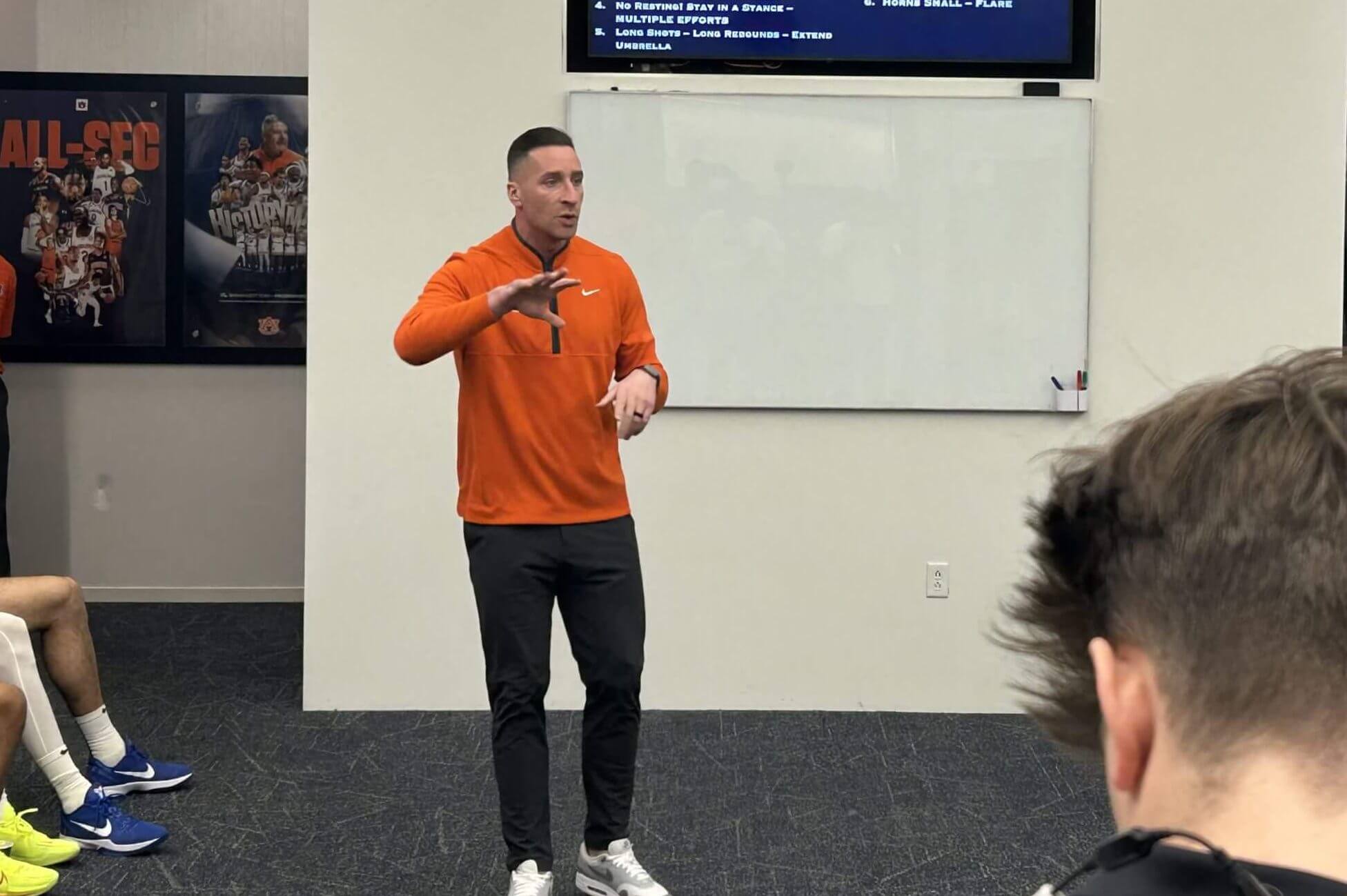
Steven Pearl addresses his team before the Alabama game. (Joe Rexrode)
Pearl said Alabama is 2-2 this season in games with 72 possessions or less, and went into the teaching points he and his coaches had just discussed. Then he changed course.
“When was the last time you guys were like broke?” Pearl asked. “A couple years ago? Last year for some of you, for D-IIs, jucos? You guys were broke as f— last year, right?”
Sophomore guard Tahaad Pettiford, the lone returnee from last season’s playing rotation, responded: “This year.”
Pearl smirked at Pettiford as some players laughed.
Pearl: “This year? No. Couple years ago, before NIL was a thing, when you check that bank account and you feel it’s getting a little tight, what does that make you feel?”
Pettiford: “Hungry as f—.”
Pearl: “A little pain too, right? Right? You’ve got to find a way. I feel like this team is best when we feel a little bit of pain.”
Then Pearl gave his main point before the 36-minute session turned to individual Alabama scouting reports.
“You’ve got to feel a little pain to make yourself do the things that are required and necessary to play with way more f—ing effort, way more energy and way more desperation in this game than they’re gonna have,” he said. “We did that when we played at Florida. We did that when we played at Ole Miss. We’ve got to be desperate. We’ve got to be hungry, like Tahaad said. And it’s f—ing Alabama, you guys. You talk about wanting to do something for our fans? This f—ing game means more to them than anything. So it’s 40 minutes of whatever the f— you’ve got to do to get that win. Let us tell you how to do it, OK?”
Shortly before the 36-minute session ended and practice began, Burgomaster told the Tigers of the Crimson Tide: “This team does not want to be touched. And what do we do best? We punk people.”
“If we aren’t taking bad shots, if we’re not settling, if we attack … they cannot f—ing guard us,” Pearl said. “They’re the worst defensive team in the league.”
Nearly two hours of practice went as hoped, with a lot of 3-on-3 defensive work on Alabama’s perimeter actions. Starting center KeShawn Murphy closed out too hard and overran his man on one play, and Pearl yelled to all: “Never, never, never! That’s how you lose.”
Moments later, Pettiford got over a flare screen to the corner, got back through a ball screen going the other way and got his hand up for a backhanded deflection of a pass back to the top of the circle.
Pearl: Now that is f—ing awesome!”
Associate head coach Ira Bowman: “This is what we’re talking about when we talk about multiple efforts.”
Practice ended with a quick huddle, and then it was time for Pearl to do things he never had to worry about when he was his father’s associate head coach, defensive coordinator, assistant coach, director of basketball operations or assistant strength coach at Auburn. He’s the face of the program now.
Bruce Pearl was at the Auburn basketball facility on Thursday, too, but he wasn’t there for film, meetings or interactions with any coaches or players. He was there to use the printers for notes and stats to help him with his new job as a college basketball analyst for TNT.
“I am out,” Bruce Pearl said. “Steven has owned this.”
Bruce Pearl, called “BP” by everyone in the program, including his son, is an outspoken conservative who said a possible run for a Senate seat got him thinking seriously about retiring in the offseason. That aspiration faded, but retirement and timing it up right for a handoff to Steven has been a consideration for years.
Steven — who goes by “SP” in the program — said he didn’t know if Cohen was going to give him the job full-time until Cohen told him. Bowman was elevated to the associate head coach spot vacated by Steven. Burgomaster, Corey Williams and Ian Borders stayed on, with Matt Gatens replacing Chad Prewett, who got out of coaching to pursue ministry.
Auburn planned a Sept. 22 announcement after the players had been told they had a new head coach. But a source told ESPN the news, and it broke early that day before the meeting with the players, setting off scramble mode for the coaches. The members of a mostly rebuilt roster had an open transfer portal window because of the change, but they stayed.
“We talked about our future here and what he was looking forward to this year,” Pettiford said of his conversation with Steven Pearl after the revelation. “My teammates agreed, so we decided to make something work. We had our talks outside of here, for sure.”
Already, it had taken a big spend to get this roster competitive after the loss of All-American Johni Broome and several other standouts. Pearl said Auburn was in the 10-12 range in the SEC in roster payroll under his father during the NIL era but got into the top five for this group. Hall came from UCF; Murphy from Mississippi State; Kevin Overton from Texas Tech.
“Steven’s job has been way harder than BP’s job at any point, besides when BP first got here,” said Bowman, who joined the staff in 2018. “But even then, NIL wasn’t a thing, there was still carryover, there was still retention. BP’s never had 10 new players, and the hardest schedule in college basketball with that. That’s no slight to BP, but all those new personalities? This set of circumstances? It shouldn’t be understated.”
Nor should the difference between the personalities of BP and SP. BP naturally fills and takes over every room he enters. SP is reserved, intense and serious by nature. The former works with recruits, parents, donors and fans. The latter is an obvious question in this succession.
“That’s why I don’t say no to anyone,” Steven said. “When you’re following in the footsteps of someone like BP, who, that was like this thing, you can’t divert from that. Then they’re like, ‘BP was great at this, why is Steven not?’ Every chance I can get to have an impression or impact on somebody, I take advantage. Because it spreads like wildfire, good and bad.
“And I’m good in those settings. But he’s always like that. When I go home, it’s like hang with my wife and daughter and be to myself. Whereas he’ll go to Twitter and fire off a million things on Israel or whatever.”
Pearl also didn’t want to change things up in the program just to try to make his own mark. But there are subtle changes. He allows players to listen to loud music during the shooting portions of practice. He seeks their input on more things. And during the season, he decided to make corrective film sessions individualized rather than in front of the whole team, because some weren’t reacting well to being called out.
“Some will call that soft, but whatever,” he said. “We’re 5-2 since then.”
No one questions Pearl’s basketball acumen. It’s a question of having the feel for people to be an effective CEO. Bowman said Pearl is “ultra-competitive and has learned to meter and channel that into what he needs to focus on.”
Because he knows what people will say. They’ve been saying it since he walked on for his dad at Tennessee and carved out a role as a bruising forward off the bench.
“‘You’re just here because of your dad,’” Bruce Pearl said of the naysayers’ sentiment, then and now. “He’s always had to prove it. That’s why he’s a tough son of a bitch and this is going to work.”
Thursday’s practice ended, leaving several players to get up shots and a few to join Pearl upstairs and outside to the wildest party in town. Pearl was supposed to hand out Chick-fil-A sandwiches to the camping students. When he got to the arena entrance, Emily Adams, Auburn’s director of fan experience, told him: “They mobbed them already.”
Adams handed Pearl a box of Dude Wipes instead. Good for cleaning up after dinner. And perhaps acting at some point as a cheap substitute for a shower. Pearl, Pettiford, Hall and others hung out for about half an hour, chatting with students and taking every selfie requested. Then Pearl had to bolt, a 15-minute drive to his weekly radio show at Baumhower’s Victory Grille.
Brittany and their 1-year-old daughter, Lainey, were waiting for him along with his sister Jacqui Pearl and her family. Jacqui got the first segment to rally support for the Pearl Family Foundation’s fund raising efforts for cancer organizations. Lainey was bouncing around the booth — she just started walking, and Pearl texted a video to the team a few days earlier showing her first steps to let them know she was fired up for Bama week.
To that point, once Pearl took his spot on stage with Brad Law and the voice of the Tigers, Andy Burcham, the microphone started moving around the room for fan questions. “Herb” wondered if Auburn’s players understood that the “Iron Bowl of Basketball” was different.
It’s been communicated, Pearl assured Herb. That is, of course, one of many challenges for coaches in today’s transient, transactional world of college athletics. Junior guard and former walk-on Blake Muschalek is the eighth man in Auburn’s rotation this season, but Pettiford is the only member of this team who can speak to the intensity of this game on the floor or what it means to the fans. Auburn’s coaches would lean on him to do so.
But first, Pearl delivered smoothies in the morning to the students, shortly after his regular 6 a.m. arrival. Worked out in the team gym. Got a protein smoothie of his own. Calls. Film. Then it was noon and time for another public appearance. The boosters of the Auburn Tip-Off Club were waiting for him in the arena’s banquet area.
“War Eagle!” Pearl boomed into the microphone.
“War Eagle!” about 200 people answered back.
He asked when the last time they had gotten together. Someone called out it was before the Jan. 17 South Carolina game.
“We were 1-3 (in the SEC). You guys were probably like, ‘I don’t know if he’s ready for this,’” Pearl said. “Well, we’ve won five of six, so shut up!”
The crowd laughed loudly. It was a BP-like moment, and Pearl had more jokes. He was 8 years old when Auburn last won at Florida, in 1996, but said he would not speculate as to how old some of them were.
Things turned serious for a moment when someone asked him about Bediako. They might get mad at him, Pearl said, but he hoped Bediako would be cleared to play and wondered what might happen if he weren’t.
“We got into this profession to help young people, not put them in compromising situations,” Pearl said, “and I think that’s what’s happening here.”
Friday’s practice was more specific, working on sets the Tigers would run and on defending Alabama’s favorite ATOs (plays after timeouts). Players took turns finishing with two coaches banging them with pads.
Pearl got word that nothing had been decided on Bediako, so he would play as expected. Pettiford said a few words to his teammates about the intensity they were about to encounter. Finally, it was one sleep away.
As Pettiford headed out to check on the camping students, he said: “Alabama hate will be in the air out there.”
It was the next day, too, as students finally filed into the arena to pack “The Jungle” student section area — with “Welcome to the Jungle” by Guns N’ Roses blaring out of massive speakers. Auburn junior Lynley Headcraft, who helps run the student section, said the final tally was 726 camping out. It sounded like 10 times that many screaming at Bediako as he took the court for warmups.
“G League dropout! G League dropout!”
Intensity filled the air. None more than when Pearl addressed his team in the locker room at 2:32 p.m., a half hour before tip. He had just visited with ESPN announcer Dick Vitale, he told his players, and he passed the Alabama players on his way to the locker room.
“There is zero f—ing respect for this program in that locker room,” he said, anger etched on his face. “Zero. … We have two hours to change that.”
It was heading that way in the first half, a 10-point lead in a slow-moving game featuring two Auburn turnovers and zero Alabama fast-break points. The Tigers were delivering those multiple efforts and pounding the ball inside. But handling Alabama’s actions is much easier against a scout team than against Philon and his fleet of helpers.
The Tigers made some crucial mistakes late in the first half to let Alabama hit three straight triples. Then it got ugly and stayed ugly in the second — 59 Alabama points, 56.7 percent shooting, 1.55 points per possession.
On possessions they got the details right, Alabama usually made tough shots anyway. On a late Holloway 3-pointer plus the foul on Pettiford, Pettiford and Murphy argued over who made the mistake. Then Overton yelled at both of them to stop arguing. That was the point of Pearl’s mention of “front runners” in a silent, tense locker room filled with people who have known each other for a few months.
High-scoring Vanderbilt, with a more elaborate offense and more attention to detail required to corral it, will be coming in on Tuesday and will happily embarrass the Tigers if they aren’t connected and ready. The first year of the Steven Pearl era was never going to be easy; it just got tougher.
“If we let this compound and affect the next one,” he told his players, “we’re missing the point.”