
Feb. 7, 2026, 9:58 a.m. ET
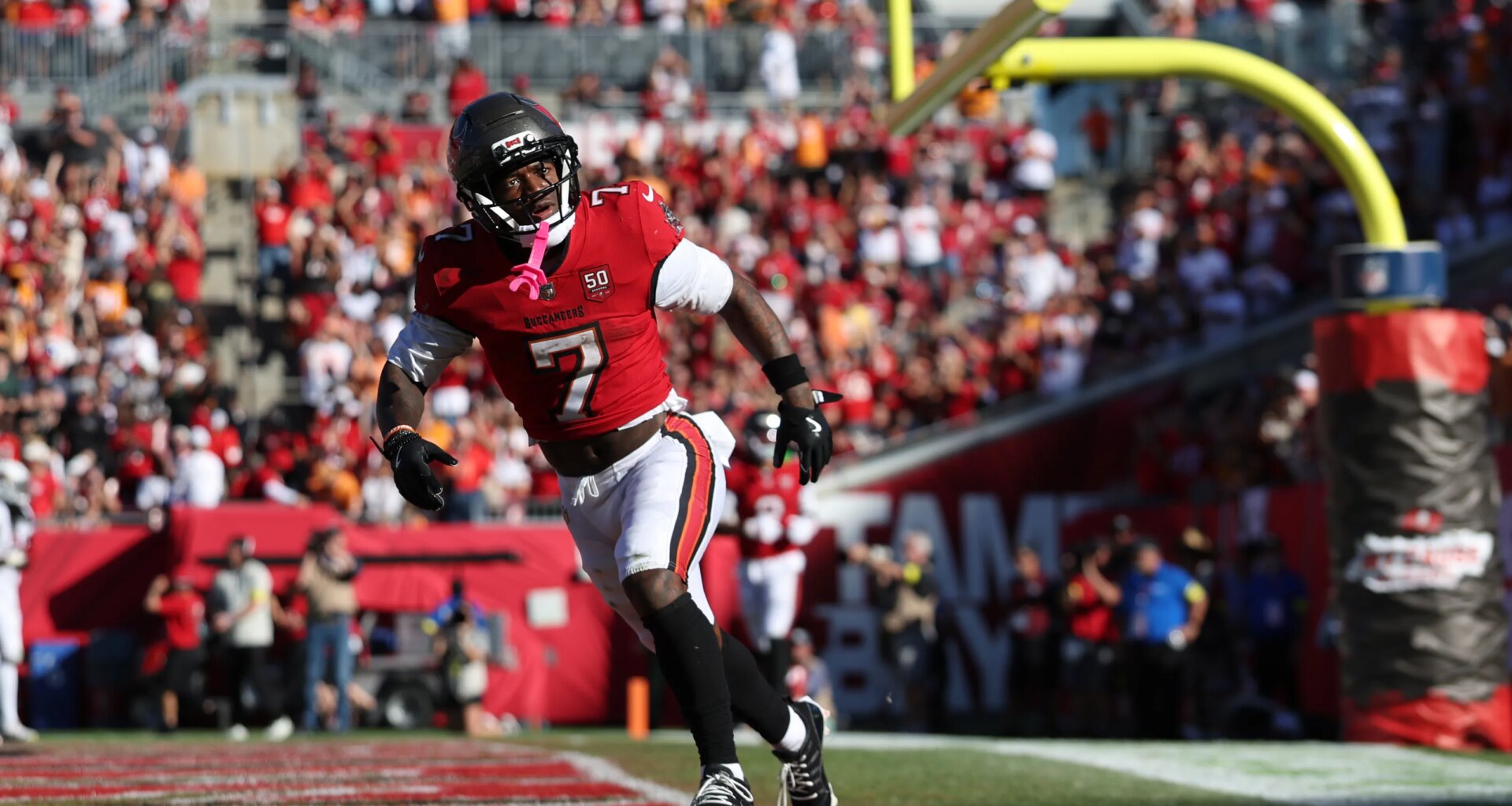
After a stellar rookie debut in 2024, Buccaneers running back Bucky Irving suffered what can only be described as a sophomore slump. While a number of mitigating circumstances can be attributed to his struggles during the 2025 season, Irving and the Bucs’ running back group as a whole will be under a microscope heading into 2026.
There is no mincing words: the Bucs’ run game was far worse in 2025 than in 2024. After totaling 2536 rush yards and 16 touchdowns and averaging 5.3 yards per attempt, 0.012 EPA per play, and a 44.4% success rate in 2024, Tampa Bay’s 2025 run game regressed to 1947 rush yards and 13 touchdowns and averaged 4.1 yards per attempt, -0.087 EPA per play, and a 40% success rate.
The Bucs went from having a top-five NFL rush offense to a bottom-10.
There are a variety of reasons for the Bucs’ struggles running the ball, many of which speak to the offense’s overall issues. First and foremost, the Bucs never had a fully healthy offensive line at any point in 2025. The only lineman to play all 17 games was center Graham Barton, and he even played a stretch at left tackle while Tristan Wirfs worked his way back from knee surgery.
The change at offensive coordinator from Liam Coen to Josh Grizzard also likely played a role, though it is certainly debatable how big a difference it made. Bucky Irving, Tampa Bay’s leading rusher in 2024, had his own injury troubles, missing eight games with shoulder and ankle injuries. In totality, the Bucs were in no position to repeat their 2024 success.
Need a news break? Check out the all new PLAY hub with puzzles, games and more!
Irving felt the regression more than any Bucs running back. His yards per attempt dropped from 5.4 to 3.4 and his yards after contact per attempt fell from 4.03 to 2.33. The only thing that largely remained steady was his receiving, averaging 7.9 yards per target after averaging 7.5 in 2024. Irving’s injuries and absence from the field affected him mentally and emotionally, which no doubt contributed to the problems he was already having in 2025.
Rachaad White filled in admirably in a contract year, making the most of a bad situation. He was easily the Bucs’ most efficient rusher, leading the team by averaging 4.3 yards per attempt and 2.95 yards after contact. He also secured 10 more first downs than Irving despite getting 41 fewer carries. White remained Tampa Bay’s best pass-blocking halfback and a valuable receiving weapon.
Despite his struggles, the Bucs’ faith in Irving is unlikely to be shaken, and he should return in 2026 as Tampa Bay’s lead back. Conversely, White’s resilience apparently was not enough to warrant a long-term future with Tampa Bay, as he has indicated on social media that his time with the Bucs has come to an end:
Losing White leaves the Bucs without a reliable RB2 and, specifically, a running back who can pass block. RB3 Sean Tucker should return in 2026 with a significant role, but despite being the Bucs’ best big-play running back in 2025, he is not an immediate replacement for White. Tucker does not have White’s acumen as a receiver or as a pass protector.
The Bucs have Josh Williams and Owen Wright signed to futures contracts, but neither is likely to replace White. Given their apparent unwillingness to pay White, the Bucs may not be willing to open their pocketbooks for other free agents either. Otherwise, a pass specialist like Kenneth Gainwell would fit White’s role well. Even the arrival of new offensive coordinator Zac Robinson might attract his former players, like RB Tyler Allgeier. The question is whether Tampa Bay is willing to pay market price for talent.
It is much more likely that the Bucs seek to find White’s replacement in the draft. With bigger needs across the roster, the Bucs are likely to wait until Day 3 to address a running back addition. At the top end of this range, the Bucs would be lucky to land Penn State RB Nicholas Singleton. While he has the profile a downhill power running, Singleton did some of his best work in the pass game, catching 92 passes for 825 yards and seven touchdowns in four seasons with the Nittany Lions.
A good value pick would be Virginia RB J’Mari Taylor. One of college football’s most prolific pass-catching backs in 2025, Taylor is well-rounded and has the burst and quickness to weave through defenders in space. He is not much bigger than Bucky Irving, which could be an issue for him in pass protection.
If the Bucs are looking for upside, they could go with Arkansas RB Mike Washington Jr. At 6’2″ and 228 pounds, Washington Jr. is a punishing runner with soft hands, having caught 28 of 36 targets for 226 yards and a touchdown. His problem is his sloppy pass protection. His technique is nonexistent, but he is at least eager as a pass blocker.