
Commanders’ biggest extension candidates and free agent decisions
Daron Payne | Defensive Tackle
Payne has one year left on his contract and will cost $28 million against the salary cap for next season. That’s the fourth-most cap space by a defensive tackle — and a lot of room for a player with only one Pro Bowl (in 2022) and no All-Pro selections in his career.
But the Commanders were pleased with how he played in 2025.
Laremy Tunsil | Left Tackle
Tunsil has one year remaining on his contract, but the Commanders traded away a lot when they acquired him last offseason (along with a fourth-round pick last year). They sent picks in the third and seventh round last season in addition to picks in the second and fourth rounds this April.
In terms of discussing a new deal, Peters said there’s been “constant communication” between the team and Tunsil.
“We definitely want to get something done with him and sooner rather than later,” Peters said a day after the season ended.
Frankie Luvu | Linebacker
A year ago, an extension would have been more likely. In his first season with Washington, Luvu recorded a career-high eight sacks and finished with 12 tackles for a loss. But Luvu, who has one year remaining on his contract, did not have a similar impact in his second year in D.C. He finished with three sacks while being forced to play more as an edge rusher due to numerous injuries at the position.
Von Miller | Defensive End
Miller has stated he wants to return but, as with Ertz and Wagner, age could be an issue. And the desire for more youth and athleticism applies to the edge. Miller did show he can still play, leading the team with nine sacks. But he’ll turn 37 next month.
Marcus Mariota | Quarterback
The situation will be a lot like last offseason for Mariota. If he finds somewhere he can compete for a starting job, he likely will leave. Otherwise, the Commanders love him backing up Daniels, and the young quarterback has said often how much he likes having Mariota around.
“If something presents itself, great,” Mariota said last month. “I will take time to iron it out, but I do love it here.”
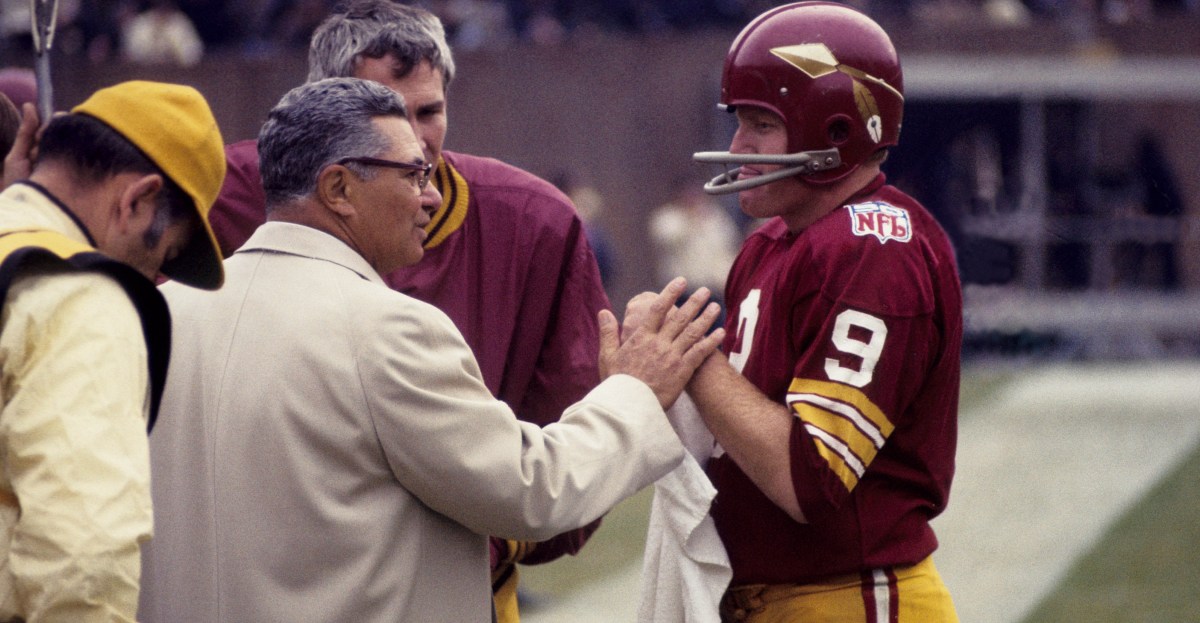
Sonny Jurgensen, in word and deed, was a majestic figure in Washington sports history
Sonny died Friday. He was 91. The franchise hasn’t had a quarterback with his combination of electricity or personality since. Well, until 2024, maybe. But in the pantheon of Washington quarterbacks, only Sammy Baugh and Doug Williams had the presence and impact that Sonny did. Beloved doesn’t begin to describe what D.C. thought of Sonny, whose second act in town was as part of the beloved radio broadcast trio that did games for WMAL-630: Sonny, Sam (Huff, the Hall of Fame linebacker) and Frank (Herzog, the play-by-play man and sports anchor for many years for the ABC and CBS affiliates in town).
“Thow the ball,” Sonny would say on the radio, over and over, swallowing the “R.”
Sonny thew the ball as well as anyone of his generation. He never became as well-known nationally as he deserved because his teams were mostly terrible, while Johnny Unitas’ Colts won multiple NFL titles, and Joe Namath’s Jets pulled off one of the great upsets in sports history, beating Unitas’ Colts in Super Bowl 3.
But people in D.C. know. They remember Sonny leading the Skins 60 yards down the field in the final two minutes against Miami in 1974, at age 40, throwing the game-winning pass to Larry Smith in the final seconds to beat the mighty Dolphins. They remember the 99-yard TD pass to Jerry Allen in 1968 — which, of course, equaled an NFL record.
PHOTOS | 80 pictures of Sonny Jurgensen through the years
Check out the top photos of Sonny Jurgensen’s career in Washington
Kliff Kingsbury joining Los Angeles Rams’ coaching staff: Source
Kingsbury’s new role is not yet clear. The Rams have an opening at offensive coordinator after Mike LaFleur left to become the Arizona Cardinals’ head coach, and they must go through an interview process that includes satisfying the Rooney Rule, which states that the franchise must interview at least two minority or female candidates for the coordinator position.
The Rams have a strong internal candidate in passing game coordinator Nathan Scheelhaase, who interviewed for the Cleveland Browns’ head-coaching job, which went to Todd Monken. If Scheelhaase were to be named the Rams’ offensive coordinator, it could open up the passing game coordinator spot for Kingsbury. Scheelhaase could also remain in his position if Kingsbury were to take over the offensive coordinator role.
In Memoriam: A Tribute to the Legendary Sonny Jurgensen After His Passing at 91 Years Old
Washington Commanders Just Got Exactly What They Wanted in new DL coach Eric Henderson, new DC Daronte Jones & new OC David Blough
Five Thoughts: On the new DL coach, Jayden Daniels and Chris Paul | John Keim Report
The Eagles are showing change can be very ugly
The departure of Jeff Stoutland is one ripple effect of the change we’ve all been asking for
[I]t’s virtually impossible to have change and for there not to be both positive and negative consequences.
I’ve been thinking a lot about this as we watch the Eagles go through some changes of their own. It’s hard to believe that exactly one year ago this weekend, your Philadelphia Eagles were on top of the football world.
In the wake of their 40-22 destruction of the Chiefs in Super Bowl 59, many fans talked themselves into the idea that we were on the precipice of a possible Birds dynasty.
There was no reason to believe, one year later, the Eagles would be in the position they are right now, desperate for change and reacting to the consequences those changes have wrought.
It appears A.J. Brown, miserable all season, cannot coexist with Jalen Hurts and wants out of Philadelphia. Jeff Stoutland, the team’s revered offensive line coach, lost his run game coordinator duties at some point last year and has decided to leave the team entirely. Landon Dickerson and Lane Johnson may both retire.
It could have been worse. Vic Fangio considered retirement. Happily, he’s staying.
A lot is changing, more than anyone could have anticipated 12 months ago.
Much of this change is necessary. It was clear last year’s elevation of Kevin Patullo to offensive coordinator was a disaster, and while Nick Sirianni tried to slap band-aids on the sucking chest wound mid-stream, none of it worked.
No one likes the trend lines we’re seeing with the Philadelphia Eagles. Nick Sirianni is on the hot seat yet again after seemingly bungling a potential title defense season. The 2026 season could be one that sees a lot of change.
Eagles defensive assistant reportedly leaving Philly
Philadelphia Eagles defensive assistant Tyler Yelk is leaving the Birds to become Nebraska’s new safeties coach on Matt Rhule’s staff, according to a report from Matt Zenitz of CBS Sports, and the Eagles might have another coaching position to fill depending on how they want to go about replacing him.
Landon Dickerson is another Eagles offensive lineman who might not return
The Eagles familiar OL room could look incredibly different in 2026
Things were not great for Landon Dickerson last season, and the Philadelphia Eagles starting left guard was dealing with injuries even before Week 1 — the 3x Pro Bowler missed most of training camp after undergoing a knee procedure. He went on to face a long list of ailments throughout the season, and left multiple games early due to injuries to his ankle, calf, knee, and back. At locker clean out day following their playoff to the San Francisco 49ers, Dickerson didn’t seem optimistic that he’d be able to return to full health, even with the benefit of the offseason.
Jeff McLane recently reported that it wasn’t just Lane Johnson who is contemplating his NFL future, saying that Dickerson isn’t a lock to return.
“Landon Dickerson may be even more of a question mark to me [than Lane Johnson].”
The report was corroborated by Mike Garafolo who had heard similar rumblings about the left guard.
It’s Jerry’s World, but our nightmare: Making sense of the Cowboys playoff paralysis
It is a frustrating time to be a Cowboys fan when we reach Super Bowl week
The finger-pointing often starts and ends at the top with owner and self-appointed general manager Jerry Jones. While Jones has turned the franchise into a $13 billion global behemoth, fans increasingly feel that his unique approach to roster building is the primary culprit behind the drought. The front office has rightfully earned a reputation for being bargain shoppers in free agency. For 10 consecutive offseasons, the Cowboys haven’t signed a single outside free agent to a contract that exceeds $6 million per year. They have consistently finished near the bottom in spending on outside talent over the last decade.
Despite their cheap ways, the front office always cries out about being strapped for cash, yet they somehow manage to pay astronomical prices for some of their own stars thanks to delayed contract negotiations. Fans often feel like they are watching a billionaire try to win a drag race in a Toyota Prius. While it’s highly economical, they’re not going to win very often. Cutesy phrases like “Pie” and “All In” only serve to infuriate fans as their roster-building ineptitude is atop the suspect list for the team’s lack of playoff success.
Despite the 30-year wait, there are still reasons to hold onto hope as we head into 2026.
Hall of Fame eyes changes, will return to in-person voting
Porter said the Hall plans to return to in-person voting and discussion for the 50-member committee after moving to a virtual meeting room following the COVID-19 pandemic. He also said the vote will likely happen closer to the annual reveal at NFL Honors — the Thursday before the Super Bowl — to reduce the chances of leaks. He added that the Hall would consider releasing vote totals and individual ballots in the future but won’t do it for this year’s class.
Porter said the Hall also will look at replacing voters who might have violated the rules either by publicly discussing the off-record debate about the candidates or by not voting for the “most deserving” candidates in each category.
“I’m not here to tell them who the most deserving is,” Porter said. “If the Hall was to tell who the most deserving is, we wouldn’t need them to vote. We understand that. We just want the rules followed.”
Porter said picking Seniors players over a coach because the players might not be guaranteed another chance as a finalist was not allowed.
“That’s not an option,” Porter said. “You have to pick the most deserving. Those are the instructions that were read four times.”
Some voters have expressed frustration over rule changes put in place last year that have grouped players in the Seniors category who have been retired for at least 25 years, along with coaches and contributors. The new rules also made it harder for anyone to reach the 80% threshold.
This is the third straight year that no coach got the honor, leading to calls from some people — including voters — to separate coaches and contributors from the Seniors.
Porter didn’t seem inclined to change that process, saying that for more than 50 years, coaches and contributors were grouped with players before changes about 10 years ago.
“The question is, what changed?” Porter asked. “What was it that the selectors could do that for the 50-some years but now can’t. They could get the right person in that didn’t require a category. I don’t know. We’ll find it out. We’ll talk to a lot of people. … But there’s a responsibility there. The responsibility is to pick the most deserving. They got down to where that number was. So, my question is, is everybody picking the most deserving?”
This was also the second straight year with fewer than five modern-era candidates getting in after a rule change. Instead of an up-or-down vote on five players, seven made it to the final stage, with voters allowed to pick five. The top three and anyone else above 80% gets into the Hall.
Last year, only three players reached that threshold. This year, there were four.
“We’ll do some tweaks, and we’ll take a look,” [Porter] said. “We’re going to do what’s best for the Hall of Fame. My job is to protect the integrity of the Hall, protect the integrity of the process.”
Ticket Prices for Super Bowl LX Steadily Dropping
Low-end, get-in pricing for the matchup at Levi’s Stadium is now hovering around $3,800 per ticket on multiple marketplaces. That is a 17% drop from the beginning of this week, and is down 42% from the comparable, entry-level figure of $6,500 right after Seattle and New England clinched their conference championships.
Every week on college and pro football fields across America, coaches have been going for it on fourth downs more frequently than ever before. At the same time, a civil war breaks out on social media over whether it was the right decision.
[T]he analytics side is winning the raging debate over whether to go for it or take the points — NFL teams opted to go for it on nearly 34 percent of fourth-down opportunities in opponent territory in 2025, according to TruMedia data. That’s the highest rate of any season this century. I’ve long been a proponent of following the math and going for it, although coaches like Mike Martz make a compelling case to kick. Martz is basically disgusted by what football has become.
“Analytics has gotten way too big of a bite with what’s happening in football today, and it’s unjustified,” he said. “Because whether you go for it or not, those numbers are based on other teams with different people, different plays, different play calling against different defenses. The only commonality between the two is the situation: fourth-and-1.”
The math behind going for it is relatively straightforward. The win probability gained from converting fourth downs is greater than what a team risks losing by turning the ball over on downs, particularly deep in the opponent’s territory.
The NFL’s changes to its kickoff rules before the 2024 season drastically shifted the data. Now, teams on average begin drives from the 30-yard line following kickoffs, according to TruMedia.
The risk of going for it in the red zone and failing is better than kicking a field goal (and giving the opponent the ball at the 30) because play calling near a team’s own goal line is typically more conservative. Hold a team to a three-and-out, get the ball back around midfield following a punt and try again.

Taking the points isn’t a guarantee. Kickers still have to make their kicks, which they did 97 percent of the time on attempts within 35 yards, according to TruMedia. Teams are converting fourth downs about 57 percent of the time. It’s easy to see why fans get so upset when teams turn down a 97 percent chance for a 57 percent chance, yet the numbers indicate teams have gotten better at going for it on fourth down in the red zone over the years.
As recently as 2020, teams went for it on fourth down 159 times in the red zone and converted 51 percent of them. The average line to gain was 2.4 yards away, according to TruMedia.
This season, the line to gain was 2.7 yards away. Still fairly similar to five years ago. Yet teams went for it 237 times and converted on 57 percent of the attempts. The 57 percent conversion rate has held relatively steady over the last three years, but this is easily the most often teams have gone for it on fourth down in the red zone since TruMedia began tracking such data in 2000.
NFL Draft 2026: Finding playmaking pass rushers
Since 2011, we’ve intermittently used a metric called the ‘Production Ratio’ to assess who the potential playmakers in the draft might be. The Production Ratio alerted us early to the likes of Kawann Short in 2013 or Aaron Donald in 2014.
The Production Ratio was initially proposed by NFL.com’s Pat Kirwan, and is really a very simple metric that adds up sacks and tackles-for-loss and divides the sum by the number of college games played. The resulting ratio is one tool among many – albeit a pretty good one – that measures the playmaking potential of front four players coming out of college. The Production Ratio is calculated as follows:
PRODUCTION RATIO = (SACKS + TACKLES FOR LOSS) / NUMBER OF GAMES PLAYED
The ratio is usually calculated over the entire college career of a prospect, but that method can be inaccurate because not every prospect has a four-year career in college. To correct for that, we’ll only look at the last two seasons of a player’s college career. For the two-year measure, a number above 1.5 is often indicative of premier talent for a pass rusher, a value above 2.0 can be indicative of elite talent.
Because double-digit sack players are exceedingly rare. Of all the edge rushers drafted in the nine drafts between 2017 and 2025, only seven have managed to average 10 or more sacks per year. The table below shows the top pass rushers drafted between 2017 and 2025 and includes each player’s Production Ratio.

With two exceptions, all players in the table above have remarkably high production ratios over their last two college years. But not every successful NFL pass rusher necessarily had prolific college production, as we can see here with Micah Parsons and and T.J. Watt. In Parsons’ case, he mostly played as an off-the-ball linebacker at Penn State, thus limiting his overall pass rush production. In Watt’s case, even the reduced two-year measure doesn’t do him justice. Watt went from almost no production in his sophomore season to a standout junior season with a one-season Production Ratio of 1.93.
But while almost all of the most successful pass rushers of the last nine years all had high Production Ratios, it doesn’t mean that a high Production Ratio automatically translates to high NFL production. The Cowboys now this all too well: Taco Charlton had a “green” Production Ratio of 1.59 but never amounted to anything in the NFL.
The Production Ratio, like every other stat-based projection tool, is not going to be a perfect predictor of how successful college players are going to be in the NFL. But it does give you something to think about as you evaluate these players and their potential, and it may be one building block in identifying who this year’s playmakers will be – and who won’t. The NFL combine will provide us with even more metrics, giving us an even bigger data base from which to assess players, and we’ll look at those in due time, but today we’re talking Production Ratio.
2026 Edge Rusher Prospects
The tables below show the 16 potential edge rushers that currently rank in the T0p 101 on Consensus Big Board at NFLmockdraftdatabase.com along with each player’s Production Ratio.

As we saw in the case of T.J. Watt described above, we may have to acknowledge that dogmatically sticking to the two-year time frame for the Production Ratio may not do every prospect justice, so here are the five players whose production ratio improves the most when only looking at their final year in college:

So we do get some “blue” prospects in this draft after all, but teams will need to understand what drove the jump in production for each player and what that means for their NFL future.