
GREEN BAY — “You can take as much time as you need,” Ron Wolf is saying near the end of an hour-long conversation in the days leading up to Super Bowl LX. Truth be told, the only things on the Pro Football Hall of Fame general manager’s to-do list are packing for California and shutting off the alarm that’s blaring in the background, notifying him that it’s time to take some medication — something he’s not especially excited about.
“An alarm to remind me to take a pill,” the 87-year-old Wolf says, annoyed. “This is something you’re going to have to live with when you get older.”
Throughout our conversation, it is abundantly clear that one of football’s smartest minds is still as sharp as ever. He doesn’t break down college prospects or build draft boards like he once did — although he does enjoy evaluating the top quarterbacks in each class — but his memory is on point and he’s still quick-witted. And, occasionally, sharp-tongued.
The man at the forefront of the Green Bay Packers’ 1990s renaissance — the architect of the 1996 Super Bowl XXXI-championship team, the man who hired Mike Holmgren, traded for Brett Favre and signed Reggie White — has been out of the game for 25 years now, but he’s back in the news because of the two teams playing on Sunday.
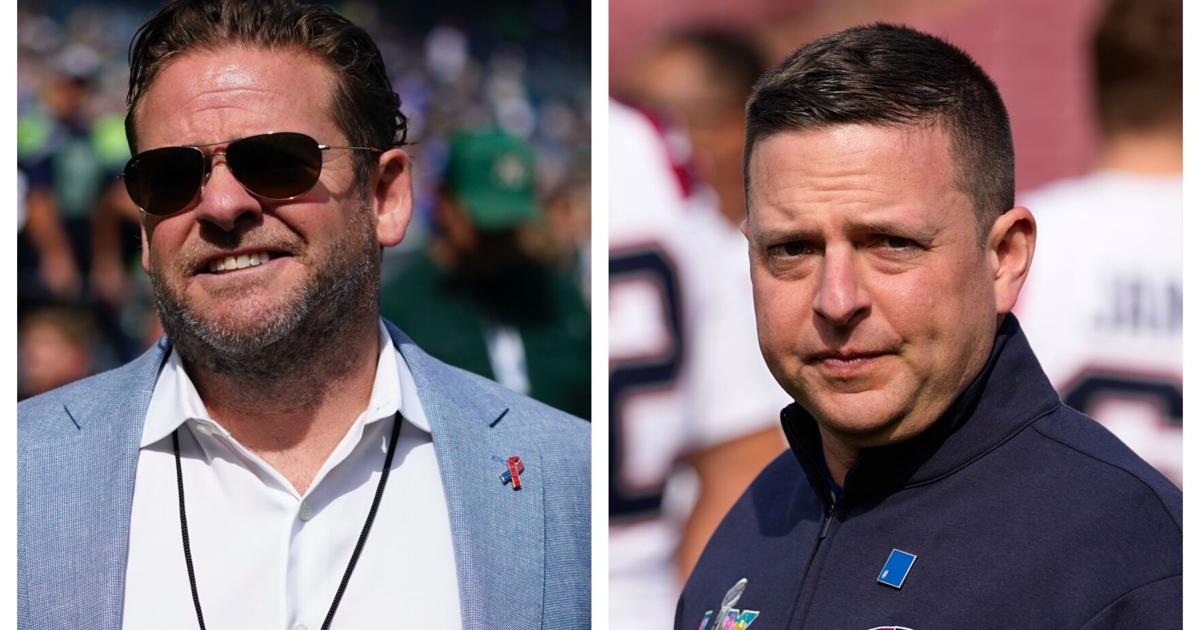
One is the NFC champion Seattle Seahawks, built by GM John Schneider, a Green Bay-area native who pestered Wolf into a scouting internship with the Packers while still a college student at the University of St. Thomas in 1992. Now, at age 54 and in his 16th season in Seattle after a dozen years in Green Bay, he is the only executive in pro football history to oversee two different Super Bowl teams with the same franchise — while doing so with two different head coaches and completely different rosters.
The other is AFC champion New England Patriots, revived by executive vice president of player personnel Eliot Wolf, the Hall of Famer’s 43-year-old son who has been in New England since 2020 and received the team’s equivalent of the general manager title two years ago. Coming off back-to-back four-win seasons — the final season of Bill Belichick’s 24-year run, followed by Jerod Mayo’s one-and-done season — the Patriots are aiming for their seventh NFL title in franchise history.
“That’s cool, isn’t it?” current Packers general manager Brian Gutekunst says. “I mean, normally, if we’re not in it, I can’t care less about that game and hope they both lose. But in this one, I just know, no matter what the outcome is, I’m going to be really happy for that person.”
Their connection has been among the most written- and talked-about storylines throughout the week, including stories about how both men attended the same high school 11 years apart and some pseudo-controversy as to whether Schneider babysat the younger Wolf when he was a little tyke.
“You know, it might have been the other way around,” Gutekunst said to a roomful of laughter during his after-the-season Q&A session with reporters last week, zinging Schneider for any occasional youthful indiscretions he might’ve had.
More importantly, Schneider and Wolf getting their teams to the big game has served as the ultimate reminder of what the elder Wolf accomplished in Green Bay, as Schneider and the younger Wolf are two branches on what has to be the most impressive personnel tree in NFL history.
Although only one is also part of the Wolf family tree, six others worked for him in Green Bay and later became general managers themselves: Ted Thompson in Green Bay in 2005, Schneider in Seattle in 2010, Reggie McKenzie in Oakland in 2012, John Dorsey in Kansas City in 2013, Scot McCloughan in Washington in 2015, and Gutekunst in Green Bay in 2018.
“How blessed the two of us are just to be playing in this game. You feel like you’ve already won in a way, you know?” Schneider says during a late-in-the-week phone conversation before he and wife Traci welcomed late-arriving family members to town.
“Like, Ron was the ultimate mentor. Eliot and I didn’t go get our doctorates in sports management, like all these kids have now. That’s how we learned — from Ron. That was like our both of our first exposure [to the NFL]. It was like a Master’s class.”
Adds Eliot, who speaks to his father every day, although the two hadn’t seen each other this season until Ron and Edie, Eliot’s mom, made the trip to Northern California last Thursday: “He’s tremendously proud, not only of me and what we’ve been able to accomplish with the Patriots, but also of John. John learned a lot from him, as well. So it’s been pretty cool for him, and our family as well.”
Upon arriving in the San Francisco area on Monday, Schneider, Eliot Wolf and Seahawks-turned-Patriots executive Alonzo Highsmith, who also worked for the Packers in the 2010s, got together for dinner to reminisce and talk about Ron Wolf’s influence — on the game, and on them.
For Schneider, the dinner brought back memories of his first year with the Packers, when he was tasked with writing reports on a handful of veteran free agents, including a star running back who would later become a Pro Football Hall of Famer himself.
Schneider’s report wound up being, well, a little wordy.
“Marcus Allen,” Schneider says of the Raiders-turned-Chiefs star who would sign with Kansas City. “I wrote a report on Marcus Allen. And Ron came in and was like, ‘Put it on my desk.’ Like, he would literally go through your report and critique it, like a professor. And he’s like, ‘I don’t have time to read War and Peace, OK?’
“And then he turns around and goes, ‘And, by the way, I drafted that guy [with the Raiders].’ I was like, ‘OK, OK. Good point.’”
Nearly 2,000 miles away, Gutekunst was feeling similarly wistful for the old days.
“One of the coolest things that has ever happened to me in my football career was stepping into that world with all those guys,” says Gutekunst, who was a scouting intern in training camp during the summer of 1997, the year after the Packers won their first Super Bowl since the Vince Lombardi Era ended nearly three decades prior.
“I didn’t know it at the time. I knew they’d just won the Super Bowl and they must be pretty good, but to learn from those guys and kind of soak that in … They were so confident at the time, they had so much faith and belief in what Ron was doing and the system that it was just really easy to buy into.”
When Schneider left the Packers in 1997 for a job with the Chiefs, Gutekunst worked for him for one season before coming back to Green Bay.
“I spent a year in Kansas City with John. It was a different system [in place], but John was trying to take what they were doing in Green Bay and implement Kansas City,” Gutekunst recalls. “And that’s just a really cool thing for the guys that come from [here], The guys that have been with Green Bay, that have come through that process, are still really close.
“Dorsey used to call it ‘The Mothership.’ This place is the mothership. And [we] all have a sense of pride coming from that process. That’s why I’ve always looked at it as one of the best things ever happened to me.”
Schneider left Kansas City in 2000, working for the Seahawks (alongside Thompson and Holmgren) and Washington Redskins (2001) before rejoining the Packers’ front office in 2002, a year after Wolf had retired.
His initial departure from Green Bay had come at his mentor’s urging, when the Chiefs and Chicago Bears both tried to hire him.
“Ron was like, ‘Hey, you need to get out of this. You grew up here, you started here, if you really want to kick ass, you need to get out and grow and see something different,’” Schneider says. Then, he pauses. “So he’s like, ‘Go … but you’re not going to the Bears.’”
Similarly, Eliot experienced other organizations after 14 years in Green Bay as a pro scout (2004–2008), assistant director of pro personnel (2008–2011), assistant director of player personnel (2011–2012), director of pro personnel (2012–2015), director of player personnel (2015–2016) and director of football operations (2016–2017).
But his departure wasn’t like Schneider’s.
When then-team president/CEO Mark Murphy chose Gutekunst over him to be the Packers GM in 2018, Wolf joined the Cleveland Browns for two seasons as their assistant GM. Briefly out of work before joining the Patriots as a consultant in 2020, he went to the annual NFL scouting combine in Indianapolis that year with Schneider and the Seahawks.
“I didn’t have a little brother. I was the youngest of that whole group — Reggie and Ted and Dorsey, those guys — so [Eliot], naturally, hung out with me a lot,” Schneider remembers. “And then, throughout the years, I was able to be there for some professional frustrations, situations he’s been through.”
One of those situations was not getting the Packers job. And to this day, it still bothers his father — although not for the reason one might expect.
“It’s not so much the fact that he didn’t get it. It was a reason given that he didn’t get it: That he was too young,” says Ron, who was elected to the Pro Football Hall of Fame in 2015, and whose Packers teams during his nine full seasons as GM went an astonishing 101-57 (including 9-5 in the postseason) while reaching two Super Bowls, winning one. “That did not sit too well with me. They took his title away and then had the gall to ask him to stay. I’m not stating that that he should have gotten the job. It’s the reason they gave that was a crock.”
Asked if it was a blessing in disguise that led to Eliot getting the Patriots back to the Super Bowl instead of living in his father’s large shadow in Titletown, he pauses.
“Sure, it worked out for the best. Because look where he is,” eventually comes the reply. “He’s involved in an amazing rebirth of a team and they’re playing for the championship of the National Football League. It worked out for him.”
As for the matchup reminding people of his own legacy, the elder Wolf emphasizes that “everybody in Green Bay should be really proud of these two guys,” while adding that Schneider “has done an absolutely phenomenal job of resurrecting the Seahawks” a decade after their last Super Bowl appearance and that he is “delighted” that Eliot has a chance to join him as a Super Bowl-winning GM.
But, as many conversations with Wolf end, he wants to close with a lesson, one that he believes is the secret to the Packers’ roster-building success and why so many of his lieutenants went on to be GMs themselves.
“I know this: People talk about systems and all that, but it’s not systems. It’s the people within the system,” he says. “I was very fortunate to have young guys like John Schneider, who loved the game of football, who spent countless hours working at their craft, who studied who the good players were and why they were the good players, and had a enthusiasm about them.
“I think the big thing was, they really liked what they did and they liked the game of football. Again, it’s the people. It’s the people.”
COPYRIGHT 2026 BY CHANNEL 3000. ALL RIGHTS RESERVED. THIS MATERIAL MAY NOT BE PUBLISHED, BROADCAST, REWRITTEN OR REDISTRIBUTED.