
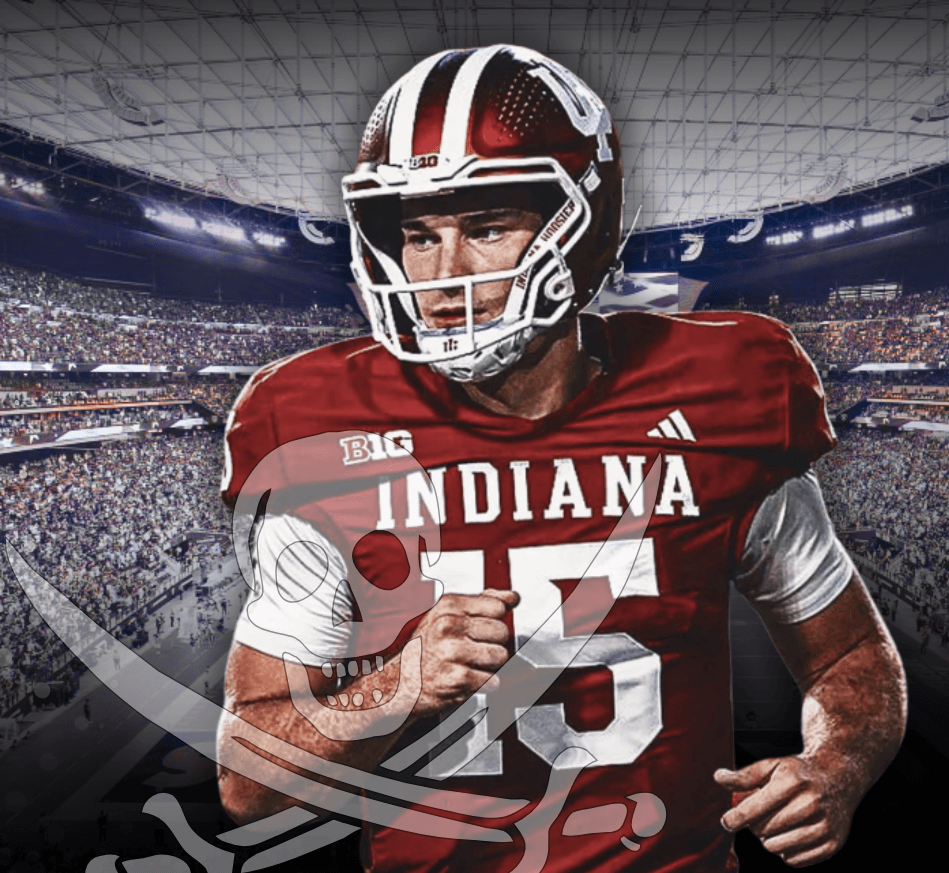
Barring a surprise, the Las Vegas Raiders’ pick is not much of a mystery. The Silver and Black are widely expected to draft Indiana quarterback Fernando Mendoza. It may not make for a suspenseful lead-up, but the lack of ambiguity has an upside. Instead of spreading the conversation across dozens of scenarios, the focus can stay on one player and one evaluation.
That also means the noise will ramp up quickly. Over the next three months, Mendoza will be called a bust, anointed a future Hall of Famer and labeled everything in between, all before he takes an NFL snap. The more useful question is simpler and harder at the same time: What are the Raiders actually getting?
This is where the true analysis begins…
Positives
Mendoza has most of the traits teams look for in a potential franchise quarterback. At 6-foot-5 and 225 pounds, he has a prototypical build. He also is not the statuesque athlete that often comes with that frame. Mendoza moves well for his size and can extend plays when he has to. Most important, he has plus arm strength and the arm talent required to make NFL throws.
The mental side of his game stands out, too. Mendoza processes quickly, diagnoses coverages and works through progressions with poise. One of the clearest positives on tape is that he generally does not put the offense in bad situations. He manages the game, protects the ball and understands when to take a shot versus when to live for the next down. He will challenge defenses, but he rarely forces throws that put the ball in danger or knock the offense off schedule.
The one drawback critics point to is that his production has not always looked gaudy on paper, a topic worth unpacking in context. Still, the results were there. He did what was required to steer Indiana to a 16-0 record and a national championship this season.
Concerns
Discussing the concerns of a presumed top overall pick can feel nitpicky by definition. Still, there are a few areas worth tracking. Mendoza’s physical tools are good, but not elite. His arm talent and athleticism do not match the rare traits of quarterbacks such as Josh Allen, Patrick Mahomes or Lamar Jackson, although that is true for almost every prospect.
The more relevant evaluation point is how he handles pressure. When Mendoza is forced off his platform, his accuracy can dip and his ball placement becomes less consistent. That is a common issue for young quarterbacks, but it remains the swing trait that will determine how quickly his game translates.
The biggest question, though, is how much his environment drove the jump in his profile. Mendoza had significant support. Curt Cignetti is widely regarded as one of the top coaches in college football, and the roster around Mendoza was strong across the board. He had multiple receivers with NFL projections, capable backs, and an offensive line that held up. The defense also gave the offense favorable game scripts.
That context does not disqualify the evaluation, but it does frame it. When a prospect rises as quickly as Mendoza did, the NFL has to separate what was created by the player from what was created by the situation.
Let’s take a closer look…
To answer that question, it helps to rewind to 2024, when Mendoza was at the University of California. Even then, he was not an unknown. He showed promise thanks to an NFL-caliber frame and legitimate arm talent. Still, his profile at Cal looked closer to a late Day 2 or early Day 3 projection than the presumed No. 1 pick he is viewed as today. That gap was driven largely by accuracy and footwork concerns, especially when pressure disrupted his platform. The themes are familiar.
After he arrived in Bloomington, those fundamentals looked notably cleaner. His footwork was more consistent, and his mechanics appeared more refined. Whatever the reasons, that technical progress should translate.
What may not translate as directly is the environment that helped him. Indiana’s offense gave Mendoza built-in answers against pressure, including a steady diet of screens and back-shoulder throws. He also benefited from strong line play and a receiver group that created defined windows. Just as important, he was not asked to carry the offense every week.
The NFL will be less forgiving. Mendoza will only be able to win on structure and game management for so long before he has to create on third down, against tight coverage, and under consistent heat. That is the real question: when the easy answers are gone, how high is his ceiling?
More: Reloading the Raiders offensive line must be the priority
Ceiling
The ceiling for Mendoza is high. With the right coaching and a strong supporting cast, he could develop into the type of quarterback who can lead a team deep into the postseason and contend for championships. The pathway, however, is different from the league’s rare outliers. Mendoza does not have the kind of elite physical profile that consistently erases mistakes or carries a roster on talent alone, so the margin for error around him will be thinner.
His value would come from command of the offense. If he can consistently win with processing, timing and decision-making, he can control games even without a highlight-reel tool set. In that sense, the blueprint is less about quarterback hero ball and more about structure.
That is where the Tom Brady-era Patriots model fits as a reference point. The point is not to suggest Mendoza will become Brady. It is to emphasize the formula: sound protection, a reliable run game, defined reads, and an offense that stays efficient and situationally sharp over time.
With that framework in mind, it is also important to outline the recipe for disaster.
Floor
A more conservative comparison is Daniel Jones, possibly with less straight-line speed. That may sound like a sharp critique, but it is not intended as a knock on either Mendoza or Jones. Jones entered the league as a highly regarded prospect, yet he has not consistently matched that billing because his overall play has often been steady rather than special.
That is the risk case for Mendoza. If he does not become an elite processor and consistent decision-maker, his physical tools may cap him as an average to above-average NFL starter. That is not an insult. The league is filled with failed first-round quarterback bets, and even functional stability at the position has real value. If Mendoza tops out as a borderline top-15 quarterback, that outcome can still justify the investment when weighed against the upside.
Still, that is the floor scenario. The more practical question is what Raider Nation should reasonably expect. Is the standard immediate stardom or steady growth into a reliable starter with the supporting cast and scheme built to elevate him?
Projection
The most accurate comparison for Mendoza is a quarterback similar to Kirk Cousins. While Cousins is not the player he once was at his peak, he was, at his best, the kind of quarterback that teams could win with. When he had a strong supporting cast and a solid structure in place, he was capable of leading teams deep into the postseason. Although he never reached a Super Bowl, his most promising opportunities came during his time with the Minnesota Vikings.
That is the bet Las Vegas is making. If Mendoza becomes an above-average to high-end starter, the Raiders can stabilize the most important position and build the rest of the roster with a clear timeline. They have been in a similar place before with Derek Carr, but the organization rarely committed to a sustained plan long enough to capitalize.
Now, the framework appears more aligned. With general manager John Spytek leading personnel and Klint Kubiak expected to shape the offense, the Raiders have a chance to build with consistency. It only works, though, if Mendoza fits what Spytek and Kubiak want to be on offense and if the organization follows through with the roster and development plan around him.
Related: Raiders retool offense in latest mock draft with Klint Kubiak here
How does Mendoza fit?
Mendoza’s potential will largely depend on the support he receives, including the weapons he has at his disposal and the protection in front of him. On paper, the Raiders appear capable of providing a young quarterback with a solid foundation. A dependable tight end and a strong running game are typically essential for a rookie, and Las Vegas possesses both. Brock Bowers and Michael Mayer form a formidable tight end duo, while Ashton Jeanty is the type of running back who can help keep the offense on track.
The receiver room is less settled. In college, Mendoza benefited from wideouts who consistently won one-on-one matchups on the perimeter. It is not yet clear which Raiders receivers can replicate that at the NFL level. Jack Bech could take a step in Year 2, but if he does not, Las Vegas may need to add a true outside separator to keep defenses honest.
Protection is the other key variable. Mendoza is not a quarterback who consistently erases pressure with elite escapability, so an unstable offensive line would raise the stakes quickly. The good news is the unit should be healthier, with Kolton Miller and Jackson Powers-Johnson expected back after injuries. If the coaching staff also stabilizes the technical work up front, the baseline should be adequate.
That leads to the biggest swing factor: coaching. The Raiders need an offensive plan that supports Mendoza’s growth and builds answers into the structure. Klint Kubiak is the logical centerpiece of that effort. He has shown he can tailor an offense around a pocket-based quarterback and lean on the run game to create manageable situations. With Jeanty in the backfield, that formula could help Mendoza settle in early while the rest of the passing game develops.
Will it all work out for the Silver and Black?
No one can predict how Fernando Mendoza’s career will unfold. But the Raiders appear positioned to make him their long-term answer at quarterback—if they build the right support system around him. That will take time. Mendoza may not play right away, and even if he does, meaningful progress often comes in stages.
Even so, the Raiders should be able to accelerate this new era if they handle the roster construction correctly. A realistic expectation is to compete for a playoff spot within the next two to three years, with Mendoza’s development moving in parallel.
The bigger question is how to define success. Championships are the standard, but they are also the hardest outcome to project. A more measurable benchmark is whether Mendoza becomes a stable, high-level starter who keeps the Raiders in contention year after year. If Las Vegas gets the infrastructure right, this pick can be the foundation of sustained relevance.
*Top Photo: Ramble Illustration/Getty Images
Join The Ramble Email List