
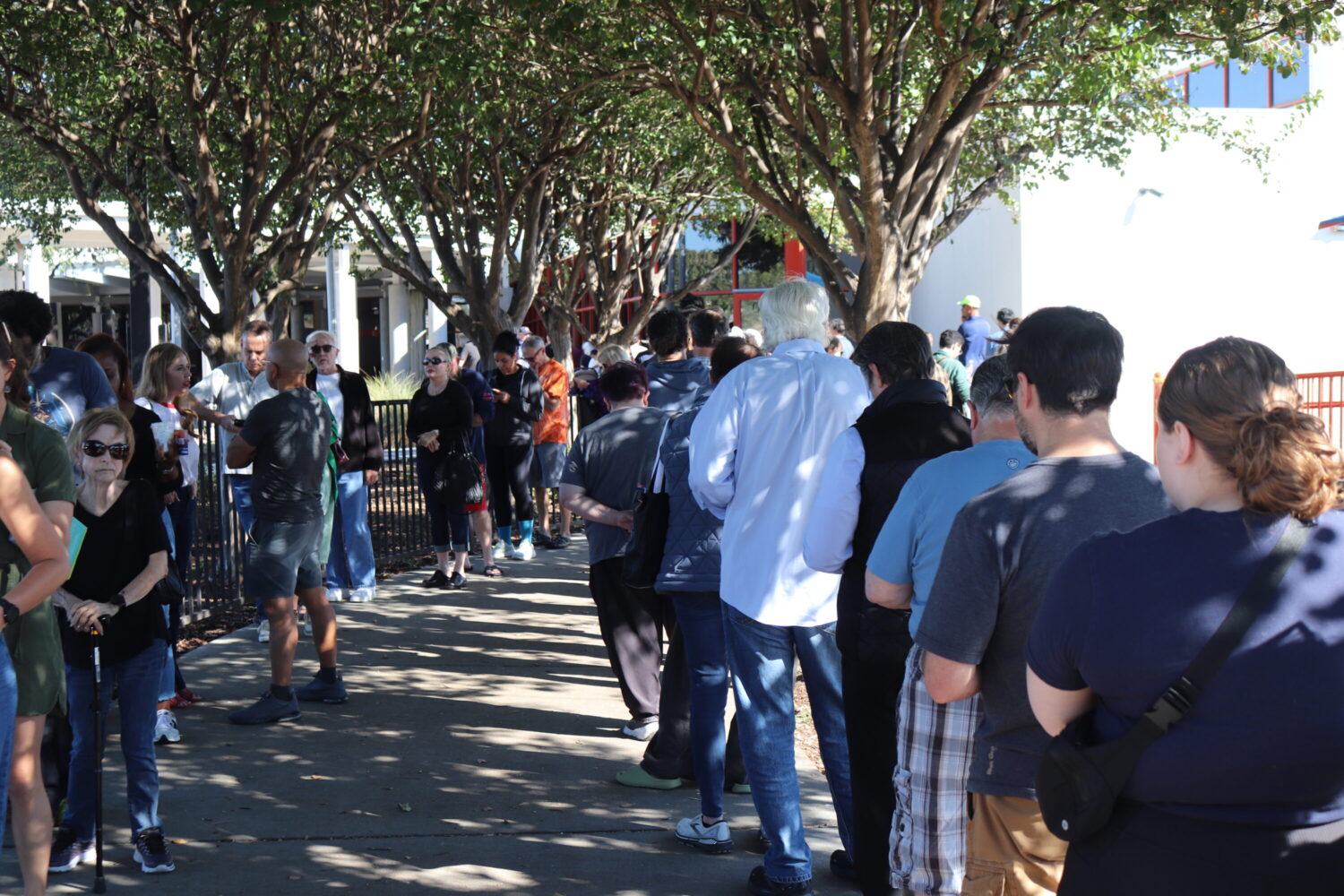
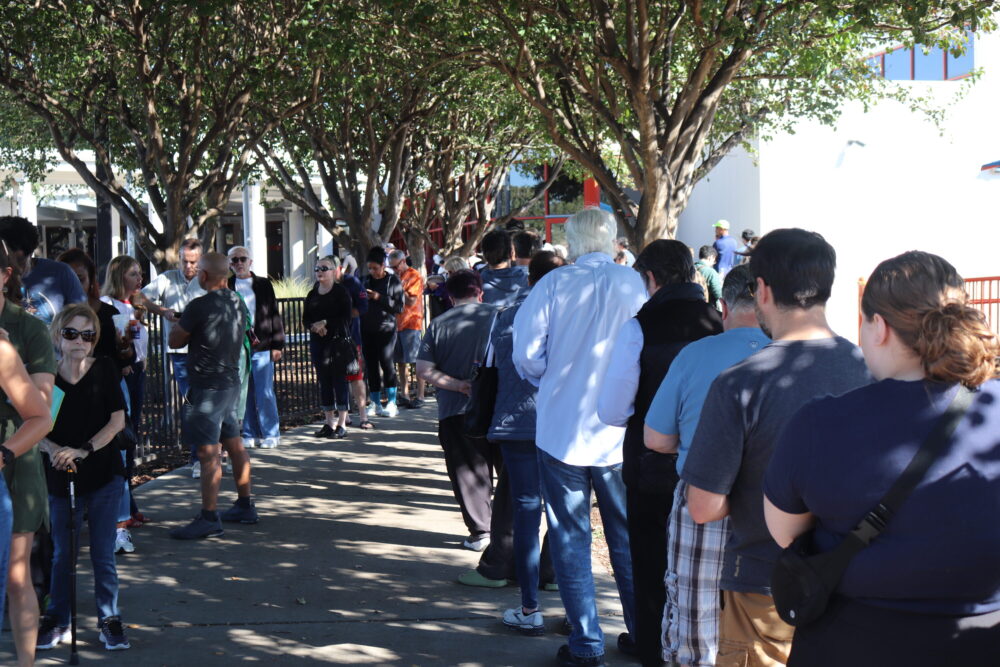
Dominic Anthony Walsh/Houston Public Media
Voters wait in line to cast their ballots at the Metropolitan Multi-Service Center in Houston on Nov. 4, 2025.
The 2026 primary election will be held March 3, when residents in the Houston area and across Texas will have a chance to choose which candidates will represent their political parties in the November midterm elections.
Some of the key races include one of Texas’ two seats in the U.S. Senate. Incumbent Sen. John Cornyn is being challenged in the Republican primary by Texas Attorney General Ken Paxton and U.S. Rep. Wesley Hunt from Houston, while U.S. Rep. Jasmine Crockett and state Rep. James Talarico are the Democratic frontrunners.
Other statewide primaries will include the races for governor, attorney general, lieutenant governor, comptroller, land commissioner, railroad commissioner and agriculture commissioner. Several state supreme court candidates will also be on the ballot.
Sign up for the Hello, Houston! daily newsletter to get local reports like this delivered directly to your inbox.
More locally, voters will weigh in on the top elected offices in Harris, Fort Bend, Galveston and Montgomery counties. Harris County Judge Lina Hidalgo announced last year that she would not be running for reelection, so former Houston Mayor Annise Parker, Former Houston City Council member Letitia Plummer and Matt Salazar will be vying for the Democratic nomination. The Republican candidates are Houston firefighters’ union leader Marty Lancton, former city council member Orlando Sanchez, Aliza Dutt, Oscar Gonzales, Warren A. Howell and George Harry Zoes.
RELATED: Here’s who will be on March primary ballots in the Houston area
Local congressional seats also are on the ballot in recently redrawn districts, such as the 18th Congressional District in Houston. Newly sworn-in U.S. Rep. Christian Menefee, who won a special election runoff in late January, will defend his seat in a Democratic primary that includes longtime U.S. Rep. Al Green, who switched from the 9th Congressional District. The 9th District now leans Republican, with state Rep. Briscoe Cain and former Harris County judge candidate Alex Mealer emerging as the top GOP candidates.
Here’s what you need to know before going to the polls, which open for early voting on Feb. 17:
Registration information
The state-imposed deadline to register for the March primary was Feb. 2. Residents can verify their registration status online to ensure their information is up to date.
A statewide search tool is available on the website of the Texas Secretary of State’s Office.
Voters in Harris County, which includes Houston, can check their registration status at the website for the Harris County Tax Assessor-Collector and Voter Registrar.
Early voting
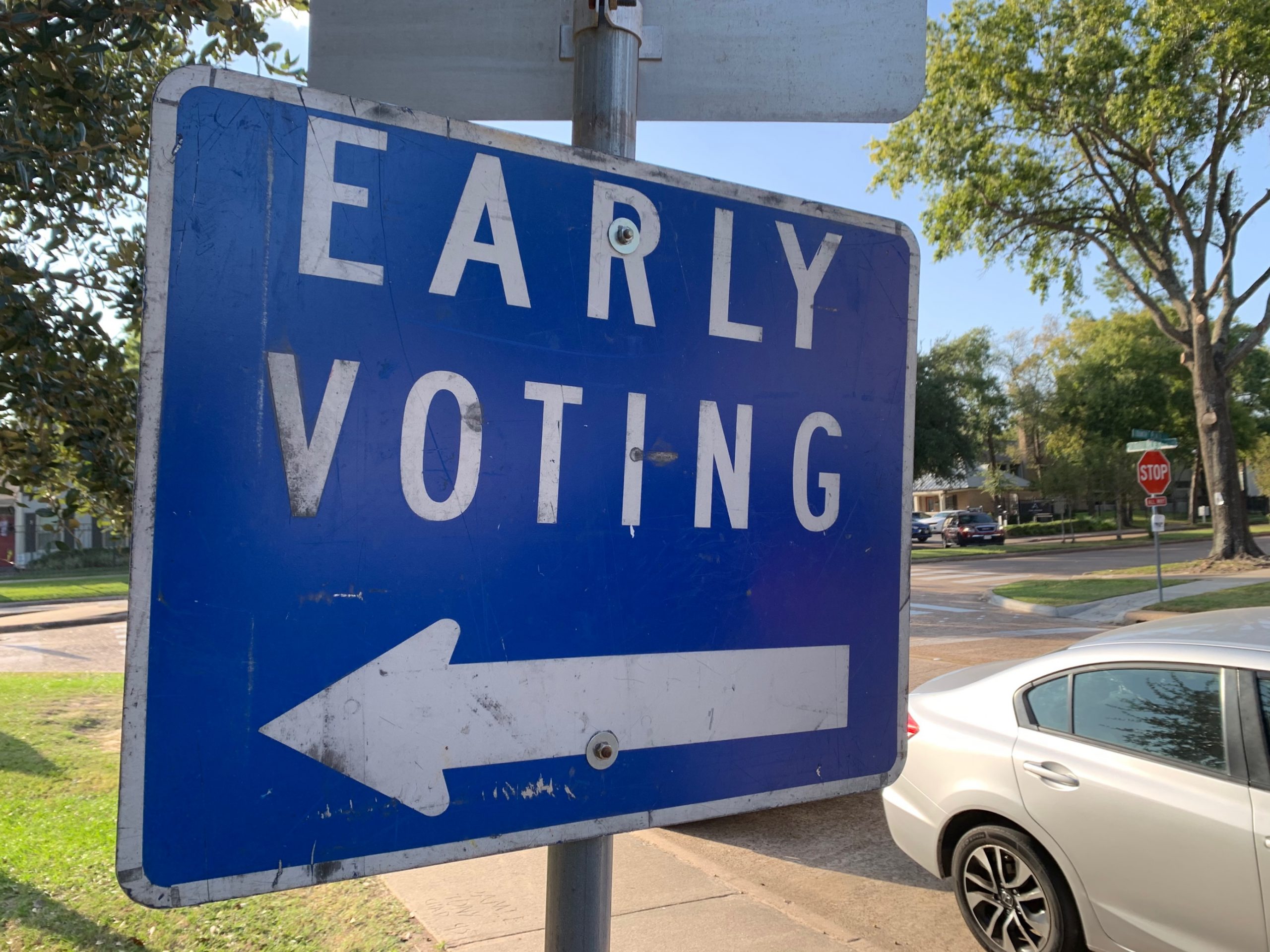
Grace Hatfield/Houston Public Media
A sign outside an early voting site at Nottingham Park in West Houston, Oct. 15, 2020.
Early voting across Texas begins on Feb. 17 and runs until Feb. 27.
Many counties, including Harris County, allow their voters to cast ballots at any polling location within their jurisdiction, regardless of where they live. Other counties may require voters to go to the polling location in their home precinct.
Check with your local voter registrar or elections office to see where they allow you to vote and when polls are open during early voting as times can vary from county to county. Some counties’ procedures for early voting may differ from their protocols on Election Day.
In Harris County, all 60 early voting locations will be open during the following hours:
Feb. 17-21: 7 a.m.-7 p.m.
Feb. 22: noon-7 p.m.
Feb. 23-27: 7 a.m.-7 p.m.
Election Day
Polls will be open from 7 a.m.-7 p.m. statewide on Tuesday, March 3. As long as a voter is in line at a polling location by 7 p.m., they will be allowed to vote.
As with early voting, some Houston-area counties allow voters to cast ballots at any polling location within their jurisdiction, whereas others require voters to vote in their home precincts. Harris County allows voters to cast ballots at any of its 200-plus polling locations on Election Day.
What you can bring
Voters should bring forms of photo identification or other materials that confirm their identity and right to vote in the election (see more on this below). They can also bring sample ballots and handwritten notes.
No phones, tablets, laptops, cameras or any device that can communicate wirelessly or record sound or images may be used inside a polling location or within 100 feet of one.
Voters likely will notice 100-foot markers as they approach a polling place. Within that 100-foot space, no one is allowed to post, use or distribute any signs or literature relating to a candidate, political party, or measure appearing on the ballot in that election.
Voters who need assistance casting their ballots, including for translation purposes, are permitted to bring one other person to help them – as long as that person is not their employer, an agent of their employer, or an officer or agent of their union. These voters must notify the presiding election judge so the helper can take an oath and sign paperwork swearing they are not forcing the voter to cast a ballot against their will and are not persuading the voter to vote a certain way.
What you can wear
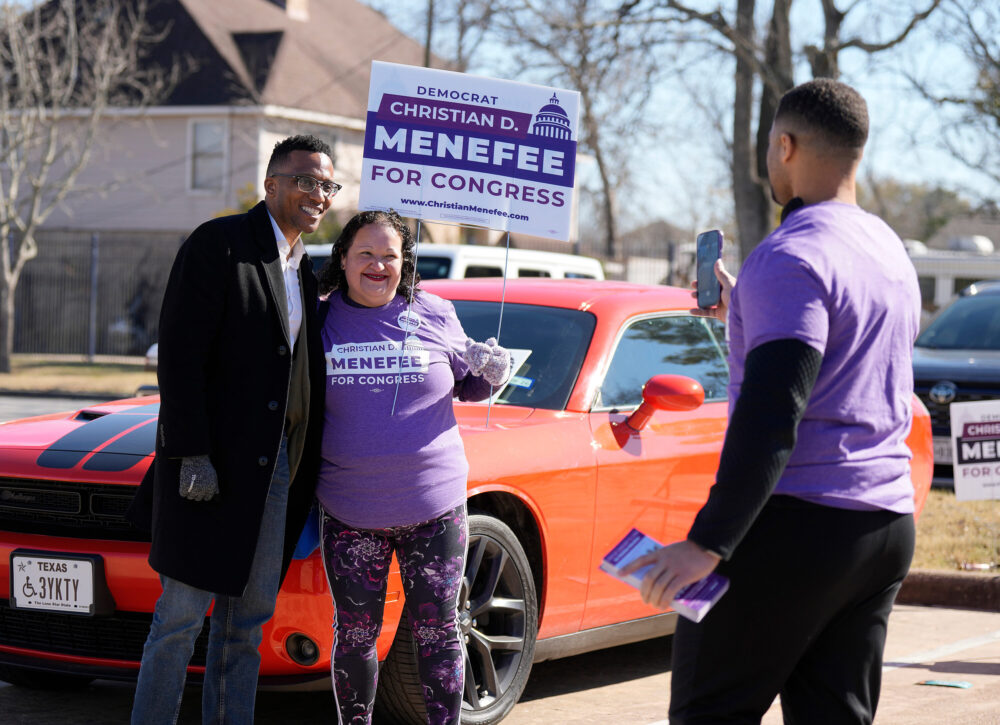
AP Photo/ Karen Warren
Texas Congressional Candidate Christian D. Menefee gets a photo with poll worker, Jessica Barraza, as he visited a polling location at Acres Homes MultiService Center on Election Day, in Houston, Saturday, Jan. 31, 2026.
Texas law prohibits voters from wearing clothing, hats, buttons and other forms of apparel at the polls if those items relate to a candidate, political party or measure appearing on the ballot in the current election. However, apparel related to candidates, parties or measures that are not on the ballot are allowed inside polling locations.
Acceptable forms of ID
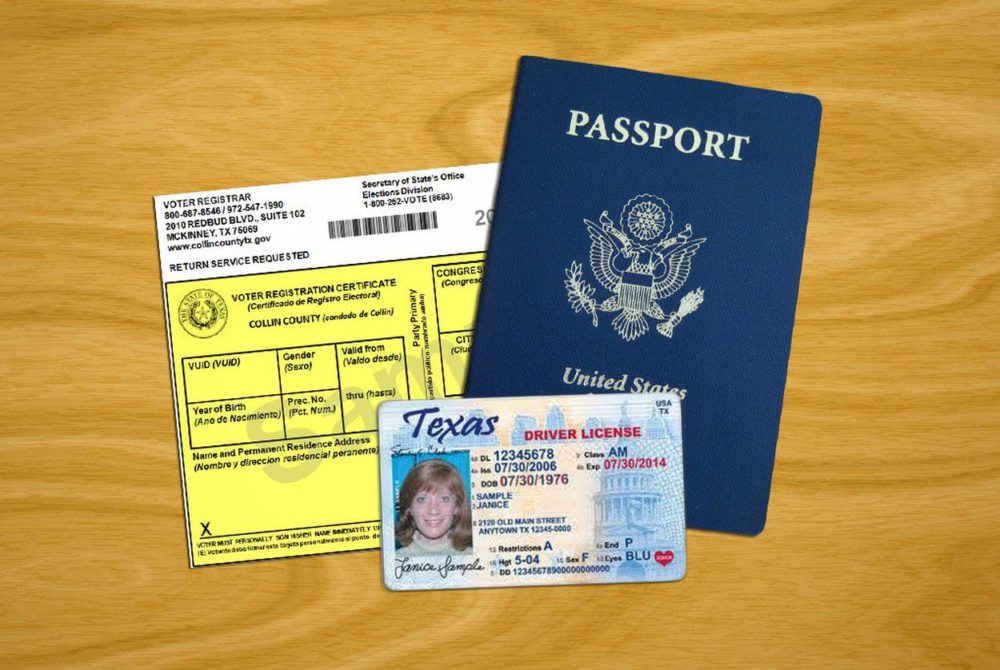
Illustration by Todd Wiseman
Registered voters can cast provisional ballots without any form of identification, but that requires some legwork after voting. To ensure your civic duty is fulfilled as soon as you cast your ballot, bring one of the following forms of photo ID to your polling location:
Texas Driver’s License or ID card issued by the Texas Department of Public Safety (DPS)
Texas Handgun License issued by DPS
U.S. citizenship certificate containing a photo
Texas Election Identification Certificate issued by DPS
U.S. passport (book or card)
U.S. military ID containing a photo
With the exception of the citizenship certificate, the ID presented must be valid or, for voters aged 18-69, have expired no more than four years beforehand. For voters who are 70 or older, there are no time limits regarding an expired ID.
Voters with no approved photo ID may apply for an Election Identification Certificate from DPS at no charge.
If voters do not have any of the aforementioned forms of photo ID, they can fill out a Reasonable Impediment Declaration and show a copy or original of one of the following forms of ID:
A government document that shows their name and address, including a voter registration certificate
Current utility bill
Bank statement
Government check
Paycheck
Also acceptable is a certified domestic birth certificate or document confirming birth that is admissible in a court of law that establishes identity. This could include a birth document from a foreign country.
The Reasonable Impediment Declaration form can be found online.
If voters are unable to provide identification or one of the aforementioned supporting documents, they can vote provisionally by signing a provisional affidavit and curing their ballot within six days after the election. They can cure their ballots by bringing an approved form of photo ID to their local voter registrar or elections office.
Who qualifies for an exemption? Voters with a disability may apply with their county voter registrar for a permanent exemption to showing an acceptable photo ID or following the Reasonable Impediment Declaration procedure at the polls. Voters with a religious objection to being photographed, or those who do not present an acceptable form of photo ID or follow the Reasonable Impediment Declaration procedure at the polls because of certain natural disasters, may apply for a temporary exemption to those requirements. Voters should contact their local voter registrar for more details about those exemptions.
Voting by mail
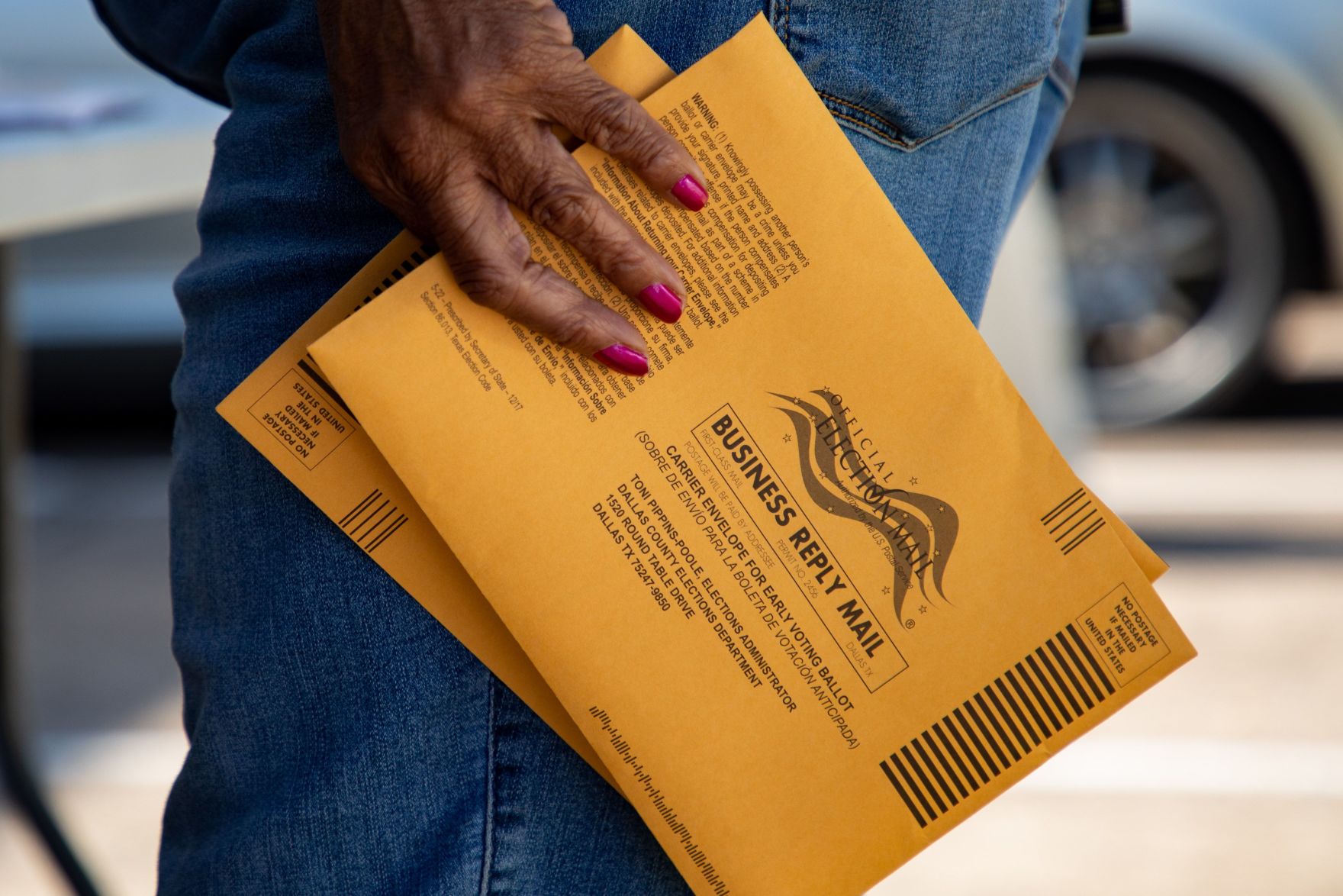
Keren Carrión / KERA News
Mail-in ballots that are dropped off must be received by an election official, curtailing ballot drop-off boxes.
Texans who meet certain requirements can receive and cast ballots by mail instead of voting at a polling location. Voters in the following groups are eligible to vote by mail:
Age 65 or older on Election Day
Sick or disabled
Will be out of their home county during early voting and on Election Day
Expected to give birth within three weeks before or after Election Day
Jailed but otherwise eligible to vote
The deadline to request a mail ballot for the March primary is Feb. 20.
Per the requirements outlined in Senate Bill 1, the elections law passed in 2021 by the Texas Legislature, all mail-ballot applications as well as submitted mail ballots must include one of the following identification numbers that match what is on the voter’s registration record: Texas driver’s license or state-issued ID number, Texas Election Identification Certificate number or the last four digits of the voter’s Social Security number. Voters can help ensure their mail-ballot applications and submitted mail ballots are accepted by including all the aforementioned ID numbers that apply to them.
In Harris County, ballot-by-mail applications sent through the United States Postal Service can be mailed to the Harris County Clerk’s Office, P.O. Box 1148, Houston, Texas, 77251-1148. Applications sent by a common or contract carrier should be delivered to the Harris County Clerk’s Office Elections Department, 15600 Morales Rd., Houston, Texas 77032.
Harris County voters also can fax their mail-ballot applications to 713-755-4983 or email them to bbm@vote.hctx.net. But if applications are faxed or emailed, the original application must still be sent by traditional mail and received by the voting clerk no later than the fourth business day after it was received by fax or email.
Voting-by-mail applicants who are at least 65 years old or disabled qualify to submit an annual application, which means they’ll receive mail ballots for all elections during a calendar year. Those can be submitted no later than the 11th day before Election Day.
RELATED: Voters with disabilities sue Harris County for allegedly lacking inclusive vote-by-mail options
If mail-ballot applicants decide to instead vote in person, they can do so by bringing their mail ballot to surrender at the polling location. If they do not bring their unused mail ballot, they can vote provisionally.
Completed mail ballots must be postmarked by 7 p.m. on Election Day and received by 5 p.m. on the first mail delivery day after Election Day. If they are not postmarked and sent by common or contract carrier – such as a personal courier, FedEx or UPS – ballots must be received by 7 p.m. on Election Day. Or, if the carrier envelope provides a receipt mark indicating a time before 7 p.m., the ballot may be received by 5 p.m. on the next mail delivery day.
In Harris County, mail ballots can also be dropped off between 7 a.m.-7 p.m. on Election Day at 1019 Congress St., Houston, Texas 77002. Only the voter can make the drop-off and must present an acceptable form of photo ID. If the voter does not have an ID, they may show one of the aforementioned supporting identification documents and complete a Reasonable Impediment Declaration.
Ballots from voters who are out of the country must be received by the voting clerk no later than the fifth day after Election Day. Ballots from military voters must be received by the voting clerk no later than the sixth day after Election Day.
Do the following when completing and submitting a mail ballot:
Use black or blue ink
Place the completed ballot in the envelope and seal it
Place the sealed envelope in the enclosed pre-addressed carrier envelope
Provide the appropriate ID number or numbers underneath the flap of the carrier envelope
Seal the carrier envelope and sign where indicated, using the same signature as used on the mail ballot application
Place the appropriate postage and send
The Harris County Clerk’s Office also recommends including contact information, such as a phone number or email address, so voters can be contacted by elections office staff to resolve any mistakes or omissions. Harris County voters can call 713-755-3150 for mail-ballot assistance in English, Spanish, Chinese or Vietnamese.
Mail ballots in Harris County can be tracked online at HarrisVotes.com.
Voting machines
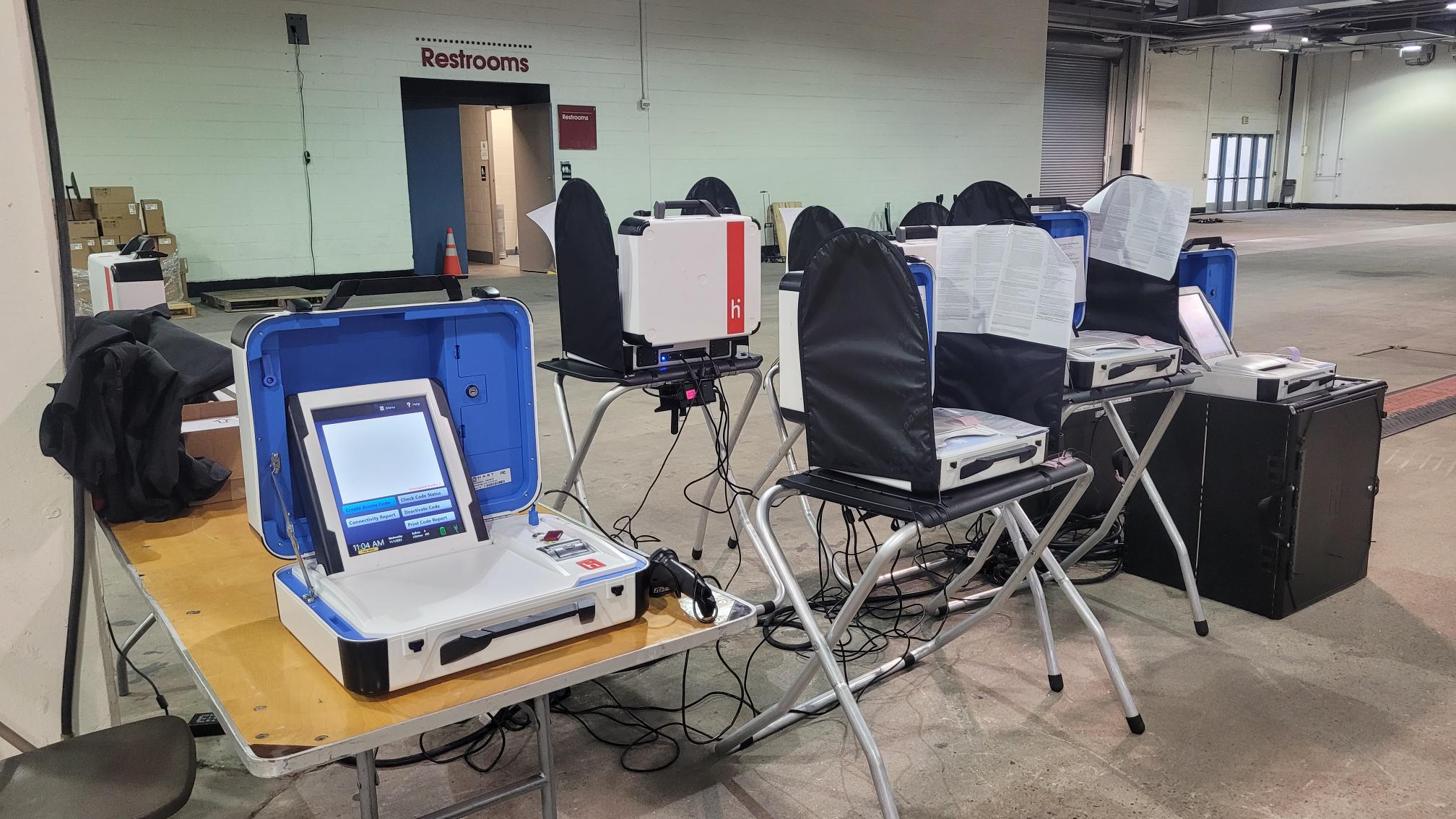
Patricia Ortiz/Houston Public Media
Voters will see a set up like this on election day, Harris County officials say.
Both electronic voting and paper ballots are utilized in Harris County, where voters will receive two sheets of paper along with an access code. They will insert the first piece of paper into a voting machine, where they will make selections electronically before printing and reviewing their choices. Then they will be prompted to insert the second sheet of paper and repeat the process.
If mistakes are identified, voters should tell an election worker. They can make corrections up to two times.
To cast their votes, Harris County voters will insert the printed, filled-out sheets of paper into a scanning machine. An American flag will appear on the screen after each sheet is inserted, indicating the process is complete.
Voting accessibility
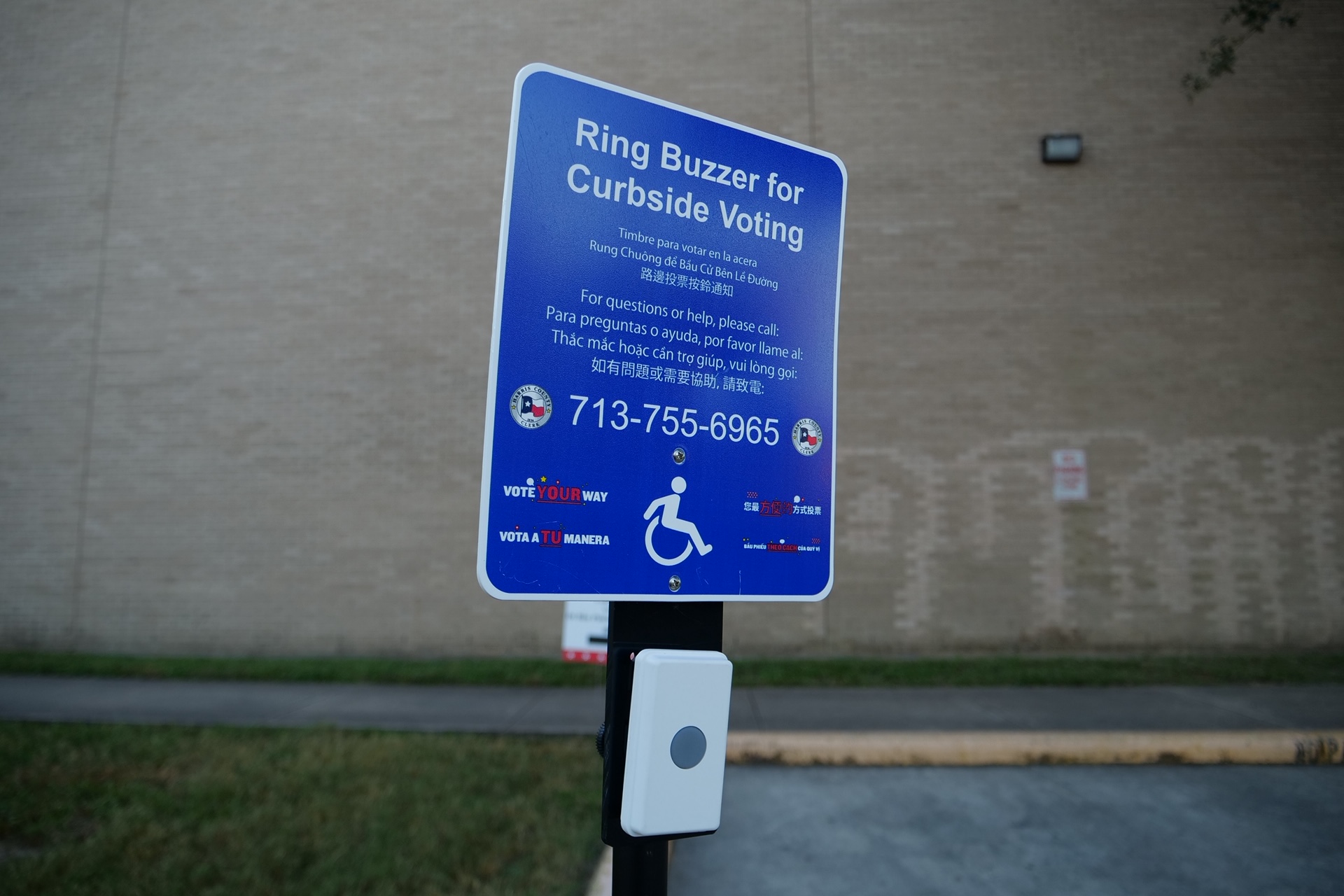
David J. Phillip / AP
A curbside voting sign in Houston’s East End on Election Day, Nov. 3, 2020.
Voters with disabilities – including hearing, vision and mobility impairments – have resources available to them as required by law.
Curbside voting is available for those who cannot physically enter a polling place. Such voters may ask an election officer to bring a ballot to a parked vehicle at a polling place’s designated curbside location. After marking their ballots, curbside voters can give them to the election officer or, at their request, to a companion who will then submit the completed ballot.
Voters with mobility limitations can ask an election official for voting order priority, which will prevent them from having to stand in line. Whether that priority is granted is up to the presiding election judge.
In addition to curbside voting, Harris County provides the following forms of voter assistance:
The ballot is available in four languages: English, Spanish, Chinese and Vietnamese
Voting machines let you increase the font size or contrast on the screen
Accessibility booths that are wider and have a separate control to accommodate mobility devices or a chair
Voting machines can hook up to components for voters with disabilities (such as headphones and sip-and-puff devices)
The voting machines in Harris County are equipped with two large buttons as an accessibility aid. They’re plugged into a standard 3.5-mm jack to allow for voters’ own input devices. Headphones and narration are also available to the visually impaired.
Special circumstances
Voters can apply for a late ballot because of sickness or disability, between the last day of early voting (Feb. 27) and 5 p.m. on Election Day. To qualify for a late ballot, the sickness or disability must originate on or after the 12th day before Election Day.
Voters may also apply for a late ballot due to a death in their immediate family that occurred on or after the fifth day before Election Day and caused them to be absent from their home county on Election Day.
Sample ballots
Sample ballots, which can help voters study candidates and propositions and make their choices before going to the polls, are available online. Visit the website for the elections office in your county to find sample ballots and other elections-related information.
Links for the election offices in the Houston area are below: