
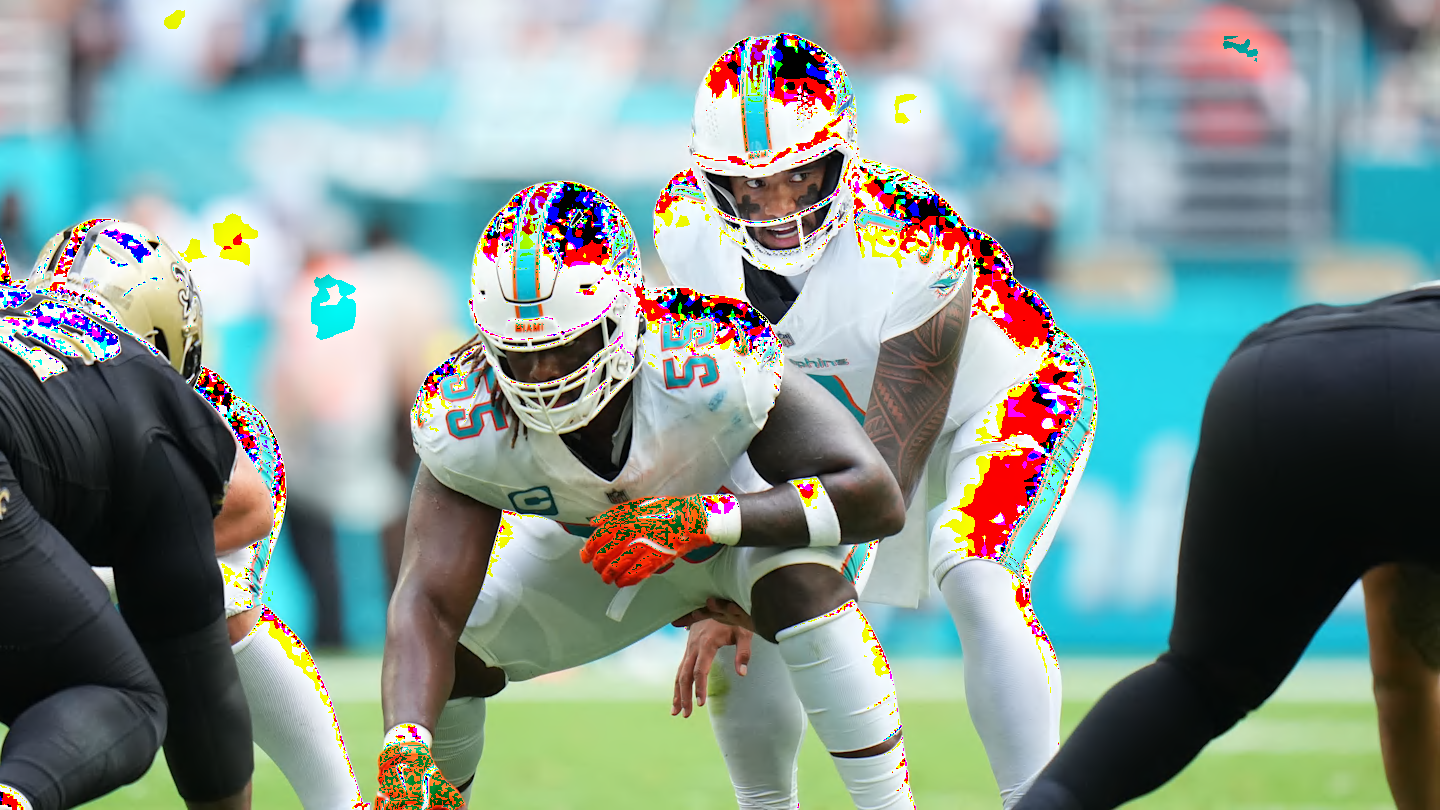
The Miami Dolphins won’t have a ton of cap room this offseason. It’s not as bad as some would have you believe, but Miami isn’t likely to sign more than one or two “significant” contracts.
One way for the team to create more cap space and strengthen the roster is to extend center Aaron Brewer. He’s playing on the last year of his deal in 2026 and has proven to be a great addition.
Brewer was an All-Pro in 2025, so we decided it’s worth it to see what an extension could look like and whether that’s an avenue the Dolphins should pursue.
What Would An Aaron Brewer Extension Look Like?
Before jumping into the pros and cons of extending Brewer, it’s useful to lay out what an extension for the All-Pro center would look like.
Brewer’s original deal came in at $7 million average annual value, which is 10th among centers. Brewer probably wants to climb into the top three with an extension, and that’s fair given how well he’s played the last two seasons.
Creed Humphrey ($18 million AAV), Cam Jurgens ($17 million AAV), and Drew Dalman ($14 million AAV) occupy the top three spots right now. However, there’s another name to consider.
Tyler Linderbaum is a free agent this offseason, and he’ll more than likely reset the center market close to $20 million in AAV. That creates an interesting dynamic if the Dolphins want to extend Brewer.
Miami would want to get it done before Linderbaum signs, and Brewer likely would want to wait because, although he wouldn’t get more than Linderbaum, it would raise the overall market price for a center.
A more realistic outcome would be for Brewer to sign a three-year, $52.5 million deal. That would put his AAV at $17.5 million, landing him ahead of Jurgens but behind Humphrey and Linderbaum. Brewer is 29, so this deal would only carry through his age-32 season.
Obviously, if the Dolphins can get him for cheaper, they should, but it’s usually more helpful to aim high with these predictions.
Pros of Extending Brewer
There are two obvious advantages to extending Brewer: clearing cap space in 2026 and keeping a good player.
Starting with the cap space, Brewer is on the books for $9.1 million in 2026. Extending him would allow the Dolphins to lower his cap in 2026 and then start paying him more in 2027 and beyond, when their cap situation is a lot clearer.
The Dolphins need money just to operate, sign their draft class, and fill depth holes on the roster. This wouldn’t free up much room (depending on the deal’s language), but every dollar counts.
The more appealing positive is that the Dolphins would retain one of the best players at their position in football. Brewer is definitely somewhat scheme-dependent, but the Dolphins’ promotion of Bobby Slowik to offensive coordinator means outside zone is here to stay.
Brewer thrives in that offensive structure and opens up so many different avenues for the team’s screen game. One thing that flies a bit under the radar is how well Brewer has played the past two seasons with arguably the worst guards in the NFL.
Most of Brewer’s reps have come next to Robert Jones, Liam Eichenberg, Jonah Savaiinaea and Cole Strange. Despite that, Brewer has consistently improved across two seasons.
For reference, Jurgens’ guard play fell off this season, and his play tanked considerably.
If the Dolphins are serious about building through the trenches and still committed to the outside zone running game, then extending Brewer makes a ton of sense.
Cons of Extending Brewer
Full disclosure, I’m fully on board with extending Brewer this offseason. That said, there are some arguments I could see for why it wouldn’t make sense.
For starters, center is not typically seen as a position that holds a ton of value. It’s one of the few positions where the top AAV hasn’t crossed $20 million because NFL teams typically don’t assign it much value.
I’m not arguing the accuracy of that statement, but I just think the NFL is wrong for that. Center is a way more valuable position than it’s given credit for. It’s not a premium position, but I’d put it closer to the middle of the pack.
However, the position value argument will be used against Brewer, and it wouldn’t be shocking to see Miami’s front office subscribe to that theory — even if I disagree.
The other argument is Brewer’s age. He’s 29, and his game is predicated on his athletic ability, so I could understand not wanting to bet on him after his age-30 season. That is especially true for a team entering a likely rebuilding year in 2026.
Those drawbacks would not overrule the positives in my mind, but they are real roadblocks to Brewer getting an extension.
Ultimately, we’ll have to wait and see. The nice thing is that Miami can wait to extend Brewer during the season and even into next offseason if it wants to. The clock on a decision has started, but it’s not close to midnight.
More Miami Dolphins Coverage