

DJ Bien-AimeFeb 11, 2026, 06:00 AM ET
CloseDJ Bien-Aime covers the Houston Texans for ESPN. He joined ESPN in July of 2022 after covering the New York Jets for the New York Daily News. He’s a former athlete who finished his college career at Louisville. You can catch DJ on ESPN Radio on his show “Talkin’ Texans.”
Multiple Authors
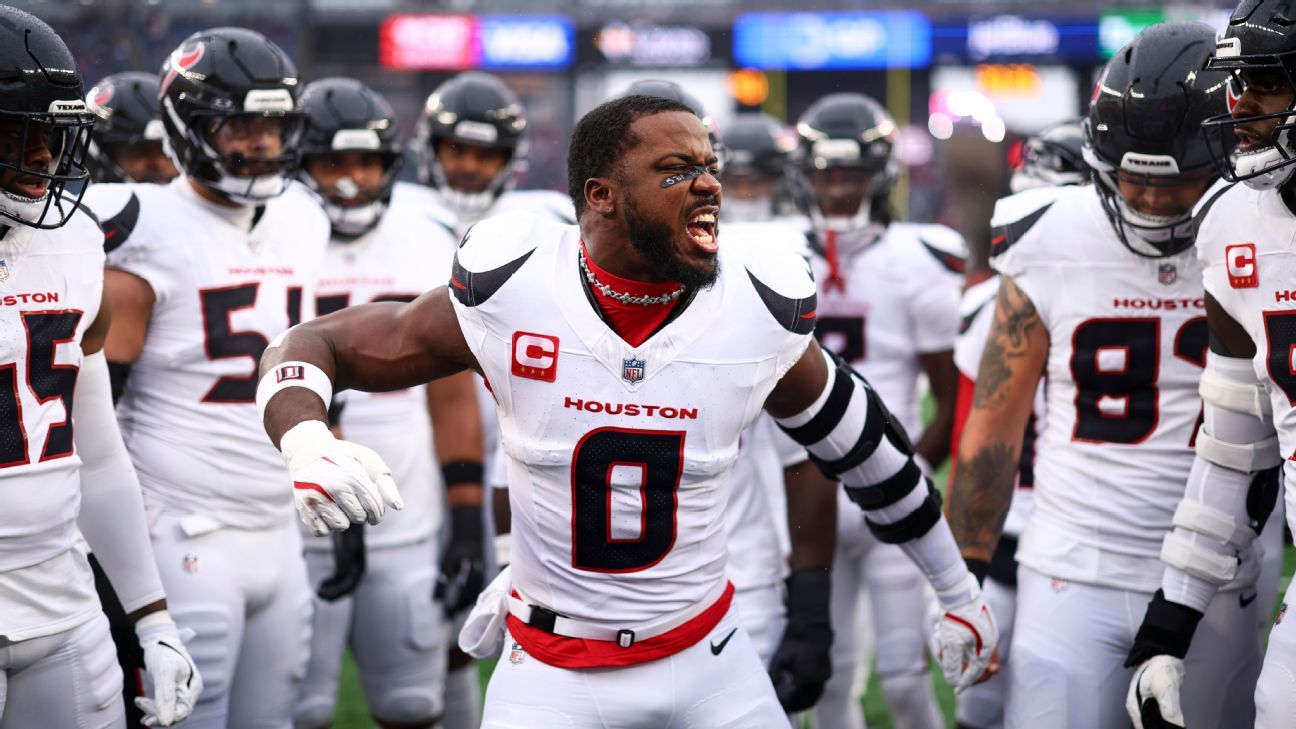
HOUSTON — Watching the Seattle Seahawks‘ dominant defense win a Super Bowl on Sunday served as a reminder of what could have been for the Houston Texans.
The Seahawks forced New England Patriots quarterback Drake Maye into two interceptions, a forced fumble and sacked him six times in their 29-13 win. It was similar to how the Texans forced Maye into three turnovers (two fumbles and an interceptions) in the divisional round, but the difference in the playoffs was mistake-free football for Seattle, something Houston and quarterback C.J. Stroud failed to do in their 28-16 loss.
Throughout the season, Houston tormented opposing quarterbacks. Whether it was the Los Angeles Chargers‘ Justin Herbert, Buffalo Bills‘ Josh Allen, Kansas City Chiefs‘ Patrick Mahomes or Seahawks’ Sam Darnold, the Texans forced Pro Bowl signal-callers into a combined eight turnovers.
Best of NFL Nation
• Challenges and solutions facing Bills, Brady
• Could Packers let Doubs and all FAs walk?
• SB proved a D can carry a team like Texans
• How can Chiefs help Chris Jones, pass rush?
• Chargers’ McConkey, Allen on playoff exit, 2026
As good as Seattle’s defense was throughout the season, the Texans’ defense was side by side with them. Houston allowed the second-fewest points per game (17.3) and fewest yards per game (279).
“The defense did an outstanding job all year,” coach DeMeco Ryans said. “It’s very encouraging, I think to everyone, when you watch the way those guys play, their play style, their demeanor. It’s impressive to see. It’s inspirational to see how they play.”
It was fair to suggest Houston had a Super Bowl-caliber defense. It opened the playoffs knocking off the Pittsburgh Steelers in the wild-card round, 30-6, where the defense scored two touchdowns (a pick-six and fumble return) off future Hall of Fame quarterback Aaron Rodgers. That’s why Stroud’s divisional round struggles (four interceptions) were magnified because of how stout the defense was in 2025.
In Year 3 under Ryans, cornerback Derek Stingley Jr., defensive end Will Anderson Jr., linebacker Azeez Al-Shaair, safety Calen Bullock and cornerback Kamari Lassiter were named to the Pro Bowl. Defensive end Danielle Hunter may not have been a Pro Bowler, but he was a second-team All-Pro selection, along with Stingley and Anderson earning first-team honors.
The Houston Texans had one of the best defenses in the NFL this season, allowing the fewest yards (279) per game. Kevin Sabitus/Getty Images
Anderson also finished second in Defensive Player of the Year voting behind Cleveland Browns defensive end Myles Garrett. He led in pass rush wins (62) as an edge, and he had the fifth-highest run stop rate (28%) among edge defenders with at least 500 snaps. Anderson finished tied for eighth (12) in sacks and tied for fourth in tackles for loss (20).
Anderson was a driving force for the defense and played a big part in Houston making the playoffs — where the Texans became the seventh team in the Super Bowl era (1966), and the first since Houston did it in 2018, to clinch a playoff spot after an 0-3 start.
The Texans went 12-2 on the back end of the season, and their nine-game win streak to end the regular season tied a franchise record from 2018.
“You’re always in it with those guys,” Ryans said of the defense. “They always give you a chance because it’s a special group and they find a way to make plays, find a way to get after the football. It’s a special group. Special group to coach. Really prideful group. I love and enjoy working with them.”
From an advanced defensive metric standpoint the pass defense was middle of the pack in the first three weeks. They allowed an EPA per dropback of minus-.05, according to NFL Next Gen Stats, the 13th fewest, and had only one interception.
The scoring defense was still stout in the first three weeks, which included holding the league’s highest-scoring team (the Los Angeles Rams at 30.5 points per game) to a season-low 14 in the opener.
Get ready for the NFL offseason
• Every team’s offseason guide | Schedule
• Top free agents | Best draft prospects
• Sizing up the uninspiring QB market
• 10 coach hirings, firings | Draft order
• Way-too-early Power Rankings for 2026
One move Houston made after the 0-3 start was release safety C.J. Gardner-Johnson for team chemistry reasons.
After the release, the scoring defense remained steady, but the pass defense took a leap, according to NFL Next Gen Stats. The Texans allowed a minus-.23 EPA per dropback (the lowest) and 17 touchdowns (eighth-fewest), and they had 18 interceptions (second-most). Houston was one of two teams with more interceptions than touchdowns allowed during that stretch.
The defense helped Houston survive Stroud’s three-game absence because of a concussion suffered during its Week 9 loss to the Denver Broncos, and the team went 3-0 with backup quarterback Davis Mills.
The elite play from the defense helped Stroud evolve his maturity within playing quarterback where he no longer felt he had to play ultra-aggressive at all times.
“Defense is making a bunch of plays,” Stroud said in January. “So, this year was a step for me where I didn’t have to be Superman all the time and I’m still growing in that. I appreciate my teammates for taking a lot of pressure off of my plate but, also, they do know that I can make those plays. So, I’m appreciative of that, of them having that perspective.”