
A federal judge will soon issue a ruling that—the NCAA contends—could lead to college athletes playing 18 seasons and beginning their play at Division I schools at the age of 32.
That idea might sound far-fetched, but in a post-House settlement world where college athletes can earn millions of dollars through NIL and revenue-share deals, the incentive to “stay in school” has never been stronger.
On Tuesday, Chief U.S. District Judge William L. Campbell Jr. held a hearing in which he listened to dueling arguments on whether to issue a preliminary injunction to allow former junior college (JUCO) players to enjoy full D-I eligibility. The NCAA limits eligibility in one sport to four seasons of intercollegiate competition—including JUCO and Division II competition—within a five-year period and generally restricts former JUCO players to three years of D-I football.
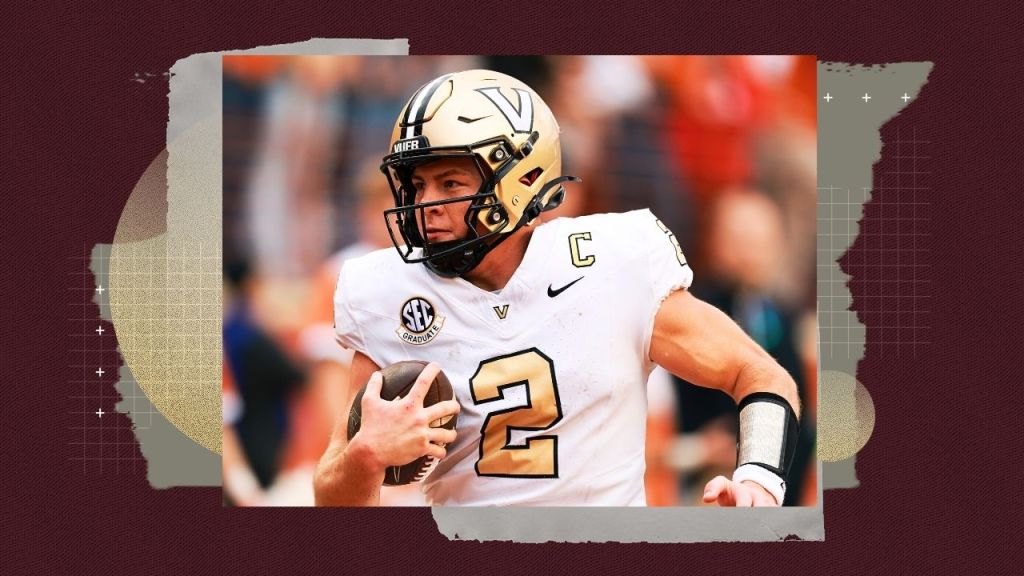
Vanderbilt quarterback and Heisman Trophy runner-up Diego Pavia is leading a group of more than two dozen former JUCO players who want D-I eligibility to start when a player first registers at an NCAA member school.
At this point, Pavia is the named plaintiff but has indicated he will enter the 2026 NFL Draft. Pavia has played six seasons of college football, the last four at D-I schools. In late 2025, Campbell granted Pavia an injunction to play in D-I in 2026, and the NCAA then granted a waiver to similarly situated players. Pavia has earned millions of dollars in college, and last June said he was offered as much as $4.5 million to transfer to another Southeastern Conference school.
Pavia has been a dynamic college football player, but listed at 6-foot, he’d be small for an NFL quarterback. He’s generally regarded as a late-round draft pick or priority free agent, which would position him to earn less as an NFL player than a college player. There is accompanying litigation, Patterson v. NCAA, that seeks to expand the maximum number of D-I seasons from four to five. It stands to reason that should litigation provide an opportunity for Pavia to play another season at Vanderbilt or another power conference school, he would seriously entertain that possibility.
The core legal controversy in Pavia v. NCAA is whether NCAA eligibility rules comply with federal antitrust law. Through Ryan Downton, Salvador M. Hernandez and other attorneys from The Texas Trial Group and Riley & Jacobson, Pavia asserts that through eligibility rules, the NCAA and member schools and conferences are engaged in a group boycott of former JUCO football players. These players are more seasoned than other college players—and, in their early to mid 20s, often more physically developed than 18- and 19-year-olds. Some are well positioned to negotiate lucrative NIL and revenue share contracts.
The alleged motivation of the group boycott is to constrain costs, since older college players are more likely to be coveted by coaches and thus have more negotiating power than an incoming freshman who might redshirt. Pavia also notes there are arguable inconsistencies in his group’s exclusion compared to other groups who are permitted to play.
For example, a player who graduates from high school and then plays football at a prep school for a year doesn’t see that year count against his NCAA eligibility. The NCAA also lets football players who previously played a different professional sport play four seasons of football, with one famed example being former Heisman Trophy winner Chris Weinke playing at Florida State after a six-year career in pro baseball. The ability of former G League players and one-time NBA draft picks to play college basketball is also relevant, since they are taking spots away from more traditional college players.
In briefs authored by Taylor J. Askew, Rakesh Kilaru and other attorneys from Holland & Knight and Wilkinson Stekloff, the NCAA disputes Pavia’s arguments.
The NCAA asserts that the players in Pavia’s group have not presented sufficient evidence to warrant a preliminary injunction. The NCAA contends that without data and empirical analysis showing how the inclusion and exclusion of JUCO players impacts the economics of college sports, antitrust law should not be used to restrain the NCAA from enforcing established rules that attempt to distinguish college sports from minor league sports and professional developmental leagues, which are much less popular with consumers and fans than big-time college sports.
Along those lines, the NCAA says Pavia’s group has “failed to establish what the relevant antitrust market is based on college sports as it exists today.” A relevant market is crucial to antitrust analysis since it identifies an area of competition for which antitrust law ought to apply.
The NCAA suggests the players are arguing that it’s unfair to exclude them, but that argument allegedly neglects “the broader equities at stake,” namely “the crowding out of incoming freshmen hoping to experience the life-changing benefits of being a student-athlete.”
The NCAA also cautions against “the gradual erosion of longstanding rules” that attempt to align the normal academic trajectory of a college student with how long they can play a sport. To that point, college students usually finish college in four years, sometimes five, and then move on to another stage of life, usually getting a job or going to grad school.
In what the NCAA describes as “not hyperbole,” it warns that Campbell granting an injunction would be the first domino to fall and could eventually lead to athletes in their late 20s and early 30s populating college rosters.
Given that universities tend to offer numerous graduate programs, it is possible for a student to study at a university for a long time; these people are sometimes referred to as professional students, meaning someone who never got a job and kept piling up degrees.
But in the 2020s, a college football player as a professional student could earn millions of dollars a year—far more than any average job. The NCAA suggests that is the end game of the Pavia litigation.
If Campbell blocks JUCO seasons counting toward athletes’ D-I eligibility, the NCAA wonders, “what will stop a similar flood of lawsuits seeking to discount competition at the D-III, D-II or National Association of Intercollegiate Athletics (“NAIA”) levels?”
The NCAA says that “if taken to its logical conclusion,” Pavia’s position “would permit student athletes to compete in, at minimum, 18 seasons of intercollegiate competition: two seasons of JUCO competition, four seasons in Division III competition, four seasons in Division II competition, four seasons of NAIA competition, only then to matriculate to a D-I member institution at roughly the age of 32 with a fresh four-season clock.” (emphasis from the NCAA’s brief).
Pavia views the NCAA forecast of a 30-something guy playing four years of D-I football as fearmongering and not what he actually seeks.
Pavia insists his case is about a group boycott of former JUCO players and asserts that case law is on his side. To that end, he cites several cases where pro sports leagues unilaterally imposed (meaning not collectively bargained) rules to exclude categories of players and those leagues were found to have violated federal antitrust law by engaging in group boycotts.
For instance, in the early 1970s, Spencer Haywood was granted a preliminary injunction against the NBA. At the time, the NBA conditioned eligibility on a player reaching the four-year anniversary of his high school class graduation. Pavia also cited Ken Linseman, who as a 19-year-old successfully challenged the World Hockey Association’s 20-year-old eligibility rule. As Pavia sees it, the NCAA and its members “have done the same thing” by “in effect, establish[ing] their own private government and exclude[ing] junior college players from the opportunity to compete.”
Pavia also contests the NCAA’s claim that allowing former JUCO players to compete for four seasons would “crowd out” high school players.
He points out the NCAA has “no rule” requiring schools to recruit or enroll freshmen, an omission that Pavia suggests undermines the NCAA framing the enrollment of freshmen athletes as a reason to deny an injunction. Pavia also highlights the NCAA’s transfer portal, where colleges recruit current college football players, who are more seasoned than high school seniors, to populate their rosters, meaning the portal “crowds out” those high school seniors. The NCAA dropped restrictions on student athletes transferring multiple times—some every year—due to antitrust litigation, but Pavia emphasizes “no Court has ever ruled that the NCAA must allow unlimited transfer.”
For those reasons, Pavia maintains, “the NCAA has not presented any evidence” that a team without the ability to retain a former JUCO player “would choose to replace that player with an incoming freshman rather than a transfer.”
There is no timetable for when Campbell will issue his ruling, though it’s reasonable to expect it will be issued within a matter of weeks, not months. Especially after a year and a half of Pavia’s litigation, Campbell is very familiar with the legal issues at play and knows that his ruling will impact not only the eligibility of players in the lawsuit but others who could lose or gain roster spots depending on his decision.