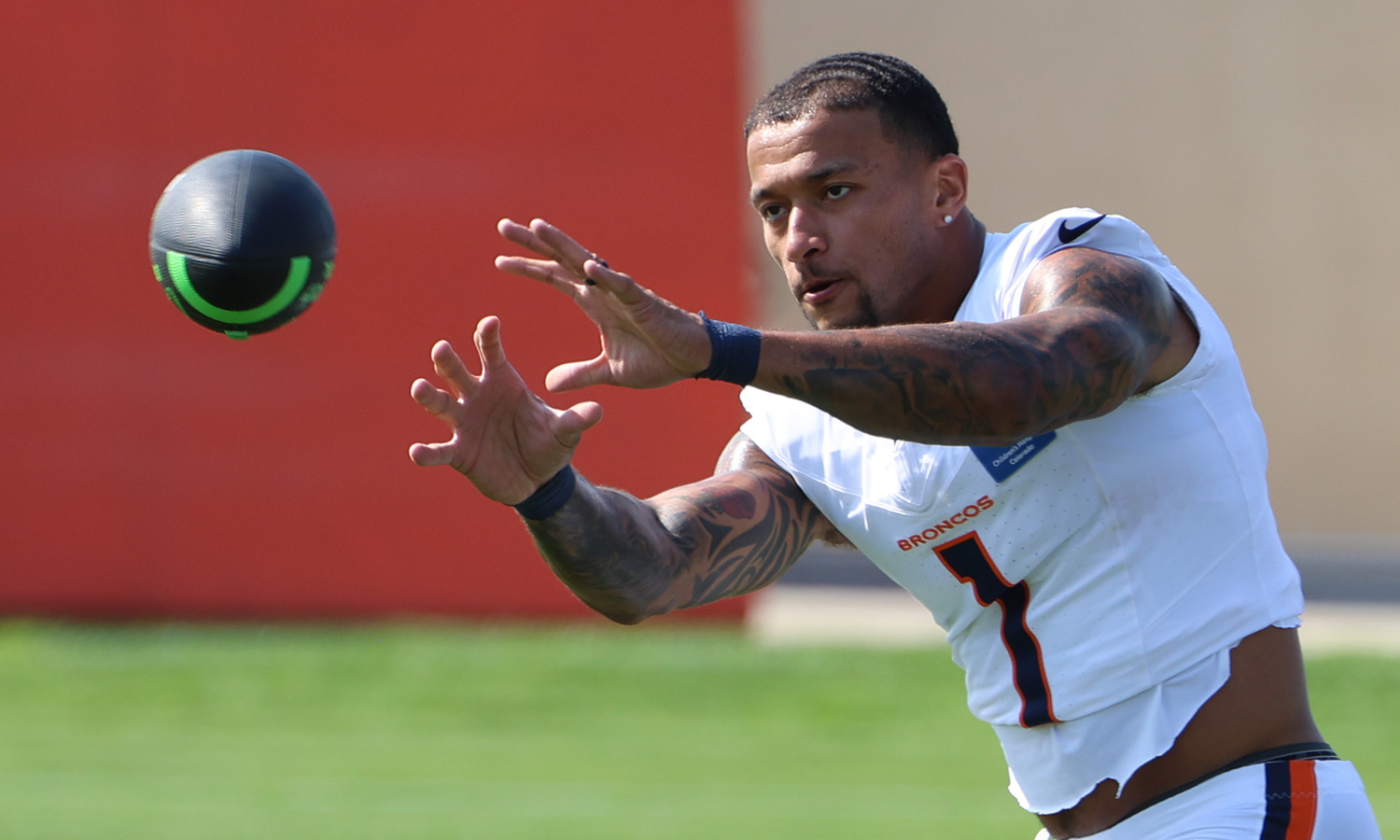
The Broncos expected Evan Engram’s arrival last year to change the production from their tight-end room.
There was some improvement. But not enough.
The Broncos’ tight-end room went from 30th in the league in receptions in 2024 — after being dead last in 2023 — to tied for 19th in the NFL with 78 total catches. In targets, the group improved from 30th to 18th, as they were targeted 114 times in 2025, 42 more than in the previous season.
But in other areas, the upturn was meager.
The group’s improvement in yardage from 483 to 719 ascended the tight-end room merely four slots, from 30th to 26th. The group generated 12 more first downs than it did in 2024, increasing its output from 21 to 33, but all that did was move the Broncos from dead last — where they had also been in 2023 — to 30th in the NFL.
And in touchdown receptions amassed by the team’s tight ends, the Broncos dropped from a tie for 13th to a tie for 28th; only the New York Jets and Tampa Bay Buccaneers had fewer touchdowns from their tight-end rooms.
But the numbers are worse when considering what the Broncos’ tight ends produced as a percentage of the team’s passing game. Only three teams attempted more passes than the Broncos, so the raw numbers don’t tell the full story.
In the percentage of passes targeted to tight ends, Denver improved from 30th … to 29th. In percentage of receptions by tight ends, the Broncos moved up from 31st … to 29th. The percentage of receiving yards from the position saw the Broncos bounce up from 31st … to 28th. And in percentage of first downs to come from the tight end position, Denver could only ascend from 31st to 30th.
In other words, on a percentage basis of the Broncos’ passing production, the tight-end room didn’t do much better than it did in 2024, and still ranked near the foot of the league rankings.
There was only one statistic in which the Broncos’ tight-end group ranked at or near the league lead, and it’s the one you don’t want to set the pace: drop rate. With one drop every 7.5 catchable passes (per SportRadar data), the Broncos’ tight-end group had the league’s highest drop rate.
Engram had the league’s second-worst drop rate for any tight end with at least 25 targets — one every 7.6 catchable passes. Only Mason Taylor of the New York Jets was worse.
No wonder that a mock draft issued by ESPN.com on Wednesday had the Broncos selecting Bo Nix’s old teammate, Oregon’s Kenyon Sadiq, with the No. 30 overall pick.
Once again, tight end is a position that needs an injection of playmaking juice.
• Times targeted: 114 — Rank: 18 (2024 rank: 30)
• Receptions: 78 – Rank: T-19 (2024 rank: 30)
• Receiving yardage: 719 – Rank: 26 (2024 rank: 30)
• First downs via reception: 33 – Rank: 30 (2024 rank: 32)
• Touchdown catches: 3 – Rank: T-28 (2024 rank: T-13)
• Percentage of passes targeted to TEs: 18.6% – Rank: 29 (2024 rank: 30)
• Percentage of receptions made by TEs: 20.1% – Rank: 29 (2024 rank: 31)
• Percentage of receiving yards made by TEs: 18.3% – Rank: 28 (2024 rank: 31)
• Percentage of passing first downs by TEs: 16.8% – Rank: 30 (2024 rank: 31)
• Percentage of passing touchdowns scored by TEs: 12% – Rank: 30 (2024 rank: T-18)
COULD THE BRONCOS’ TE ROOM LOOK ENTIRELY DIFFERENT?
It’s possible. Adam Trautman has an expiring contract and is an unrestricted free agent; while it would probably be easy to re-sign him to a relatively low-cost deal, a decision to overhaul the room might leave him expendable, even though he had the most reliable hands among Broncos tight ends, with just one drop in 21 catchable passes.
Nate Adkins is a restricted free agent after a season strangled by injuries. It was a frustrating campaign all around; he dropped three of nine catchable passes, per data collected by SportRadar, and in his career has a drop rate of one every seven catchable passes. He’s not on the team for his work as a pass-catcher; it’s for blocking, positional versatility and special-teams work.
Lucas Krull is also a restricted free agent after having his season cut short by an early-season practice injury. Re-signing him would be relatively clear-cut, but as was the case last year, he would face a fight to make the roster.
Engram’s contract is by far the most interesting. After the season, he expressed some frustration with the chances provided compared to his expectations.
“A lot of the stuff that was different was out of my control,” Engram said after the season.
I can only do the most with the opportunities that I get. There were times when I had opportunities; there were times when they were a little slim,” he said.
“… I do feel like I made a lot of big plays this year that put us in great spots, helped the team. Yeah, there were some tough moments in there. I wanted to always contribute more. Every week I wanted to contribute to the team.
“But yeah, a lot of stuff is out of my control, and I kind of had to stop trying to figuring out what that was and just focus on what I was asked to do.”
Still, the drop rate is notable; that is something that was largely within his control, and part and parcel of what made his first Broncos season a disappointing one. The drop rate was his worst since 2020, when he dropped 11 of 74 catchable passes.
The Broncos added a void year to Engram’s two-year contract, which seems to lock in a second season. Because of the void year, cutting him before June 1 would create $10.33 million of dead cap space and would save just $3.8 million, per data from Over the Cap.
But a post-June 1 designation would create $6.47 million of savings with $7.67 million of dead money this year — not ideal, but more palatable.
This could arise if the Broncos end up overhauling the room with both a free-agent signee from a deep class that includes Cleveland’s David Njoku, Atlanta’s Kyle Pitts and Philadelphia’s Dallas Goedert and an early-round draft pick.
But the bottom line is simple: For a third-consecutive offseason, the Broncos’ tight-end room is considered a team need.