

Courtney CroninFeb 12, 2026, 06:00 AM ET
CloseCourtney Cronin joined ESPN in 2017, originally covering the Minnesota Vikings before switching to the Chicago Bears in 2022. Courtney is a frequent panelist on Around the Horn and host of Best Week Ever and GameNight on ESPN Radio. She also co-hosts The Chicago Bears Podcast on ESPN 1000. She previously worked at the San Jose Mercury News as a multimedia sports journalist.
Multiple Authors
LAKE FOREST, Ill. — As Ben Johnson embarked on his first NFL draft as the coach of the Chicago Bears in April 2025, there wasn’t much question about which position the team would address in the first round. The debate became whom the Bears selected with the 10th overall pick.
Many draft analysts, including ESPN draft analyst Mel Kiper Jr., expected Penn State’s Tyler Warren to be the first tight end taken. Warren led all FBS programs in receptions (104) and set the Nittany Lions and Big Ten single-season records for tight end receptions and receiving yards (1,223) to go along with 12 total touchdowns during his senior season in 2024.
Editor’s Picks
2 Related
Chicago took the tight end most didn’t expect when it selected Michigan’s Colston Loveland over Warren, who was drafted four picks later by the Indianapolis Colts at No. 14. Although Loveland’s production during his junior season was significantly less than Warren’s, the Bears saw the potential for Loveland to become one of their main contributors on offense given Johnson’s Detroit unit used 12 personnel (1 RB, 2 WR, 2 TE) at the third-highest rate in the NFL (32.2% of plays) in 2024.
“Tyler is going to be a great player,” Bears senior director of player personnel Jeff King said moments after Chicago’s pick at No. 10. “But for us, we just felt that the alignment from coaching, scouting, everybody that touched both players that [Loveland] was the best fit for us. We aren’t comparing players. Both of those guys are going to have really good careers, but Colston was the best fit for us.”
Loveland capped off one of the most productive seasons by a Bears first-round pick in recent history when he finished as Chicago’s leader in receptions (58), receiving yards (713) and receiving touchdowns (six, which tied WRs Rome Odunze and DJ Moore for first). The last rookie tight end to lead the Bears in receptions and yards was Mike Ditka in 1961.
Loveland’s 58 catches are the third most by a Bears rookie, while his 713 receiving yards rank fifth by a Bears player in his first season. Loveland and Odunze (734 in 2024) were the only Bears rookies to generate that many receiving yards in the past 40 years.
The Pro Football Reference “Approximate Value” metric aims to determine a single number on a season value of a player at any position since 1960. Loveland’s rookie season registered a 7 in AV, which entered him into the upper echelon of first-round wide receivers, tight ends and running backs in franchise history.
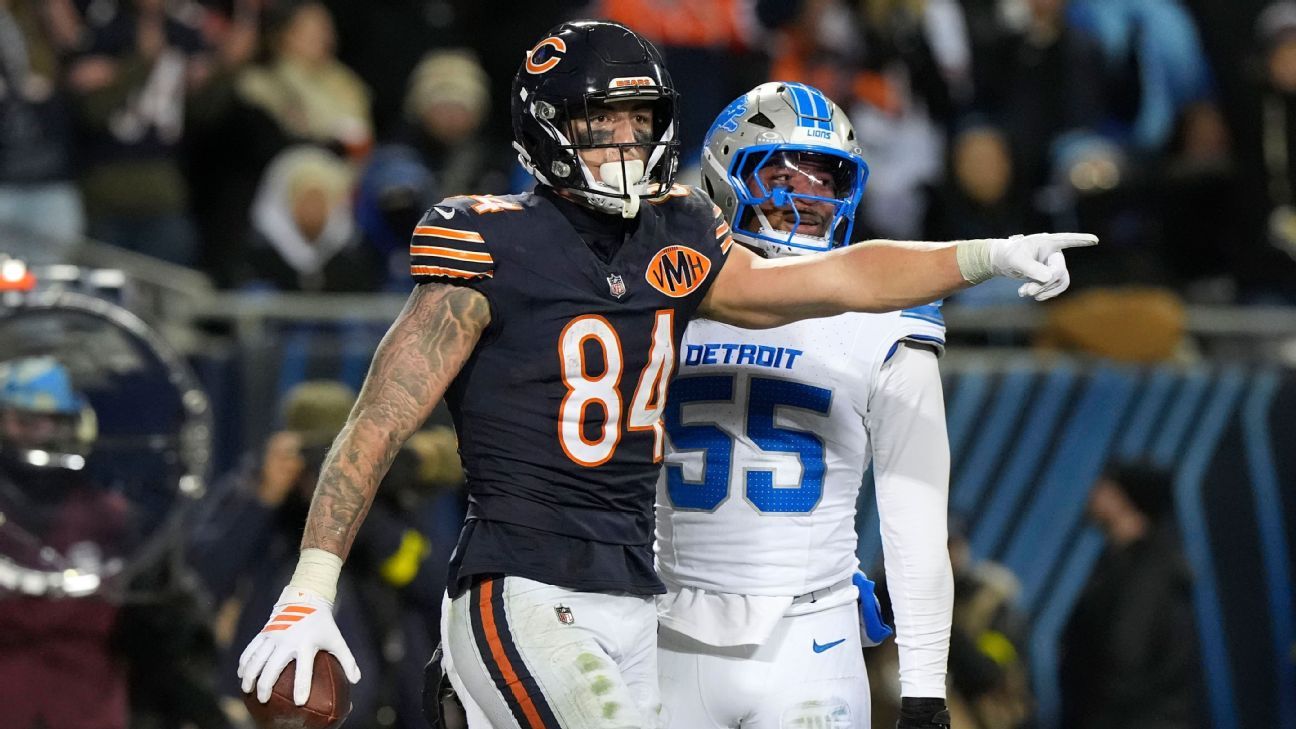
Tight end Colston Loveland had one of the most productive seasons of any rookie in Bears history. Nam Y. Huh/Associated Press
Others with an AV of at least 7 during a rookie season since 1960 include running back Gale Sayers (18), Ditka (13), running back Rashaan Salaam (8) and wide receiver Willie Gault (7).
“I think Colston can do a lot of things,” Johnson said. “He’s going to be a weapon for a long time in terms of the passing game. I think he does a phenomenal job in our running game. I think he’s been a key component in terms of where we’ve been able to line him up and what he’s been able to do in terms of blocking linebackers and defensive ends at times, and then even in pass [protection], we’ve asked him to do that a few times as well and he’s done a great job. I see him as a complete tight end and I think that’s what makes him so dangerous is because he can wear so many hats.
“He’s not just a one-trick pony.”
Though Loveland finished with the fourth-highest snap count (60.75%) among skill players on offense, his rookie year started off slow as he recovered from shoulder surgery in the offseason and dealt with a hip injury in Week 3 that sidelined him during the Bears’ first road win of the season at Las Vegas the following week.
The 6-foot-6 tight end didn’t register more than three catches for 38 yards in any game during the first eight weeks of the season. It wasn’t until Chicago’s Week 9 win at Cincinnati that Loveland had his breakout game with six receptions for 118 yards and two touchdowns, including the game-winning 58-yard score that cemented him as one of Caleb Williams‘ top targets in crunch time.
“That’s something that I take pride in and took pride in early,” Loveland said. “That was the biggest thing for me, just earn the trust, build that relationship with the coaching staff and the team so I can be put in positions to make a play.”
From that point, Williams’ trust in Loveland continued to evolve, particularly on third and fourth down. Loveland was targeted at least 10 times in Chicago’s final two games of the regular season (at San Francisco, vs. Detroit) and in playoff games against Green Bay and the Los Angeles Rams.
Best of NFL Nation
• Challenges and solutions facing Bills, Brady
• Could Packers let Doubs and all FAs walk?
• SB proved a D can carry a team like Texans
• How can Chiefs help Chris Jones, pass rush?
• Chargers’ McConkey, Allen on playoff exit, 2026
His strongest performance of the season came against the Packers in the wild-card round. Loveland once again emerged as Williams’ top option, generating 115 of his 137 yards in the second half.
It’s the type of trajectory Johnson believed Loveland could reach when he met with him during the predraft process, a trajectory that mirrored another star tight end Johnson coached for two seasons: Detroit’s Sam LaPorta.
Loveland’s 18-yard reception in the fourth quarter of Chicago’s 20-17 loss to the Rams in the divisional round broke LaPorta’s record for the most receiving yards by a rookie tight end in a single postseason since 1970. LaPorta had 176 receiving yards in the 2023 playoffs. Loveland finished with 193.
“We got a home run with him, and that’s something Coach said [in January] to me,” Williams said. “We were sitting in his office and everybody goes back to draft night. Why did we get Colston Loveland, and why did we do this and why did we do that? It’s Colston Loveland, you know what I mean? That’s who he is. One of the hardest workers on this team. He’s there late, he’s there early.
“His body language when he’s on the field, all of that, is — I’m excited for what’s to come … [in the] future for our trust, our bond, seeing different route concepts and seeing different defenses and just being on the same page 99% of the time. I’m excited.”