
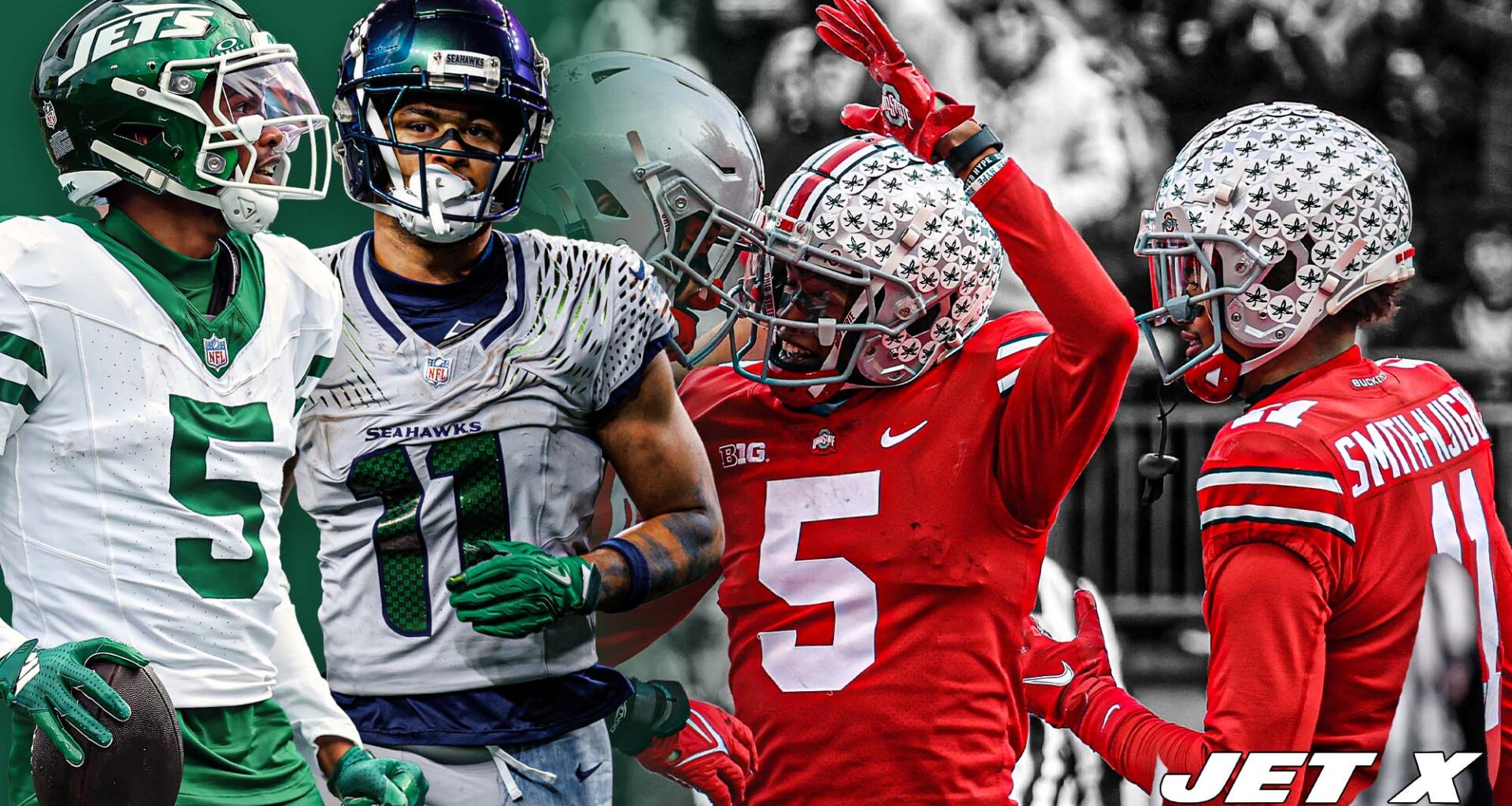
There is nothing stopping Garrett Wilson from becoming just like Offensive Player of the Year Jaxon Smith-Njigba.
Not even the New York Jets and their history of aerial ineptitude should stand in his way.
The two Ohio State receivers have similar body types; both are listed at six feet and under 200 pounds. Each has played with multiple quarterbacks throughout their NFL careers and remained consistently productive.
Easily the biggest difference between the two?
Seattle has focused their offense solely on getting JSN open as much as possible. In Sam Darnold, they found a quarterback who can get him the ball. New York has struggled to achieve that with Wilson.
Talent-wise, Wilson is on the same level as his former Buckeyes teammate. It’s the discrepancy in production that has JSN earning more recognition.
It’s why the Jets can, and should, do everything in their power to put their star receiver in a similar situation.
Jets must expand GW’s workload
Last offseason, the Seahawks made the bold decision to trade away DK Metcalf and entrust Smith-Njigba as their true No. 1 wideout. It was a risk that paid off in droves, as it allowed Smith-Njigba to star as the focal point of Seattle’s offense.
After trading away Metcalf, the Seahawks bolstered the receiving room by signing Cooper Kupp while trading for Rashid Shaheed midway through the year.
The Jets are already equipped to create that setup for Wilson. Much like Seattle after the Metcalf trade, there is no second star behind Wilson.
That has never stopped him from being one of the more dependable receivers in the game. The former 10th overall pick and Offensive Rookie of the Year began his career with three straight 1,000-yard seasons. A knee injury in 2025 was the only reason he wasn’t able to make it a fourth last year.
As consistent as Wilson has been, though, he has yet to reach a statistical peak that comes close to JSN’s 2025 season. His 119 catches, 1,793 yards, and 10 touchdowns led to a first-team All-Pro season and Offensive Player of the Year honors. The 2023 first-rounder added 17 catches, 199 yards, and two touchdowns in Seattle’s Super Bowl run.
So, what is stopping Wilson from reaching those numbers?
It starts with the quarterback. Wilson’s best year came with Aaron Rodgers in 2024, when he recorded career-highs in catches (101), yards (1,104), and touchdowns (7). However, Wilson only had the future Hall-of-Famer for a single season, and even then, he had to share targets with Davante Adams. He’s never had a full season with a competent quarterback and no stars to compete against for targets.
That could change in 2026.
The Jets have many potential quarterback options this offseason who can throw the ball at a better clip than Justin Fields, whether it’s Jacoby Brissett, Tanner McKee, Derek Carr, or Kyler Murray, among others.
Better accuracy from the quarterback spot, along with the lack of a second star receiver, could be the formula Wilson is looking for.
The second key is play-calling. Before his injury last year, Wilson was on pace for a 102-catch, 1,119-yard, and 11-touchdown season. This all came without another receiver recording over 400 yards on the entire season.
Those numbers are not quite on par with JSN’s totals, but they are certainly impressive with Justin Fields throwing the football.
A primary goal for new offensive coordinator Frank Reich will be scheming ways for Wilson to make plays at a similar volume to Smith-Njigba.
Through their first few years in the league, there’s no denying that JSN has officially lapped Wilson to this point. But that doesn’t mean it will stay that way. With competent coaching and quarterback play, there’s no reason to think Wilson can’t reach OPOY status.
That should excite Jets fans going forward.