
CINCINNATI (WKRC) – The Bengals enter the offseason with solid salary cap flexibility to address multiple needs on defense, and they could create even more room by restructuring quarterback Joe Burrow’s contract.
Using an offseason roster-building tool developed by The Athletic, it is possible to explore various scenarios for how Cincinnati could reshape its roster under the salary cap.
The website released an interactive roster-building spreadsheet that allows users to simulate offseason moves while operating within defined cap constraints.
A version of the exercise completed last week did not include a Burrow contract restructure, and those results were previously detailed here.
The following parameters were set:
– The website tool previously projected the Bengals would have about $41 million in available salary cap space before any potential roster cuts, based on an estimated $35 million cap figure used prior to the NFL’s official 2026 announcement. The league’s finalized cap is expected to be roughly $8 million higher than those initial projections.
OverTheCap.com now lists Cincinnati with approximately $54 million in available cap space.
From that total, about $4 million must be allocated to meet minimum salary requirements to fill out the roster. Teams also typically reserve an additional $10 million to $15 million for draft pick signings, in-season injury replacements, practice squad salaries and performance-based bonuses.
– Some positions feature players already under contract and locked into place, while others include drop-down menus that allow users to simulate cuts, add free agents, insert draft picks and extend current players.
Each transaction carries a projected dollar amount that automatically adjusts the available salary cap as changes are made.
The Athletic notes that the tool estimates free-agent contracts at roughly 20% below a player’s projected average annual value, reflecting the reality that first-year cap hits are typically structured lower than the overall value of most deals.
– The website allowed four draft picks, and those picks are based on Dane Brugler’s first round mock draft and for the other three rounds the Pro Football Focus big board is used. The cost to sign the picks is already accounted for as noted above, so they don’t show a dollar figure.
– Several Bengals players were locked into the roster-building exercise because of their existing contracts.
On offense, those included quarterback Joe Burrow, running back Chase Brown, wide receivers Ja’Marr Chase and Tee Higgins, and left guard Dylan Fairchild. Offensive linemen Orlando Brown Jr., Amarius Mims and Ted Karras, along with tight end Mike Gesicki, were also under contract for 2026 but had to be placed using the tool’s drop-down options, which allow for scenarios ranging from retaining them to potential cuts or positional shifts — such as Mims moving from right tackle to left tackle.
On defense, every position required use of the drop-down feature. Among the players under contract who were placed into the projected lineup were defensive ends Myles Murphy and Shemar Stewart, defensive tackle Kris Jenkins (as the No. 3 tackle), linebackers Demetrius Knight Jr. and Barrett Carter, cornerbacks Dax Hill and DJ Turner, and safety Jordan Battle.
All three specialists were fixed on the roster: kicker Evan McPherson, punter Ryan Rehkow and long snapper William Wagner.
My first big decision was to create additional cap space. Defensive tackles T.J. Slaton and B.J. Hill, tight end Drew Sample and linebacker Oren Burks were all released, generating $16.4 million in savings. That brought total available cap space to approximately $57.4 million.
Then came the decision to restructure Burrow, which added another $12 million in cap space and allotted $69.3 million available to spend.
That led to the following roster moves:
– Cornerbacks Dax Hill and DJ Turner were given modest contract extensions in the exercise to maintain stability in the secondary.
No extension was applied to running back Chase Brown, as the remaining cap space was allocated to other priority needs. While an extension for Brown is likely something the Bengals will consider, it was deferred in this scenario until next offseason.
– Andrei Iosivas was retained as the No. 3 wide receiver, a move that did not impact the salary cap since he remains under contract through 2026.
The Bengals frequently used two-tight end sets last season and could continue that approach if Erick All returns healthy. All missed the 2025 season while recovering from knee surgery related to an injury suffered in 2024.
– Guard Dalton Risner was signed in the exercise to a one-year, $4 million deal, and center/guard Lucas Patrick was added for $1.5 million to bolster interior line depth.
Second-year guard/tackle Jalen Rivers and center Matt Lee are also expected to compete for roster spots, though they were not factored into this particular simulation.
– Veteran quarterback Joe Flacco was signed in the exercise to a one-year, $4.5 million deal to back up Joe Burrow. While that represents a relatively high cost for a backup, it could be justified based on Flacco’s performance during Burrow’s absence last season.
– I considered releasing Ford and signing free agent offensive tackle Jedrick Wills, a former first-round pick of the Cleveland Browns who sat out last season because of ongoing knee issues. However, Wills carried a $600,000 higher cap hit than Ford, and the added injury risk did not justify the move in this scenario.
Additional depth at offensive tackle would instead be addressed through the draft.
– Samaje Perine was retained as the primary backup at running back. Because he is already under contract, his inclusion did not impact the available salary cap space in the exercise.
Overall, the approach effectively keeps the offensive core intact. My only disappointment was not adding a better backup swing tackle.
On defense, the following moves were made:
– The decision was made not to re-sign or apply the franchise tag to defensive end Trey Hendrickson. His projected cost was considered too high, particularly given that he is coming off core muscle surgery, recorded four sacks in seven games last season and will turn 32 during the 2026 season.
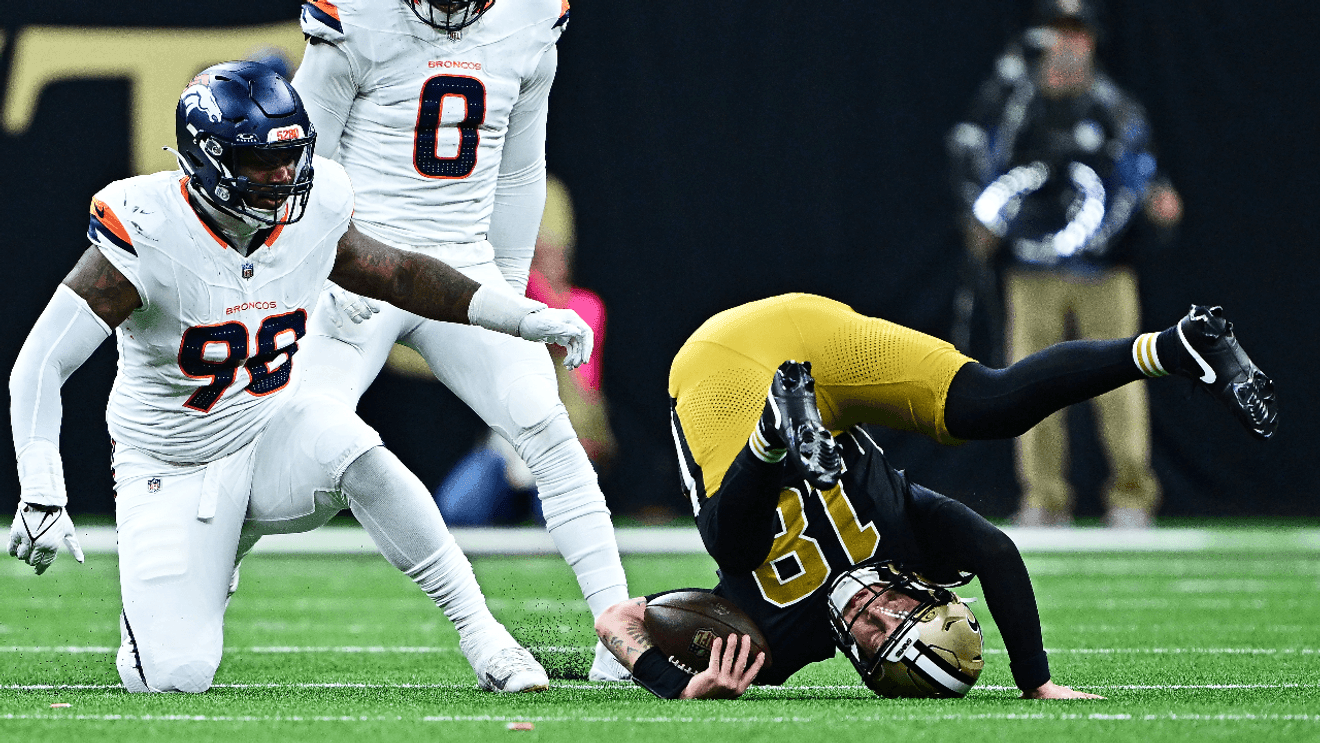
– The first priority in the exercise was adding an impact defensive tackle. That move came in the form of John Franklin-Myers on a projected $17 million deal.
The 6-foot-4, 288-pound lineman spent the past two seasons with the Denver Broncos and produced 7.5 sacks last season, ranking fifth among defensive tackles. He also ranked eighth in pass rush win rate and 18th in total pressures with 39. Franklin-Myers recorded 7.0 sacks in 2024.
– Defensive tackle David Onyemata was added on a projected $9 million deal.
The 33-year-old gave some pause because of his age, but the 6-foot-4, 300-pound lineman is coming off a strong season. He ranked ninth among defensive tackles in run-stop, or “stuff,” rate and 17th in pass rush win rate. According to Pro Football Focus, Onyemata earned the ninth-highest overall grade among 134 interior defensive linemen last season.
– Defensive end Dre’Mont Jones was added on a projected $11 million deal.
The 6-foot-3, 281-pound edge rusher recorded a career-high 7.0 sacks last season and ranked 25th among 115 edge defenders in pressures.
Myles Murphy, who finished last season with a strong second half, is projected to hold down one starting spot. The opposite edge would be a rotation between 2025 first-round pick Shemar Stewart and Jones, who provides experienced depth if Stewart does not take a significant step forward.
– Safety Coby Bryant was added on a projected $7 million deal.
The former University of Cincinnati standout has played well over the past two seasons with the Seattle Seahawks and ranked 45th among 98 safeties in Pro Football Focus’ grading system last season. For comparison, Jordan Battle ranked 61st, while Geno Stone — the Bengals’ other starting safety last season — ranked 81st.
– Linebacker Alex Anzalone was added on a projected $7 million deal.
The 31-year-old has been a steady contributor for several seasons and would provide a veteran presence alongside second-year linebackers Demetrius Knight Jr. and Barrett Carter. Anzalone ranked 32nd among 88 linebackers in Pro Football Focus’ grading system last season.
Knight and Carter struggled during their rookie campaigns in 2025, ranking 82nd and 85th, respectively, among the 88 graded linebackers. The expectation is that both will improve after spending much of last season playing side by side, but Anzalone offers experienced insurance if that development does not materialize quickly.
– Cornerback Roger McCreary was added on a projected $3 million deal to compete for the slot corner role and provide depth in the secondary.
The 5-foot-11, 190-pound defensive back was acquired by the Los Angeles Rams from the Tennessee Titans at the trade deadline. While he played limited snaps with the Rams, McCreary’s overall Pro Football Focus grade last season ranked 27th among 112 graded cornerbacks.
There was $58 million spent on defense that added a player in every position group before we even get to the draft.
Here is where I went with the draft:
– Miami (Fla.) defensive end Ruben Bain Jr. was available when the Bengals selected in the first round, while Ohio State safety Caleb Downs and Texas Tech defensive end David Bailey were already off the board.
Bain was a strong consideration, but with two former first-round defensive ends already on the roster and Dre’Mont Jones added for depth — along with upgrades made to the interior pass rush — the greater need was in the secondary.
Instead of selecting Bain, the choice was LSU cornerback Mansoor Delane.
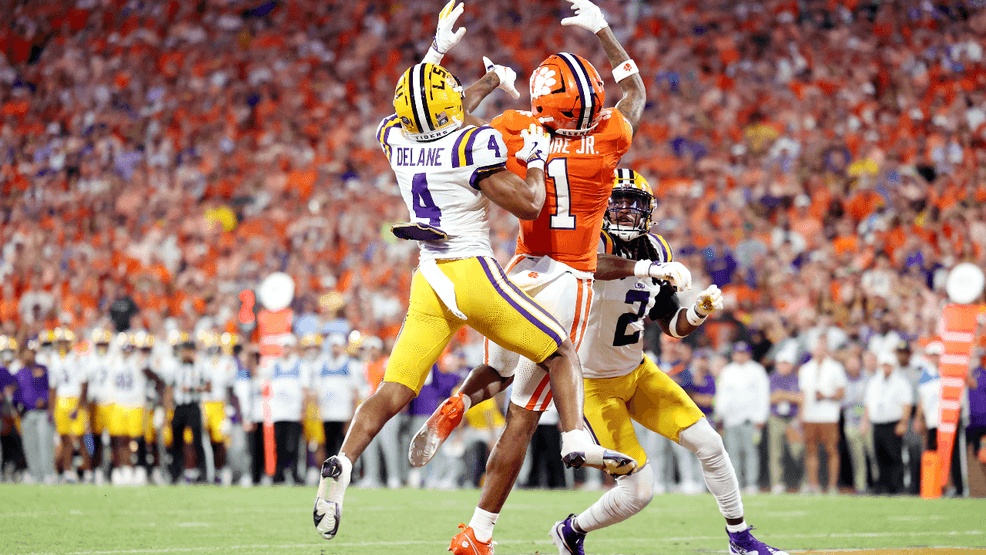
T.J. Moore #1 of the Clemson Tigers attempts to get the ball against Mansoor Delane #4 and Jardin Gilbert #2 of the LSU Tigers during the first quarter at Memorial Stadium on August 30, 2025 in Clemson, South Carolina. (Photo by Katie Januck/Getty Images)
Brugler writes of Delane: “Delane lacks elite size and length, but he has the best tape among this cornerback class. In both man and zone, he plays sticky in coverage, with the route awareness that will make him an immediate contributor.”
His NFL.com draft profile says he can play either in the slot or on the outside and the Bengals need a starting slot corner. Jalen Davis played well in the few starts he made down the stretch, but he is a free agent and even if he is re-signed he is better served in a backup/special teams role, plus I signed McCreary to add depth and competition.
– The second-round selection was Georgia defensive tackle Christen Miller.
Miller, who stands 6-foot-4 and weighs 311 pounds, is viewed as a strong presence in an even-front scheme. NFL.com draft analyst Lance Zierlein described him as a nose tackle who can create early advantages at the point of attack.
“He has good stack-and-shed against single blocks, but lacks the prototypical mass of a space-eater,” Zierlein wrote. “He’ll continue to bulk up and should become a good starter who is more consistent than dominant along the interior.”
This gives me a chance to take snaps off the 33-year-old Onyemata.
– The third-round pick continued the defensive focus with Penn State safety Zakee Wheatley.
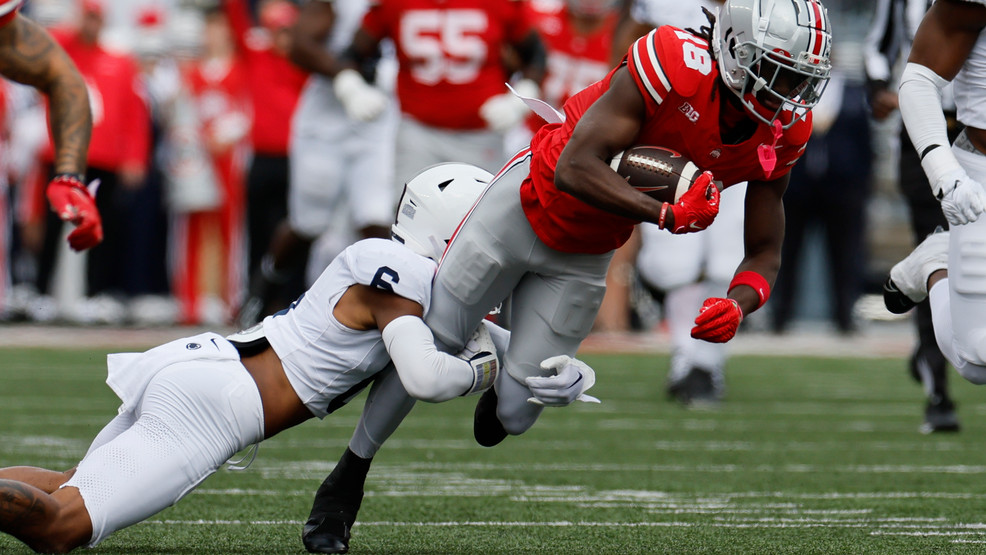
Penn State defensive back Zakee Wheatley, left, tackles Ohio State receiver Marvin Harrison during the first half of an NCAA college football game Saturday, Oct. 21, 2023, in Columbus, Ohio. (AP Photo/Jay LaPrete)
The 6-foot-3, 201-pound Wheatley has reportedly run a 4.40 in the 40-yard dash and offers versatility, including potential snaps at slot corner. According to NFL Draft Buzz, Wheatley possesses the speed, instincts and positional flexibility valued in today’s pass-heavy NFL. “Wheatley has all the tools NFL defensive coordinators covet in today’s passing league – the speed to erase mistakes, the instincts to create turnovers, and the versatility to handle multiple assignments. Watch him trigger from his deep alignment and close on intermediate routes, and you see a player who understands leverage and spacing at an advanced level. This is a solid starting safety prospect who should develop into a reliable contributor at the next level.”
He provides depth and competition for Bryant and Battle.
– The first offensive selection came in the fourth round with Indiana offensive tackle Carter Smith.
The 6-foot-5, 308-pound lineman started 31 games over the past three seasons for the Hoosiers, including all 16 games for this year’s College Football Playoff national championship team. According to NFL Draft Buzz, Smith logged 2,516 career snaps across 40 games and allowed just four sacks over three seasons as a starter — two in 2023, two in 2024 and none through the 2025 conference championship game.
Smith would provide immediate depth and versatility along the offensive line, with the potential to eventually replace Orlando Brown Jr.
The overall exercise highlights the challenges the Bengals face in balancing roster needs, salary cap constraints and long-term planning. Each move carries ripple effects, but the approach shows a pathway for Cincinnati to add enough defensive talent to potentially turn things around in 2026.