
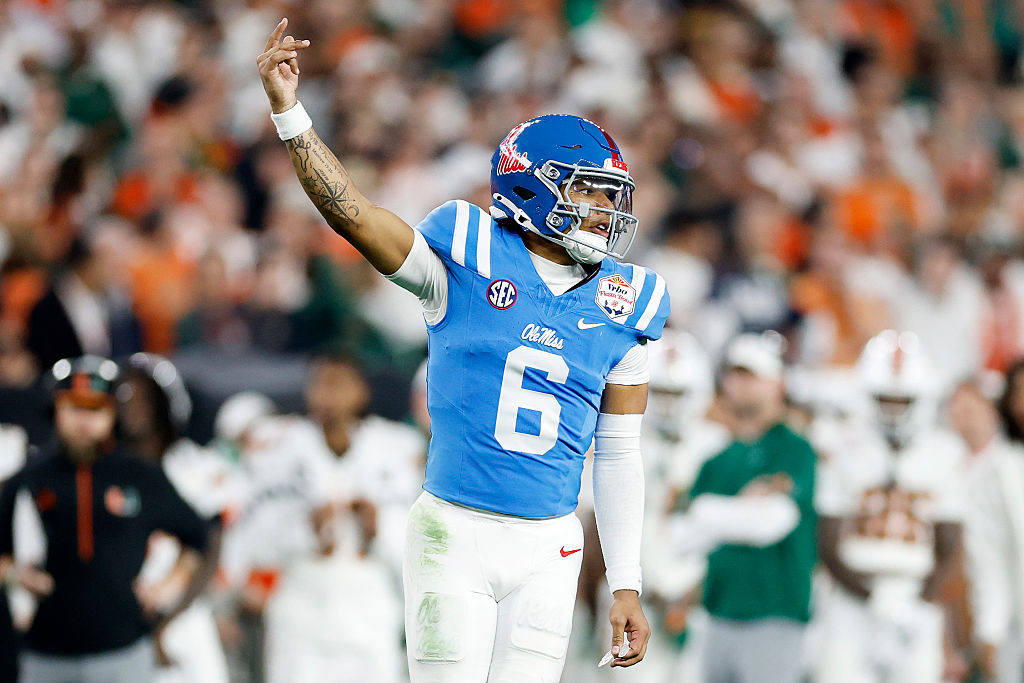
Inside a small courtroom in Pittsboro, Mississippi, the fate of Trinidad Chambliss playing quarterback for Ole Miss hung in the balance in his preliminary injunction hearing against the NCAA.
Judge Robert Whitwell granted the preliminary injunction that Chambliss was seeking, which paves a path for Trinidad to play for Ole Miss next season as this case goes through the court system.
It ended up taking a while for Judge Robert Whitwell to read his ruling, which lasted over eighty minutes. But, in doing this, Whitwell was making sure that when the NCAA appeals the decision, all grounds would have been covered.
In what has been one of the most discussed eligibility cases, outside of Diego Pavia’s hearing last year, the Ole Miss Rebels were hoping that attorneys for Trinidad Chambliss presented enough evidence to show that the quarterback should have been granted a medical redshirt in 2022 that would afford him one more year of college eligibility.
“The NCAA never really sought the truth in its investigation, and therefore, based on the totality of circumstances and evidence, Trinidad could be successful on the merits at trial.”
If folks inside the courtroom wanted an opinion of what the NCAA thought about the hearing, the organization’s attorneys left the Pittsboro, Mississippi, court before Judge Robert Whitwell could read his ruling.
This only agitated the judge, who mentioned he would decide on whether to hold them in contempt of court, saying that he told all parties that he would be working on reaching a decision before the end of the day.
“This court is of the opinion that the NCAA breached its duty of good faith and fair dealing owed to Trinidad, and acted in bad faith by denying him an additional year of eligibility,” Judge Robert Whitwell said in his ruling that lasted over one hour.
Straight Out Of A Courtroom Novel With Trinidad Chambliss
This played out like a John Grisham book, with Judge Robert Whitwell having to ask Ole Miss assistant Joe Judge to slow his testimony down at one point because the court reporter was having a hard time keeping up with the northern-born coach and his fast talking.
There was a doctor, an assistant coach, the mother of Trinidad Chambliss, and the quarterback himself that took to the stand on Thursday to argue their case as to why a clerical error by Ferris State in not classifying the 2022 season as a medical redshirt should be the reason why Ole Miss should have their gunslinger back for this upcoming year.
“I’ve struggled to find what the harm to the NCAA is,” Trinidad Chambliss attorney Trey Byars told the court in his closing argument.
As for the NCAA, they contended that Trinidad Chambliss was not impacted by his medical condition, and that this isn’t a law-abiding judgment.
“There is no evidence that Mr. Chambliss was not incapacitated in 2022… This is about law, not fairness,” NCAA attorney Doug Minor said in his closing statement.
In his ruling, Judge Whitwell disagreed with this assessment.
“Obviously, his medical issues prevented him from playing at Ferris State in 2022,” Judge Whitwell said in his ruling.
Chambliss said on the witness stand that he was under the impression that he had two years of eligibility left when he enrolled at Ole Miss, due to what coaches and administrators from Ferris State told him. Again, this all stemmed from Chambliss arguing that his medical problems prevented him from being physically able to play in 2022.
“I tried my best,” Chambliss said when asked about trying to physically get back to a healthy weight to play.
According to Trinidad, Ferris State head coach Tony Annese told him he was being medically redshirted before the 2022 season. This alone was one of the most damning pieces of testimony against the NCAA, along with what Judge Robert Whitwell said was the NCAA not taking provided medical records into consideration.
“It appears to the court that the NCAA chose to ignore the statements that Trinidad submitted from treating medical doctors and witnesses from Ferris State, who had perfect knowledge of Trinidad’s physical and medical condition,” Judge Robert Whitwell said in his ruling.
“By ignoring these letters and supporting documentation, the court is of the opinion that the NCAA erroneously and unfairly determined that Trinidad was medically and physically capable of competing in intercollegiate football in the fall of 2022, despite not playing or dressing for a single game.”
How ‘wild’ did some of the questioning get? Just after taking the stand, Trinidad Chambliss was asked by his attorney about the final play of the Fiesta Bowl, where Ole Miss fans argued for a pass interference call.
We got to this point because the NCAA denied multiple waiver requests from Ole Miss pertaining to the eligibility of Chambliss, even denying his request for reconsideration during the court lunch break on Thursday afternoon.
For over six hours, we heard testimony from four different witnesses, which included previously mentioned Joe Judge, who made multiple references under oath that Chambliss would benefit from another year of college football.
At one point, Joe Judge referenced how football players can’t be mentally prepared if they have a child, and have to get up in the middle of the night for a feeding. Yes, you’d have a hard time making this stuff up.
It was also easy to notice that the NCAA was enemy number one inside the courtroom, with the organization declining to cross-examine the mother of Trinidad Chambliss, who testified how much his health problems related to Tonsilitis, Covid and sleep apnea affected his ability to be prepared enough to participate with Ferris State in 2022.
Trinidad Chambliss Will Be The Ole Miss QB In 2026, Most Likely
At long last, around 6 p.m. ET, after closing arguments had been completed and court proceedings had finished for the day, Judge Robert Whitwell granted Chambliss the temporary injunction he was fighting for.
This will allow Trinidad to participate with Ole Miss until the entire lawsuit process is completed, which lawyers will drag out enough that it’s not completed until after the 2026 season is finished. This will allow Chambliss to play, without worrying about whether he would be taken off the field by a court ruling.
Attorneys for the now Ole Miss quarterback, once again, knew what they were doing when they filed this lawsuit in a state court, and not a federal court. Also, in my opinion, it felt as though the NCAA knew this was going to be the outcome before they even stood for the judge entering the small-town Mississippi courtroom.
NCAA Responds To Trinidad Chambliss Injunction
Immediately following Judge Robert Whitwell’s ruling, the NCAA called on Congress to come up with ways to help fight eligibility rules in college athletics.
“This decision in a state court illustrates the impossible situation created by differing court decisions that serve to undermine rules agreed to by the same NCAA members who later challenge them in court. We will continue to defend the NCAA’s eligibility rules against repeated attempts to rob future generations of the opportunity only college sports can create.
“The NCAA and its member schools are making changes to deliver more benefits to student-athletes, but the patchwork of state laws and inconsistent, conflicting court decisions make partnering with Congress essential to provide stability for current and future college athletes.”
It was the exact opposite of what transpired in Alabama earlier this week, when a Tuscaloosa judge denied the temporary injunction of Charles Bediako, making him ineligible for the remainder of this season after participating in five games following a TRO being granted by a judge who had to recuse himself due to donating to the Alabama athletics department.
Charles Bediako No Longer Eligible To Play For Alabama, As Judge Denies Injunction In NCAA Upset Win
Now, with Chambliss being granted an injunction, eyes turn to Knoxville, Tennessee, on Friday. Quarterback Joey Aguilar filed a lawsuit against the NCAA, arguing that the organization is impeding on his rights to earn a living, while also arguing that his time playing at the junior college level should not count towards his NCAA eligibility clock.
Just when you thought it would be a slow offseason in college football, the NCAA found itself at the center of more lawsuits pertaining to eligibility. In other words, just another day in college athletics.