
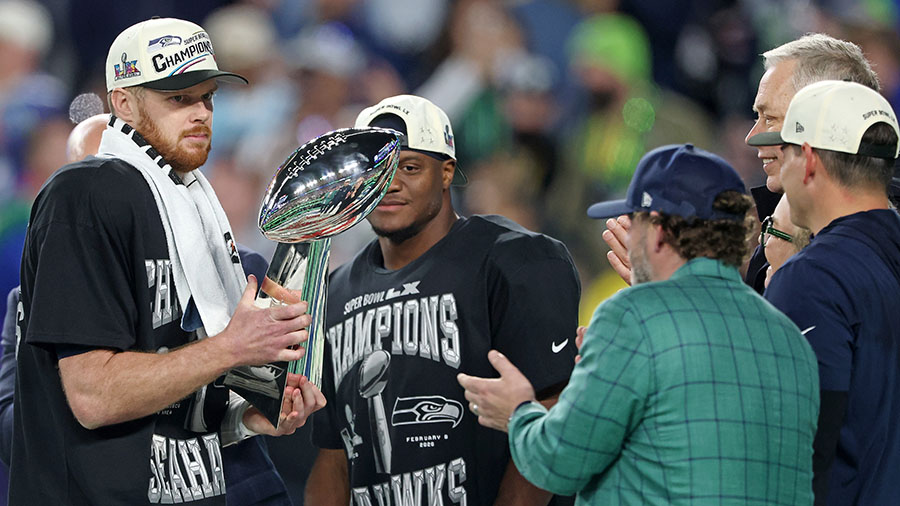
Winning a Super Bowl is hard enough. Getting back to another the following year? That feels nearly impossible. Only two teams have managed to win back-to-back championships in the last 25 years, and just three – the New England Patriots, Kansas City Chiefs and Seattle Seahawks – have even appeared in consecutive Super Bowls.
Should Seahawks consider QB trade this offseason?
But if there was a candidate to keep the party going, it’s this year’s Seahawks. They have a two-ingredient recipe typically reserved for a rebuilding roster: youth and cap space. In fact, one of the league’s youngest teams will enter 2026 with the sixth-most cap space behind the Tennessee Titans, Las Vegas Raiders, Los Angeles Chargers, New York Jets and Washington Commanders.
That’s important when it comes to looming offseason contract decisions. Because if there’s one thing we learned from a player who’s been to back-to-back Super Bowls, it’s that the single most important thing a team can do is also the most obvious:
Bring as many guys back as possible.
“For starters, we kept pretty much the same personnel. We really did,” said Bryan Walters, a wide receiver on the 2013 and 2014 Seahawks teams, when asked Thursday on Seattle Sports’ Bump and Stacy how Seattle fought its way back to the Super Bowl a second straight year. “There were not a whole lot of guys on different waves. Defensively, your core stuck together. And that’ll be the big question (for this team). What are they gonna do with the cornerbacks?”
There are a few unrestricted free agents on defense, including corners Riq Woolen and Josh Jobe, as well as safety Coby Bryant.
With eyes on re-signing (or franchise tagging) running back Ken Walker and extending reigning Offensive Player of the Year Jaxon Smith-Njigba, it’s not likely Seattle can hang onto all of those defensive weapons — something the LOB-era Seahawks were able to do with their core group.
Helping Seattle is the stability on the defensive line, the strength of this group, and the fact that two key parts of that DB room — corner Devon Witherspoon and safety Julian Love — aren’t going anywhere.
However, there’s a key difference between that team and this one, according to Walters.
“I think the difference between 2013 and this group is that if (multiple key defensive players left) in 2013, there’s a huge drop off,” Walters said.
“Let’s say Earl Thomas and Richard Sherman and Byron Maxwell were free agents after 2013. Those are three huge defenders, and if one of them doesn’t come back it’s a whole different team. Whereas this squad is built different, because if one of those guys doesn’t come back, I feel like Mike Macdonald has proven time in and time out he has the ability to just throw another guy in there… So that’ll be a key piece, but I think they can do it, I really do.”
There are the unrestricted free agents for Seattle this offseason:
• WR Rashid Shaheed
• T Josh Jones
• EDGE Boye Mafe
• RB Kenneth Walker III
• CB Josh Jobe
• CB Riq Woolen
• LB Chazz Surratt
• S Coby Bryant
• WR Dereke Young
What about the franchise tag?
This has been thrown out as an option for Walker in particular. John Schneider has only used it once in his 16 years as Seahawks general manager, which was to tag and later trade Frank Clark. Teams can tag one player between Feb. 17 and March 3, though it’s infrequently used. Once tagged, the player and team have until July 15 to reach an agreement on a long-term deal.
One note on Bryant
Per ESPN’s Brady Henderson, Seattle tried to work out a contract extension with Coby Bryant before the start of the season but couldn’t reach an agreement. With a career-high four interceptions this season, I’d doubt Bryant’s asking price is coming down.
More on Super Bowl champion Seattle Seahawks
• Seahawks sign 15 players to futures contracts
• Reports: Two Seahawks coaches getting interest for coordinator jobs
• Seahawks’ Abe Lucas hit his head on a traffic light during parade
• Seahawks cut loose as ‘best team in the world’ at title parade
• Report: Seattle Seahawks interviewing four in-house OC candidates
