
The last time a Chicago professional sports team came this close to leaving Illinois, back in 1988, Gov. James Thompson stopped the statehouse clock, against a midnight deadline, until he had the votes needed for a tax break deal to keep the White Sox from leaving Chicago and the state.
The clock is ticking again, and this time it’s the Chicago Bears that have set the deadline. The McCaskeys, who control the Bears, have put out word they need state incentives this month for a new Arlington Heights stadium or else Hammond could be their new home.
Credit the Bears with creating the leverage needed to spur Gov. JB Pritzker into action. Shortly after the Bears revealed their consideration of Hammond, Pritzker suddenly began talking cheerily about possible state infrastructure support for an Arlington Heights stadium.
Pritzker even made room on his schedule for two calls with NFL Commissioner Roger Goodell when Goodell visited Chicago for the Bears-Packers game last month. Goodell abetted the Bears’ leverage by paying a visit to Hammond, too.
Pritzker has the right idea. Losing the Bears to Indiana — a Republican-run state that has shrewdly developed a low-tax, pro-business reputation at Illinois’ expense — would be a blow to our state. It wouldn’t help Pritzker’s national political profile, either.
But Arlington Heights is not the best available option.
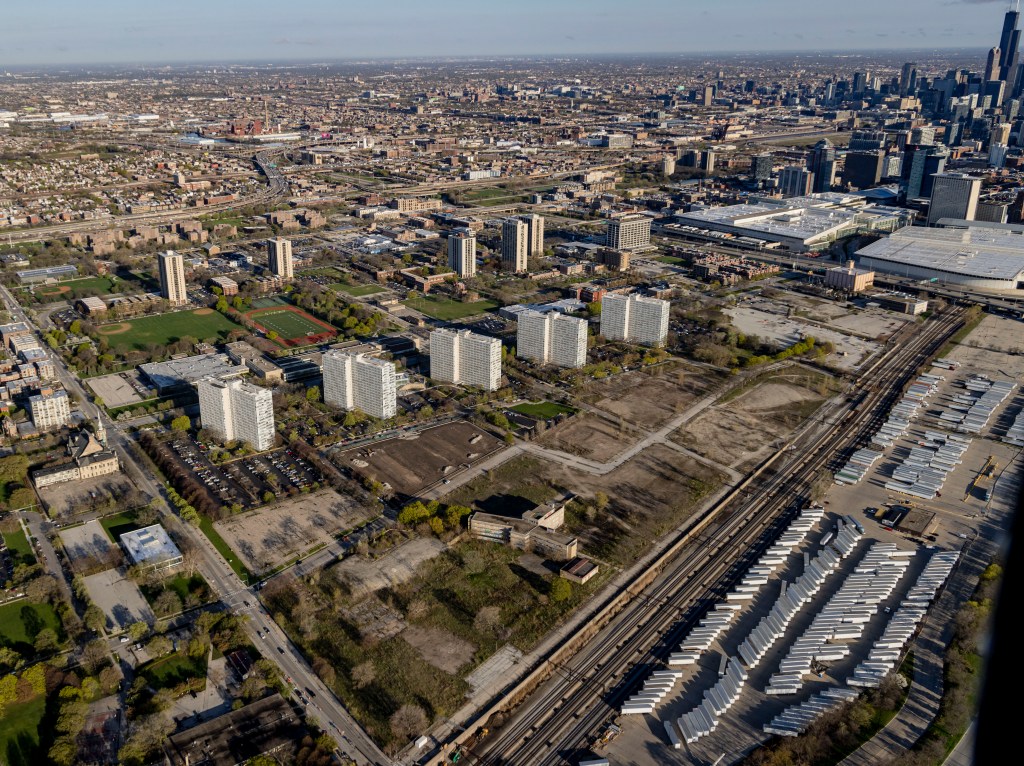
If the governor wants to do the most good for Chicago, the state’s economic engine, he could freeze the clock on the Bears’ pressure tactic and reconsider the stadium plan that makes the most sense: Build on the site of the former Michael Reese Hospital, where infrastructure spending and tax breaks could best be leveraged for public good.
It’s a long shot. And for now, the McCaskeys aren’t biting. But if Pritzker and state legislators were to handle this right, the Bears’ owners might ultimately see the Michael Reese site is in their best interest, benefits the city and state, and preserves Bears founder George S. Halas’ legacy.
It’s likely the Bears owners’ attachment to the 326 acres they own in Arlington Heights is clouding their ability to see the bigger picture of building a stadium in Chicago.
A stadium in Bronzeville could accelerate growth in a once-threadbare neighborhood that’s already beginning to experience a renaissance. It could be a bookend to Joe Mansueto’s privately funded $650 million Chicago Fire stadium at The 78, about 2 miles away. Residential, retail and entertainment development would fill in — potentially becoming a new entertainment district that builds on Bronzeville’s “Black Metropolis” history while generating tax revenue for Chicago.
When Bears President Kevin Warren in 2024 first unveiled the team’s plans to build a new stadium adjacent to Soldier Field, he laid out a vision of an entertainment mecca — a concert venue with pop star residencies; Super Bowls and Final Fours; a McCormick Place annex even.
Much of that could be realized in a Chicago stadium not far from downtown. Most of that likely would be a pipe dream for Arlington Heights.
An alternative, audacious vision for a new Bears stadium is one that starts with the vacant land on the South Side where the Michael Reese hospital once stood. It extends east to a deck built over the railroad tracks just west of DuSable Lake Shore Drive, on which the stadium itself would sit.
In terms of urban megaprojects, the numbers could be doable. Back-of-envelope estimates from boosters of a possible Michael Reese project come in like this: $2 billion from the Bears for the stadium; $2 billion from the state for the deck over the tracks, road construction and a new Metra station; and $2 billion from the city, by donating the Michael Reese land and earmarking tax increment financing funds for the project.
OK, so that’s a lot of money, and stadiums are notoriously tricky investments. And while state Rep. Kam Buckner, whose district includes Bronzeville, has said $466 million in state money could be found, that’s far short of what the backers figure they need.
But the Bears’ share could be no more costly than what they plan to spend in Arlington Heights. The state’s share is more than double the Bears’ ask for Arlington Heights — but the economic impact of a Bronzeville investment, the so-called multiplier effect, could create a return on the investment.
The city would need to contribute the Michael Reese property, true, and it likely would need to buy out the investment group GRIT Chicago that committed up to $100 million five years ago for rights to develop the land. But the Michael Reese tract currently is vacant, meaning taxes paid to the city are immaterial.
As for that deck over the railroad tracks: Yes, the ambition and cost of the project might knock your breath out at first. But consider the other two projects that have spanned those tracks over the years — the one that made the McCormick Place expansion possible in 1986 and Millennium Park beginning in 1998. Both paid dividends in the form of construction jobs, permanent employment, and revenue generated from economic growth and taxes.
Mayor Richard M. Daley marshalled private, city and state resources to cover a downtown commuter rail line with Millennium Park. What once was an urban eyesore is now the largest tourist attraction in the state.
The Bears’ search for a new stadium site could become something even larger. It could become the city’s transformative effort for the 21st century — an ambitious undertaking at the center of a community area where around 80% of residents are Black. The project could become a showcase for equity-focused public investment.
If the case for the Michael Reese site is so compelling, then why is it such a long shot? Simple: The McCaskeys, who own the Bears, do not want it.
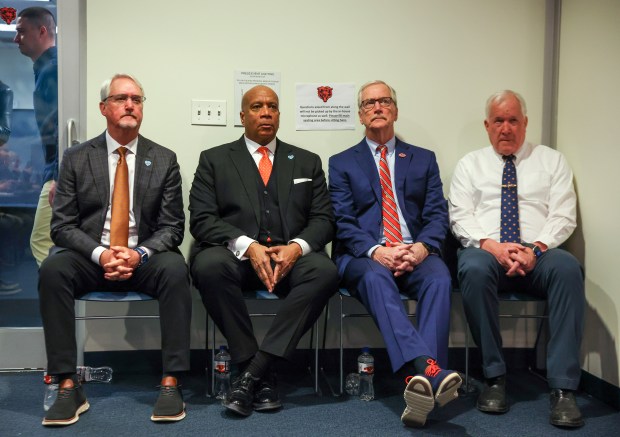 Chicago Bears leadership Brian McCaskey, from left, Kevin Warren, George McCaskey and Patrick McCaskey listen as head coach Ben Johnson speaks at Halas Hall on Jan. 21, 2026, in Lake Forest. (Stacey Wescott/Chicago Tribune)
The McCaskeys bought the 326-acre Arlington Heights site for $197 million in 2023. They promptly tore down Arlington International Racecourse, and they’re determined to build a football stadium there, to anchor a projected $5 billion mixed-use development.
That is the McCaskeys’ right. And so long as they don’t need help from the taxpayers, the descendants of Halas can do what they want with their money. The Bears are their business, not ours.
But the McCaskeys do want taxpayers’ help.
The Bears are seeking state investment in infrastructure — an estimated $855 million for roads, expressway ramps, rail and utility connections. And after wringing major tax concessions from the village of Arlington Heights, Cook County and three school districts, years before construction would begin, they are asking the Illinois legislature to pass a megaprojects bill that would enable the team to lock in property tax cuts for years to come.
The McCaskey-owned Bears have refused meetings with the investors who control the Michael Reese property and who have developed a serious, detailed plan. But these aren’t nobodies that nobody sent: They include Farpoint Development founder Scott Goodman, whose firm owns high-rises adjacent to the Michael Reese site that would need to be demolished; Jim Reynolds, CEO of Loop Capital; David Doig, a city planning department veteran; and two leading community development organizations. Quintin Primo, whose Capri Investment Group is a lead investor in a city-backed plan to redevelop LaSalle Street, isn’t a partner officially, but has begun assisting the group with outreach to the team, based on his relationship with Warren.
Pritzker and his staff have zeroed in on what the Bears want: a state infrastructure plan and passage of the megaprojects bill. But neither is guaranteed.
Only the state legislature can make those deals happen, and House Speaker Emanuel “Chris” Welch so far has withheld support. Welch typically insists on supermajorities in support before calling a bill for a vote, and he knows that’s a difficult hurdle when more than a quarter of the districts in the House are based in Chicago.
The McCaskeys in their effort to push through an Arlington Heights project have said they need to commit to Indiana this month. Pritzker told reporters this week that he takes the Bears’ threat seriously.
But the Bears’ February deadline does not stand up to scrutiny.
True, Indiana lawmakers right now are scrambling to create a stadium financing authority, which would be the first concrete step toward building a state-funded playground that the Bears could eventually purchase from the state for the low, low price of $1.
That’s a lot of sizzle. But the fact is that the only bill before the Indiana legislature to date would get very little done: Creating a finance authority is a far cry from having a concrete development package ready to go.
It’s not the same as making a firm offer to the Bears. And even if it were, could the Bears possibly evaluate and commit to a $1 billion state-owned stadium before the Indiana legislature adjourns at the end of the month? Not likely.
In short, Chicago and Illinois likely have more time to work out their side of any stadium deal than the Bears would like us to believe. And Pritzker and his staff would be well advised to use that time to find ways to help the Bears and optimize the benefit for the state of Illinois.
Mayor Brandon Johnson lacks the political skill and will to make such an audacious project come to life. But Pritzker has those traits, and a transformative project in an economically challenged neighborhood — that also happens to vanquish a Republican cross-border rival in Indiana Gov. Mike Braun — would appeal to Pritzker’s base and draw national attention.
In pursuing that aim, Pritzker could look to the Millennium Park precedent for inspiration. The lesson here: The state need not act alone.
Daley got Millennium Park done by rallying the city’s monied class, led by Sara Lee CEO John Bryan, to fund much of the project. For an investment in transforming the economics of Bronzeville, Pritzker could unleash private capital, too.
As a scion of one of Chicago’s wealthiest families, Pritzker for decades has traveled in circles with civic leaders the likes of whom made Millennium Park a reality. And while the ranks of corporations that call Chicago home have thinned considerably since then, there are enough left to make a difference: United Airlines, McDonald’s, Grosvenor Capital Management and Mesirow are headed by civic-minded leaders who could rally others to the cause.
In pushing for the Michael Reese plan, Pritzker and allies would have a simple story to tell: An Arlington Heights deal would benefit the McCaskeys almost exclusively, with the village coming in a distant second and the state hardly at all. Chicago would be hurt. A Bronzeville-based investment would benefit the Bears, the city and the state in more equal measures and drive investment toward neighborhoods and a populace that is too often overlooked.
The McCaskeys have set the clock ticking for Chicago and Illinois by pursuing an Indiana site. They are creating an Arlington Heights-versus-Indiana binary that serves their interests, but not necessarily ours. With such a monumental decision at hand, Chicago and Illinois cannot afford to ignore this viable Michael Reese alternative.
Pritzker and the state’s legislative leaders should set aside any sense of alarm and turn their attention to landing the new Bears stadium in Bronzeville — by the time the Illinois General Assembly adjourns at the end of May.
David Greising is president of the Better Government Association.
Submit a letter, of no more than 400 words, to the editor here or email letters@chicagotribune.com.