
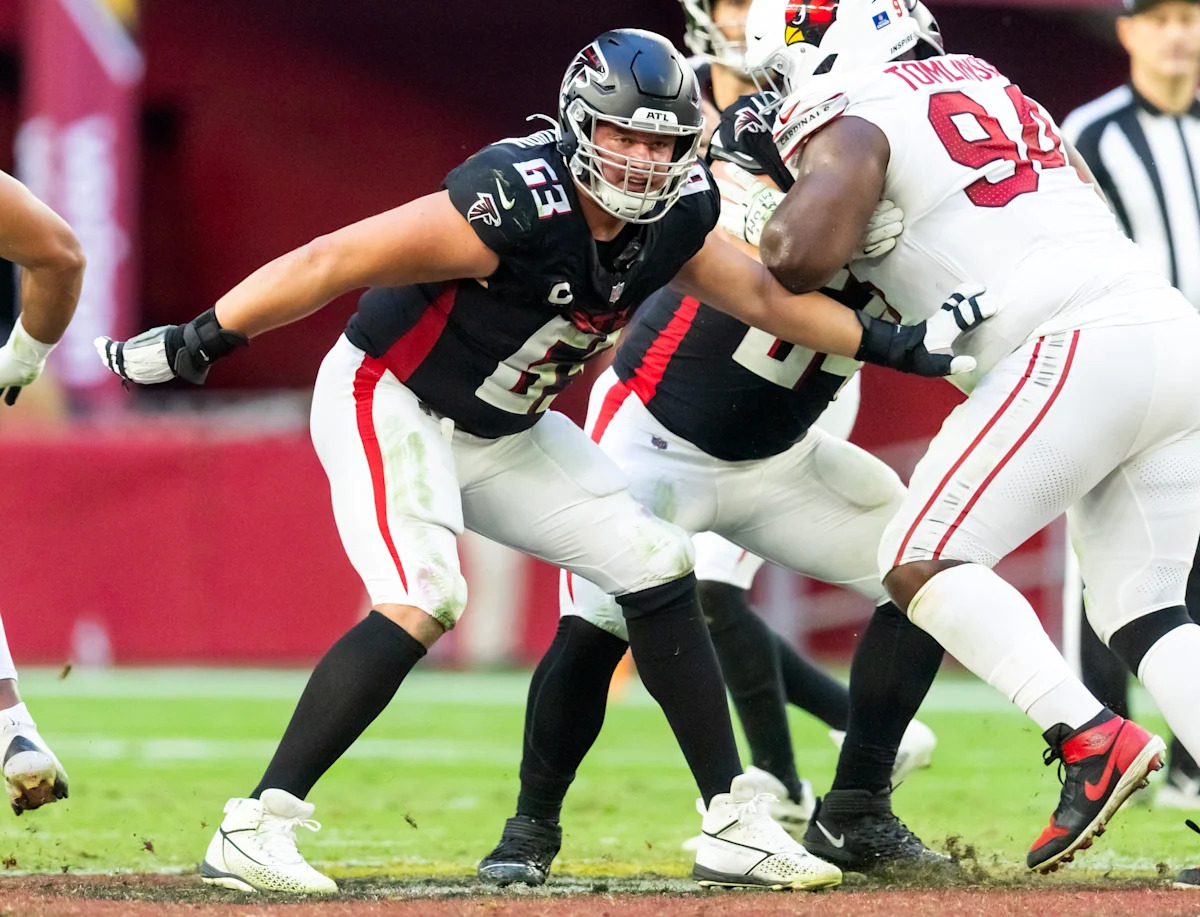
The offensive line was this team’s unquestioned strength from, say, 2022-2024. Last year, we saw signs of cracks forming in that foundation, and change now feels possible with Bill Callahan replacing Dwayne Ledford.
But even though one piece changes here and one pieces changes there, and injury took out a key starter, this line’s continuity has enabled some pretty great ground games and keep a messy passing attack from going completely off the rails for years now. It will be fascinating to see how the Falcons tackle—pun intended—their line, and whether it involves holding on to what they have or deciding it’s time to forget something new.
Advertisement
Let’s look back at 2025’s stalwarts, its one unexpected starter, and our possible outlook for the group.
Jake Matthews
He’s an ironman and will go down as an all-timer in franchise history, in the neighborhood of greats like Mike Kenn and Bob Whitfield. His pass protection remains very good, which has kept him on the field week after week, but his run blocking was less effective than it had been in recent years and he was hit with 8 penalties, tied for the third-highest total of his career.
What you’re getting from Matthews at this point in his career is above average pass protection with some struggles with power alongside it, as well as decent-to-pretty good run blocking. That’s a recipe for a very solid starting tackle, and the Falcons will take that as long as he can give it.
Advertisement
Matthew Bergeron
Next to Matthews is Bergeron, who is slowly but steadily rounding into a fine starter. Pass protection is not his best attribute, but he’s plenty solid in that regard and is a capable run blocking left guard. Critically, he went from 12 penalties in 2024 to just three in 2025, which was a big difference maker with the rest of the line struggling with discipline.
Bergeron is probably never going to be an elite guard, based on three years of results to this point, but he’s a good starter who still is young enough and talented enough to get better. With the Falcons needing to address multiple pieces of this line in the coming years, Bergeron should stick around if he’s not prohibitively expensive.
Ryan Neuzil
He was the starter I worried about the most heading into the year, but relative to expectations, Neuzil was quite good. His pass pro is not standout, but is not worse than what Drew Dalman was offering in Atlanta, and he was an effective run blocking center who moved well and opened holes. Combined with a lack of the snapping issues that sometimes plagued Dalman, Neuzil’s first full year as a starter went well.
Advertisement
The question is whether the new regime will want a different, bigger player at center moving forward, but Neuzil played well enough to justify keeping him on as the starter for another year. His path from undrafted free agent guard to quality starting center deserves props.
Chris Lindstrom
While he was named an All-Pro again, this was probably Lindstrom’s worst season since his rookie year. The fact that he still was justifiably honored tells you how good he really is, given that a dip in performance did not make him in any way a lackluster player.
He was typically elite as a run blocking right guard, and he, Neuzil, and Wilkinson were able to make Bijan and Tyler Allgeier’s jobs much easier when running up the gut or to the right. Lindstrom also allowed just one sack and cut his year-over-year penalty total down from eight to six, which was welcome when Matthews and Wilkinson were particularly struggling with penalties.
Advertisement
The problem for Lindstrom is that the one sack total does obscure the extent to which he struggled in pass protection. Pro Football Focus credited him with 35 hurries allowed, the highest single season total of his career by a full 12 and the highest total allowed on the team, ahead of Elijah Wilkinson’s 31. I should note that Wilkinson’s presence next to him could certainly help to explain such a drastic rise, but it’s not the full story. He was still a damn good guard and both Penix and Cousins having trouble with escaping and getting rid of the ball quickly did not help, but we’ll hopefully see him return to his usually steady form in pass protection here in 2026.
Elijah Wilkinson
It’s not Wilkinson’s fault that he was starting all season, and considering he was the team’s third-string option at right tackle, he played at an admirable level and remained healthy all year. The problem was that while that performance was admirable, it was obviously not great.
Wilkinson was good enough paving the way for Bijan Robinson that the run game continued to purr, even if he’s not exactly Kaleb McGary. The twin problems for Wilkinson were in pass protection, where he had effective stretches but was often overmatched, and discipline. His 12 penalties were a team-high and featured way too many drive-altering false starts and holds.
Advertisement
I give Wilkinson an enormous amount of credit for keeping the job all year and holding up as well as he did, and I’d welcome him back in Atlanta if he doesn’t land a more promising job elsewhere. I just would hope not to see him starting for a full season again.
Kyle Hinton
He actually had to play quite a bit, logging over 150 snaps as an injury fill-in. Hinton’s pass protection has been pretty solid whenever he’s forced into the lineup, but he’s a significant downgrade from Bergeron and an extremely significant downgrade from Lindstrom in terms of his run blocking. As a reserve who can and has slotted in at both guard spots and has held up well, Hinton’s welcome to stay, but I’m not sure Kevin Stefanski and Bill Callahan are going to stand pat on depth.
Jovaughn Gwyn
He played all of 11 snaps, but for the first time in his career with the Falcons, those 11 snaps looked pretty good! Given that Ledford was his major champion, there’s no guarantee that Gwyn will be back, but training to play both center and guard and having multiple years in Atlanta should ensure he has a landing spot.
Advertisement
Outlook: Solid but uncertain
I don’t think anyone besides Matthew Bergeron and Chris Lindstrom is a lock to be here in 2026, even though the chances they simply run it back are well above zero. There’s enough talent and continuity here if McGary returns to full health to talk yourself into this starting five again, especially with Callahan coming aboard to ensure the coaching remains quite good and given the team’s laundry list of other needs.
But nobody should be surprised if changes are coming. The Falcons can cut McGary and get nearly $15 million back this year and $16.5 million in 2027, even though it comes with $16.4 in dead money in 2026. If they want to supplant Neuzil as the starter and use him as an interior super substitute, his contract isn’t prohibitive enough to stop them from doing so. Matthews is a trickier thing, Lindstrom definitely won’t be cut, and Bergeron is on a rookie deal, so the two most likely changes will come at right tackle and center, if indeed any do.
If changes do not come for the starters, expect the team to shake up their depth and add players Callahan likes there. I wouldn’t expect Storm Norton to necessarily return coming off his injury, and Jovaughn Gwyn and Kyle Hinton were favorites of Dwayne Ledford, who will land elsewhere.
With a pair of aging tackles, a new coaching staff and front office, and contract decisions looming for Neuzil and Lindstrom, change is inevitable, even if it doesn’t happen all at once.