
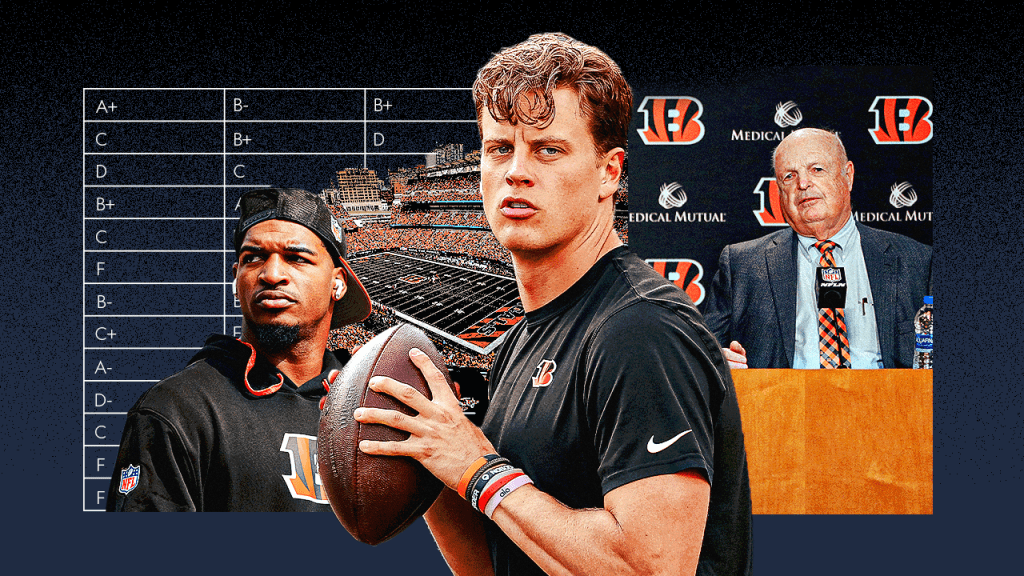
The NFL has defeated the NFLPA in a grievance over the union’s publication of annual team report cards that have sparked ridicule of some teams and owners.
As first reported by ESPN, NFL Management Council general counsel Lawrence P. Ferazani Jr. sent a memo to club executives and counsel on Friday announcing the victory.
According to the memo, the arbitrator found that publication of the report cards violates the CBA and ordered the NFLPA to refrain from publishing or publicly disclosing any future report cards.
Last November, Sportico detailed the NFL’s legal case. The league asserted that publicizing the cards ran afoul of several CBA provisions.
One provision was Article 51, Section 6, which obligates both the NFL and NFLPA to “use reasonable efforts to curtail public comments by club personnel or players which express criticism of any club, its coach, or its operation and policy, or which tend to cast discredit upon a team, player or league.”
The report cards slammed several teams with anonymous comments that accused some teams of disrespecting players’ families, employing substandard training staffs and other denunciations. For example, the Cincinnati Bengals scored an “F-”—a grade that doesn’t exist in higher ed since an “F” is a failure and isn’t modified down—for “treatment of families,” with an unnamed player criticizing team personnel.
Article 2, Section 4 and Article 39 were also relevant provisions. They contain language prohibiting certain types of public expression and contemplate a joint NFL-NFLPA survey on medical care offered by teams’ medical and training staffs. The efficacy of the joint survey and its response rates, the league argued, were compromised by multiple surveys covering similar topics.
To that point, the league claimed the joint survey’s designer, the National Opinion Research Center at the University of Chicago, expressed concern about the NFLPA’s study.
In addition, the NFL argued that the NFLPA refused to share important information about its survey, including methodology such as whether the data is weighted or averaged, and how qualitative feedback sways results. Another alleged problem was that anonymous comments lacked contextual details, such as the player’s relationship with the team when he made critical remarks.
Unlike litigation, arbitration is conducted in private, and related materials are not publicly accessible. However, Ferazani’s memo details the arbitration, at least from the vantage point of the league.
The NFLPA, the memo claims, argued that the report cards constitute union speech as protected by labor law—an argument that did not persuade the arbitrator. The memo also says an NFLPA witness “admitted” the union “reviewed player responses and cherry-picked which topics and responses to include (or not)” in the report cards and that player quotations were picked to “support” the NFLPA’s “chosen narrative.”
“In essence,” Ferazani wrote, “the record established that the report cards were designed by the union to advance its interests under the guise of a scientific exercise.”
The NFL’s decision to arbitrate reflects in part what is known in labor law as “the law of the shop.” When a union and management develop a routine or custom, there are expectations that routine or custom will be honored going forward.
This is why both management and labor try to enforce CBA provisions: failure to enforce could be interpreted as acquiescence to the other side’s violations. While some might depict the NFL as thin-skinned in challenging the report cards, both the league and union use arbitration to enforce CBA provisions.
Sportico reached out to the NFL and NFLPA for comment.
In a statement, an NFL spokesperson said the league is “pleased” with the decision, which is depicted as “upholding the parties’ collective bargaining agreement and prohibiting the NFLPA from disparaging our clubs and individuals through ‘report cards’ allegedly based on data and methodologies that it has steadfastly refused to disclose.”
The statement added that the league remains “committed to working in partnership with the NFLPA and an independent survey company to develop and administer a scientifically valid survey to solicit accurate and reliable player feedback as the parties agreed in the CBA.”