
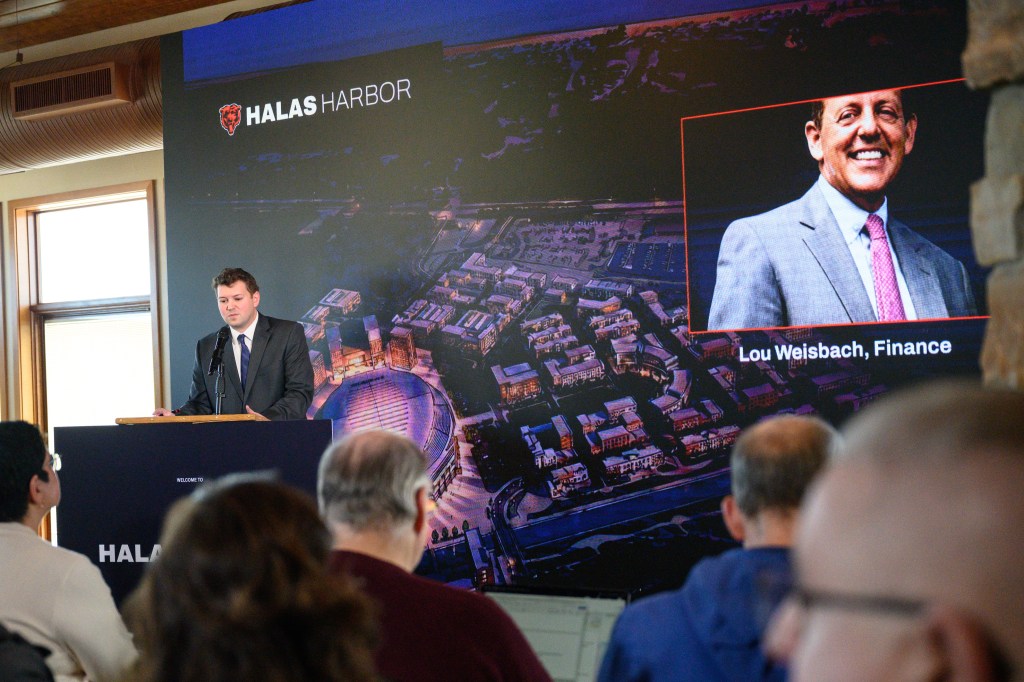
Even if the Chicago Bears hibernate at another location, Portage’s pitch for a stadium could end up benefiting the city.
Lou Weisbach, the man behind the financing for the proposed stadium, is connected with a capital C.
He’s CEO and cofounder of Stadium Capital Financing Group. He founded and was CEO of HA-LO Advertising Specialties. He’s heavily invested in fighting cancer through the American Center for Cures. Over this year’s Super Bowl weekend, Weisbach was given the Steinberg Denicola Health Humanitarian Award for health innovation as director of that charity. Weisbach has worked in politics at the national level.
“I kind of know all the players,” he said. He counts Bears President and CEO Kevin Warren as a friend.
Weisbach not only knows people and money, he also knows how to sell a product – and he’s sold on Portage.
At $5 billion for the proposed Portage stadium plus a $2 billion sinking fund, Weisbach knows who can sink that much money into the project.
“All the money comes from a single source. It’s not a lot of money for that source,” he said. And that source isn’t the taxpayer.
“There’s no public funding,” he said Thursday. “Thinking out of the box is what the future is.”
Weisbach’s method is so different from the way stadiums have been financed in the past that there are patents pending on the method.
So why Portage? “It just kind of happened because of a chance meeting I had with Andy” Maletta, executive director of Portage Economic Development Corp., who set up a meeting with Mayor Austin Bonta and others. They asked him to help in any way he could.
“It’s been joyous and fascinating,” he said.
“I know a lot about Portage for a lot of reasons,” Weisbach said. “I’m impressed with a lot about Portage, including its location and being on the water.”
The city’s leadership is “delightful, down-to-earth, easy to talk to and honorable,” he said, unlike their counterparts in some places he’s known.
Weisbach is working to build stadiums in other locations globally, but not for any of the other sites wooing the Bears. That’s a long list of suitors, too. Hammond and Gary want the Bears to come to Northwest Indiana. Arlington Heights wants the Bears; the team even bought land there. Even Iowa decided to jump on the Bears stadium bandwagon in a last-minute what-the-heck move.
Long-beleaguered Gary is serious about the Bears. Are the Bears serious about Gary?
The Bears have a decision to make, and the plethora of options isn’t making that decision easier. The team wants a 70,000-seat stadium, which means Soldier Field will have to soldier on and not Bear down. A domed stadium, like the one Weisbach hopes to bring to Portage, would make attending games in cold weather a lot more comfortable for the fans as well as the players.
The Bears would gain rent-free use of the stadium, Bonta stressed.
So what are the odds of Portage attracting the Bears?
The city’s leadership began thinking about the Bears early on, then figured there was a 1% chance of attracting the team when the Bears purchased land in Arlington Heights. But when negotiations there became more complex, Portage’s odds improved.
Weisbach is realistic about Portage’s chances and won’t give odds. “It’s only one decision-maker here,” he said.
What sets Portage apart from the other contenders is that it’s the only one that doesn’t involve taxpayer dollars.
“Logically, if this is viewed on a reasonable level, we’ve got the best proposal,” Weisbach said. Taxpayers are fed up with funding teams owned by billionaires, he noted.
Maletta, of course, agrees. He’s even magnanimous enough to say the Bears already have a nice headquarters and a training facility in Lake Forest. Portage officials would be happy – overjoyed, truly – just to get the Bears to play games in Portage.
Weisbach, the numbers guy, knows that’s only about 10 games a year, depending on playoffs. He and Portage officials vow it would be a Super Bowl-worthy stadium.
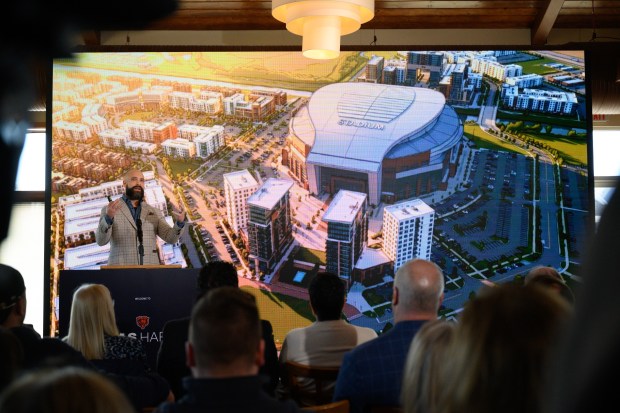 WeCreate Media CEO Wade Breitzke speaks as renderings are displayed behind him during a news conference in Portage concerning the proposed Chicago Bears stadium and development in the city on Wednesday, Feb. 11, 2026. (Kyle Telechan/for the Post-Tribune)
But it’s not just about the Bears games. The arena would be busy at other times, too.
“The numbers work,” he said, even without the Bears.
In the Chicago area, there are about 100 concerts a year, he said. There’s revenue, food and merchandising to consider. “Basically, that’s the security, the revenue for a lot of those.”
“The numbers in this case work beautifully, and it’s very exciting,” Weisbach said.
People putting up the money for major entertainment events benefit from escalation. Look at Taylor Swift 10 years ago vs. now, he said. The Portage stadium would have one of the most advanced sound systems, and Bears fans wouldn’t have the same parking issues as at Soldier Field.
“The fans will feel much safer in Portage than they do in Chicago,” he added.
What to know about the Chicago Bears’ possible move from Soldier Field
Plans for the stadium call for building a high-rise of condos for not only players and opponents to stay in the night before a game, but also top entertainers like Taylor Swift, Rihanna and others. After all, what are pro athletes if not entertainers? “We’re doing some really upscale things in that area,” Weisbach said.
The condo complex would be connected to the stadium by tunnel.
If the stadium isn’t built for the Bears, there are other professional teams that could come to Portage. A domed entertainment venue has advantages that include major concerts not being rained out. “The model works just as well to do that,” Weisbach said.
“We have a great story to tell, and there’s no holes in the story,” he said.
Bonta holds out hope that Halas Harbor, as his team calls the proposed stadium development site, will come to fruition.
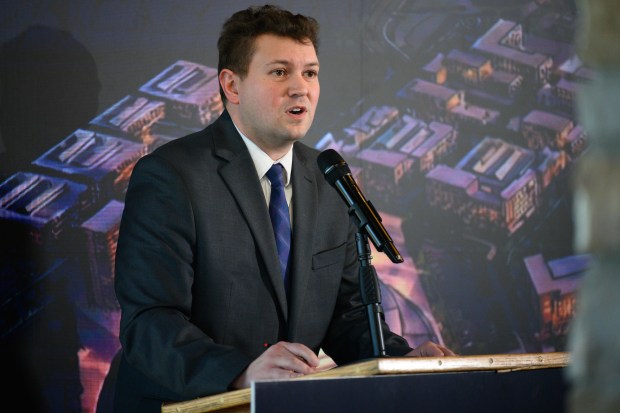 Portage Mayor Austin Bonta speaks during a news conference concerning the proposed Chicago Bears stadium and development in the city on Wednesday, Feb. 11, 2026. (Kyle Telechan/for the Post-Tribune)
“In a remarkably short period of time, Indiana has moved from conversation to credible competition,” he said in a statement Friday. “That progress represents the governor’s leadership and the coordinated effort of state, regional and local partners who recognize the magnitude of this opportunity.”
“By continuing to work together and advancing the Halas Harbor proposal through a fiscally sound, privately financed approach, Indiana has the opportunity to deliver a historic outcome that strengthens our economy, our region and our future,” he said.
Portage Redevelopment Director Dan Botich sees the city’s proposal and its Wednesday news conference as bringing positive attention to the city and its economic development potential.
The news conference brought Chicago TV stations’ cameras to the city, which cements Portage’s claim to being close to downtown Chicago – less than an hour by rail or highway, 85 minutes by boat.
People who visited that Marina Shores news conference were a stone’s throw from Indiana Dunes National Park. Portage has two beaches in the national park – West Beach and Portage Lakefront Park. The latter is the national park’s most-visited beach.
Botich dreams big. The stadium could host NCAA tournaments and others, he said.
The site is big, with plenty of room for not only a stadium but also a famous Chicago-based chocolate manufacturer and others.
Maletta said the pitch Wednesday shows the city’s thoughtfulness, professionalism and opportunities. “We know it’s a special place,” he said.
To developers, his pitch is a familiar refrain: “We’re open for business.”
“I think it’s like this. Nobody is really debating Portage has one of the best locations for a higher-density, very transit-oriented site, taking advantage of its proximity to the highways, Lake Michigan, again the water with the marinas,” Bonta said. “Everybody realizes that something amazing could happen here on the north side of Portage.”
“The fact that what’s being discussed, debated, talked about is what kind of thing do we want to have here, that’s a big change in the city of Portage,” he said.
When he ran for mayor, he talked about how the residents can have nice things. They can lure amenities.
The fact that the debate is not about whether it can happen but will happen really shows a change in Portage, he said, including confidence in the city.
“The vision for this property remains what it’s always been, essentially a smaller city based on the train, based on the water, a place where we have the opportunity to do a more walkable combination of commercial and residential that really takes advantage of the water and the train,” he said. The Marquette Greenway, a trail that will connect Chicago to New Buffalo when completed, will run through the site.
It has taken the city years to acquire the land needed for large developments to occur. Attracting the Bears would just make it all happen faster and enhance that, Bonta said. “That’s the direction of this land, no matter what.”
The city has been calling it the Hillcrest development site but began using Halas Harbor in hopes of attracting the Bears.
The city’s marina is a key part of the development site. “How do we create a stronger boating culture between the private marina, the public marina and Burns Waterway,” he said, is a challenge facing the city. “Or Bears Waterway. We may need to rename it.”
Crossing that waterway means building a bridge. “We never wanted to build a bridge to nowhere,” he said. But increasing connectivity in the city – for the Marquette Greenway as well as vehicular traffic – requires tying the site near the South Shore Line station to the rest of the city.
“Connectivity was that piece. Do we either get the bridge built with some development, even if not the other site, built on the other end, and we gradually build the rest of the Hillcrest site, or do we get another development to star on the north end and it continues south?”
“If the Bears choose our site, then we have the ability to solve the connectivity issue and the development issue simultaneously, so that’s the opportunity for us,” Bonta said.
“This has always been envisioned as a high-density, walkable site taking advantage of the highway, the water and the train. The Bears enhance that, and maybe make it happen faster, but if the Bears do not come, the mission is still to have that particular kind of development here,” he said.
“We’ve had calls about other people interested in the site now that they know it is here,” Bonta said.
Getting the Bears to play in Portage would be the big touchdown, but even a field goal is getting points on the city’s economic development scoreboard.
Doug Ross is a freelance reporter for the Post-Tribune.