
For the first time in a long time, the Las Vegas Raiders successfully landed a highly coveted coach. For years, they’ve hired retreads or candidates who weren’t highly in demand. Klint Kubiak was one of the hottest candidates in this coaching cycle, fresh off winning the Super Bowl as the Seattle Seahawks’ offensive coordinator, and when the dust settled, he was intent on coming to Vegas. Having the No. 1 pick and the second-most cap space in the league are two major selling points, but ownership competence is one of the biggest concerns for a coach with choices.
Tom Brady’s presence helped to turn the Raiders into a desirable destination. Reportedly, Brady and Kubiak hit it off talking Xs and Os in their first meeting — an advantage similar to those the late Al Davis brought to the table when he was in his prime as the Raiders owner.
With Kubiak, you don’t have to do mental gymnastics to like the hire like you had to do with the rash of previous Raider hires. Of course, we can’t judge Kubiak properly for a year or two. However, we can judge the process up to this point, and the Raiders accomplished what nearly every team tries to do when looking to hire a new head coach: getting the best, young offensive play caller available.
Play-calling ability certainly doesn’t always translate to success as a head coach, but it’s a tangible and valuable skill that Kubiak will bring. We saw the difference Ben Johnson and Liam Coen made for the Bears and Buccaneers, respectively, last year. Similarly, Kubiak will look to perform a radical turnaround for an offense that ranked dead last in several important metrics last season.
Kubiak isn’t just another coach from the Mike Shanahan tree. His father, Gary Kubiak, is one of the founding fathers of the outside zone system that is the current offensive meta in the league. The Raiders have tried to run the outside zone system unsuccessfully for years, but it was with coaches who weren’t truly entrenched in the offense. Luke Getsy tried to implement it in 2024, but he didn’t have much experience coaching in that sort of offense. Last season, a team source told The Athletic that Chip Kelly essentially had his offense hijacked by Pete Carroll and other staff members and was forced into running an outside zone system that wasn’t his.
Naturally, there was a distinct lack of details in the Raiders’ scheme and they were unable to adjust because the proper knowledge base to draw from was lacking. That won’t be an issue for Kubiak, who came up in this system. Last season is no indication of whether the Raiders have the right personnel for this system.
Kubiak majors in under-center formations and heavy-personnel sets. His philosophy is to reduce the number of snaps he asks the offensive line to pass block on true dropbacks. The Seahawks ran the ball at the highest rate in the league by a wide margin last season, but it took a while for the running game to become effective. It was bad early in the season, but a sign of good coaching is improvement as the season progresses. Kubiak’s goal is to get defenses to match his heavy-personnel sets with base defense (four or fewer defensive backs) and create explosives through play action.
The Seahawks’ running game’s efficiency remained sporadic, but they became an explosive running team by season’s end. From Weeks 1-11, they had an explosive rush rate (rushes of 12+ yards) of 6.2 percent. From Weeks 12 to the Super Bowl, that figure jumped to 9.3 percent. Those explosive runs were a vital part of their offense.
Even when they struggled to run the ball, Kubiak found ways to dial up explosive pass plays through play action, which is a good sign for the Raiders, who had the league’s worst running game last season. Through Week 9, the Seahawks had the highest explosive play rate since the Rams’ “Greatest Show on Turf” offense in 2001 (21 percent). However, defenses adjusted and started to match the Seahawks’ heavy personnel with sub personnel (five or more defensive backs), which caused a dip in production after Week 11. They eventually got back with an improved running game, as mentioned.
One of the most impressive aspects of what Kubiak did last season is understanding his players’ strengths and putting them in a position to succeed. Because of how explosive the offense was, it’s easy to forget that they didn’t have a stacked roster. Sam Darnold was a free agent who wasn’t coveted by every team with a quarterback opening, including the Raiders. The offensive line was among the worst in the league in 2024. Receiver Cooper Kupp signed with Seattle but was showing signs of decline at 32. Jaxon Smith-Njigba had a breakout season in 2024, but was the only star on offense and became a bona fide superstar playing for Kubiak.
NFC Championship Game, 12:51 remaining in the first quarter, third-and-5

In the NFL Championship Game, Kubiak lined up Smith-Njigba in the backfield to create an explosive pass play, and just a play earlier, Kupp lined up in the backfield. So the Rams were alert as Kupp motioned offset to Darnold’s left.

The Seahawks had brackets on Kupp and Smith-Njigba called and one-on-one coverage on everyone else.

Kubiak had speedster Rashid Shaheed run a go-route as Darnold’s third read.

Darnold went through his progressions, found the mismatch and threw a beautiful deep ball for the explosive pass play.
Though defenses keyed in on Smith-Njigba every week, Kubiak made it hard to double him by moving him all over the formation. Smith-Njigba was mainly a slot receiver going back to his college days, but Kubiak played him more on the outside. He only lined up in the slot on 17 percent of snaps last season.
One reason for that is all of the condensed formations in this offense. With all of the tight splits that Kubiak calls, essentially every receiver is a slot receiver because each has space for a two-way go and can use switch releases. Smith-Njigba finished second in the league in target rate (35.9 percent) and second in average yards per route run (3.68).
NFC Championship Game, 0:25 remaining in the second quarter, second-and-14

Kubiak dialed up his best high-red-zone play with just 25 seconds remaining before half on second-and-14. This time, Darnold motioned Smith-Njigba into the backfield. The Rams had a “box” call on. The two deeper players would take the two deeper routes, breaking inside or outside, and the two underneath defenders would take the two shorter routes after the route distribution.

After getting burned by Shaheed earlier, both the corner and safety were overly concerned with him running a post and ran with him. Kupp held the flat defender underneath and no one was left to cover Smith-Njigba.

Darnold found the one player everyone should have had their eyes on wide open in the corner, thanks to great design and play calling.
Obviously, he’ll be used differently, but tight end Brock Bowers will be Kubiak’s new target funnel. Bowers will line up all over the formation, including in the backfield, as Smith-Njigba did at times.
Everyone had a specific role in Kubiak’s offense. Tight end A.J. Barner was mainly an underneath target who could run after the catch and was used occasionally on shot plays. Rookie tight end Elijah Arroyo was an effective vertical threat who could burn defenses that tried to match him with a linebacker. Kupp isn’t the receiver he once was, but he’s still a physical run blocker and an effective No. 2 receiver. Shaheed could beat one-on-one coverage when teams focused too much on Smith-Njigba and was used as a gadget player.
Tight end Michael Mayer could run the routes Barner did. Bowers’ role will be a cross between Smith-Njigba’s and Arroyo’s. Tre Tucker will play Shaheed’s role, while Jack Bech will attempt to do some of what Kupp did. Adding offensive line talent should be the priority, but finding a credible receiver on the outside should also be on the Raiders’ to-do list.
There are some similarities between how running backs Ashton Jeanty and Kenneth Walker run. Both are explosive power runners with excellent balance. Kubiak didn’t ask Walker to do much from a route-running perspective, but he has reliable hands and was hard to tackle in open space, so Kubiak designed a lot of screen passes for him.
Super Bowl, 11:17 remaining in the third quarter, second-and-7

Knowing that the Patriots would be well aware of Smith-Njigba’s presence in the backfield after the NFC Championship Game, Kubiak designed a counterattack. After Smith-Njigba motioned into the backfield, the Patriots rotated a safety down to cover him and rotated the weak safety to the middle of the field.

Darnold initially looked to Smith-Njigba to draw the defense that way, but the play design was a slip screen to Walker in the opposite direction.

Without the coverage rotation to the other side of the field, the Seahawks perfectly set up a screen and Walker gained 20 yards.
It will take some time for Jeanty to become as precise with his outside zone reads as Kubiak wants him to be, but part of the beauty of this offense is all the reps that Jeanty will get running the same play. With better play calling and more built-in adjustments for the blocking scheme, the number of negative plays for Jeanty should be greatly reduced. Giving Jeanty a shot to run untouched into the line of scrimmage should unlock his vast potential.
The players who will benefit most from Kubiak’s system are the offensive linemen. They won’t be asked to pass protect as much, but they have to learn all of the nuances of a sophisticated outside zone system. Left tackle Kolton Miller is a natural fit and is already an excellent zone blocker. Where the rest of the line will fit will be the question.
There is enough athleticism in the offensive line room to excel in this scheme, but there must be major technical improvement. Rookie guard Caleb Rogers showed some promise late in the season, but he has the power and feet to play in multiple systems. Right tackle D.J. Glaze has the feet to play guard or tackle in this offense, but his technique has been wildly inconsistent.
Jackson Powers-Johnson has the talent to be the Raiders’ second-best offensive lineman. He wants to play center, but according to a team source, he struggled to make the checks and adjustments at the line of scrimmage required of a center, which is why the Raiders’ two previous staffs didn’t want to play him at center.
In Kubiak’s system, the center is in charge of setting the protection, pointing to the “Mike” linebacker, and making adjustments at the line. The quarterback has authority to change it, but the center is going make the final call a vast majority of the time. Powers-Johnson’s best fit may be at guard, where he can play freely without the burden of all this responsibility. That makes finding a veteran center a huge priority for the Raiders, especially with the possibility of starting a rookie quarterback.
Presumably, the No. 1 pick will be Indiana quarterback Fernando Mendoza. From a traits perspective, Mendoza was built in a lab for this offensive system. He has prototypical size, the athleticism to execute in the boot game and elite accuracy. However, Mendoza played mainly from shotgun and pistol his entire college career. He played in a run/pass option (RPO)-based offense last season at Indiana, so he likely will have a transition period. Also, Brady has openly talked about the importance of rookie quarterbacks to sit their first year, in which case the Raiders will need a bridge quarterback.
Though Geno Smith is coming off a season in which he played like one of the worst quarterbacks in the league, there aren’t many quarterbacks who could have functioned in last year’s offense. Kubiak said one of the reasons that he joined the Seahawks was for the opportunity to work with Smith. Kubiak could still have faith that he could bring the best out of Smith with a much more quarterback-friendly offense than the one he played in last season. Smith still has the mobility and arm talent to work in this offense.
Smith has to reduce turnovers, but Darnold was turning the ball over at a similar rate as Smith last season — Smith threw 17 interceptions and Darnold threw 14. However, Darnold was responsible for many more explosive plays, with an explosive pass rate of 17.1 percent (third in the league). Smith’s was 13.8 percent (16th).
Another area that Kubiak excelled at as a play caller that should translate to being a head coach is understanding the game flow. There were some games in which Kubiak had to be ultra-aggressive throughout, like in the NFC Championship Game, and other games in which he had to adjust, like in the Super Bowl. It was obvious that the defense would dominate in the Super Bowl, so Kubiak did a great job picking his spots for when to take shots.
Also, Shanahan tree coaches are often accused of being beholden to opening scripts — the offense can see a drop off after the first scripted 15 plays. There is an element of that to Kubiak’s Seattle offense. According to Yahoo Sports’ Nate Tice, the Seahawks ranked fifth in EPA per play in their first 15 plays of the game, but their efficiency dropped off after. They ranked 18th in EPA per play overall. They were an offense that relied more on explosive plays, but Kubiak has shown he can make adjustments and set plays up for later.
A great example of this is how he set up Barner’s touchdown in the Super Bowl.
One of Shanahan and Kubiak’s staple runs is “Zorro,” in which the tight end motions toward the play side to double-team the defensive end.
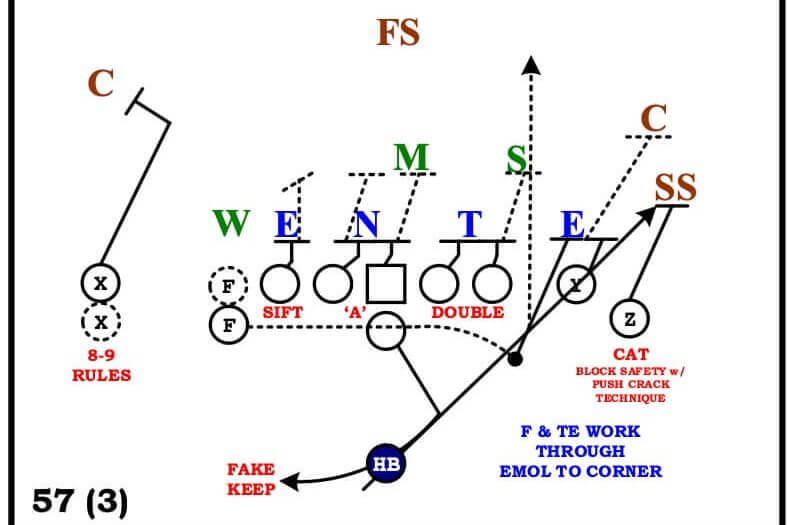
Above is a diagram from Kyle Shanahan’s 2018 playbook in which the “F” motions to the play side.

The Patriots were well aware of this play, so before Seattle even ran Zorro, Kubiak called his counter to it. Barner motioned to the offensive left, causing the linebackers to bump in that direction.

But Kubiak actually had a weak-side mid-zone (outside zone designed to hit underneath rather than outside) play called away from the motion. Linebacker Jack Gibbens (No. 51) went from lining up in the slot to the outside to off the ball inside. His momentum didn’t allow him to play the run aggressively.

Walker’s read on the play was defensive tackle Khyiris Tonga (No. 95). Walker set Tonga up with a fake inside before cutting the play to the open B-gap.
Later in the game, Kubiak did run Zorro for a short gain, but it was enough to set up the Patriots for the shot play that essentially put the game away.
14:00 remaining in the fourth quarter, third-and-9

On the play, Barner went in motion. Keeping him inside of the opposite tight end also ensured that Gibbens (No. 51) would cover him rather than a safety.

After the play fake, Gibbens bit hard, leaving Barner wide open.

Gibbins wasn’t close to Barner. Again, Kubiak created an explosive play with great design that required minimal relative skill by the players.
Again, we don’t know how successful Kubiak will be as a head coach. Predicting how a coach will do after such a promotion is as hard as drafting a franchise quarterback. All we can judge right now is the process. The Raiders hired a coach who has the perfect offense for Mendoza, the consensus top quarterback in this class. There are traits that Kubiak has shown as a play caller that look to translate to being a head coach. The Raiders are still a ways away from being a competitive team, but they should be pouring their resources into fixing their offense and supporting the edge that Kubiak brings.