
Micah Parsons or Kyle Hamilton?
When the New York Jets make their draft decision in April, they might face that very question. (And no, it has nothing to do with some mind-boggling loophole where Parsons or Hamilton will be allowed to re-enter the draft in 2026.)
Instead, these two players represent the upside of arguably the two most talented players in the pool.
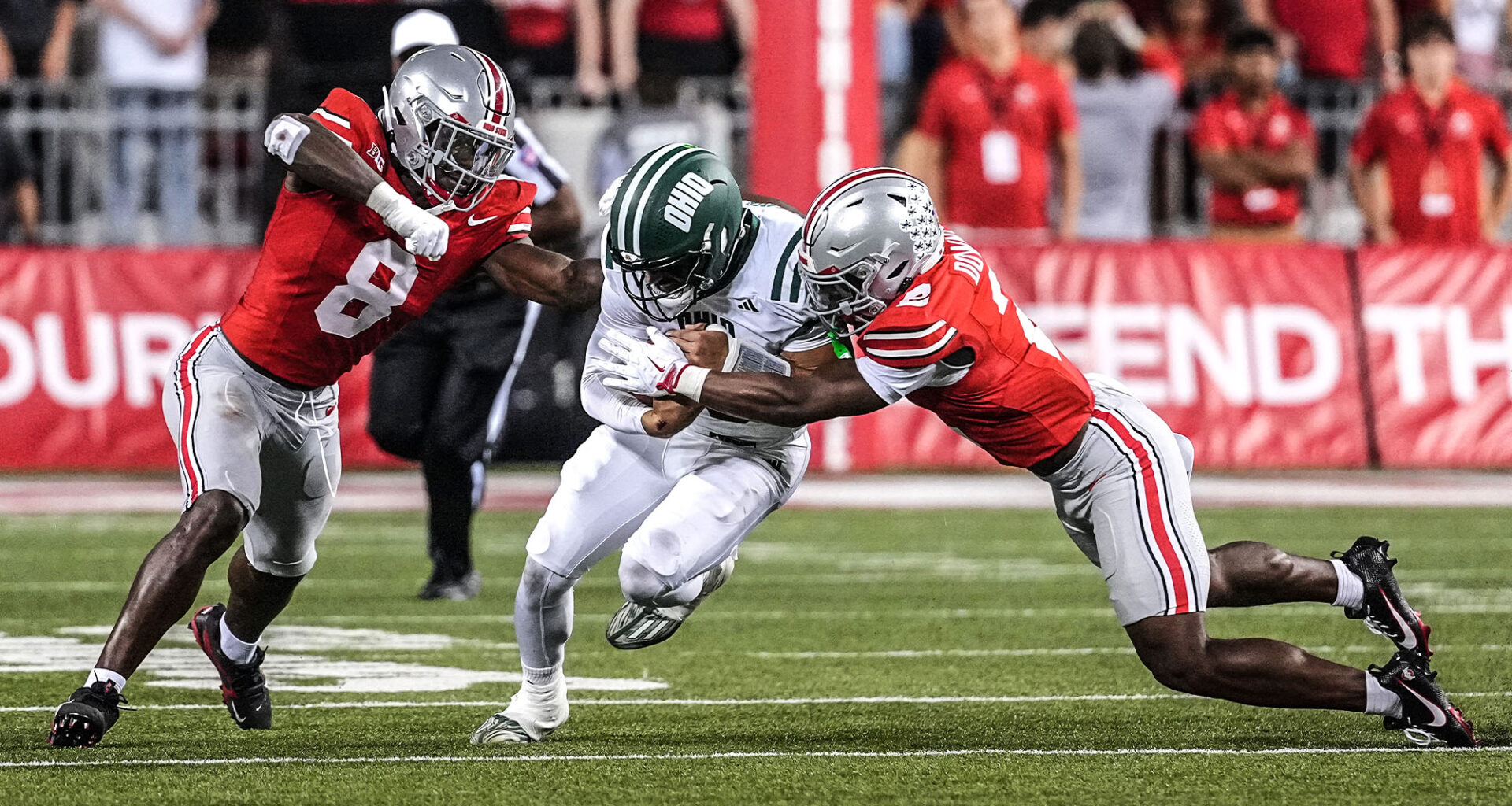
Ohio State is proudly bringing two of the top prospects to the first-round draft party, versatile safety Caleb Downs and destructive edge/off-ball linebacker Arvell Reese. Both were standouts on one of the best defenses in the nation last season, and both share a similar likeness to the play of some of their aforementioned NFL comps.
The hard part for New York is figuring out which kind of player they should take with the second overall pick and how each prospect’s position factors into the equation.
Jets’ draft strategy at No. 2
When it comes to a player like Arvell Reese, scouts have drawn comparisons to the current Green Bay Packers All-Pro because he has explosive raw pass-rushing ability and potential to play both at the line of scrimmage and off the ball. His range makes him the best kunebacker to come out since Parsons in 2021.
Downs, on the other hand, has similarities to Hamilton in Baltimore because of his combined high-low skills: coverage ability and strength to play inside the box.
The Jets may want to play multiple fronts this season, and having a chess piece like Downs to move around isn’t to be taken lightly.
Fun question I’ve been asking to scouts: “Caleb Downs is the best safety prospect you’ve personally scouted since….?”
A few have answered “Ever” https://t.co/6jOUZWe677
— Dane Brugler (@dpbrugler) February 12, 2026
While Reese and Downs clearly have the upside of two of the league’s best, they also carry the potential to resemble prior situations New York has experienced.
Vernon Gholston was a 2008 draft pick whiff of epic proportions. As an athletic linebacker who just couldn’t find a role in Rex Ryan’s defense, and Eric Mangini’s Bob Sutton-led scheme before it, Gholston — another Ohio State product — busted in an overwhelming fashion.
At the so-called do-it-all defensive back level, Jamal Adams was once an All-Pro safety in New York, but he ended up being nothing more than an overpriced box safety. Hey, at least he was never a Buckeye, right?
However, for each Gholston or Adams the Jets have experienced at the NFL draft, there’s a truly dominant game-changer available.
It begs the question: Who should be valued higher, Downs, the safety, or Reese, the edge player, with the second pick?
The verdict
Both Ohio State superstars can operate in the kind of multiple defense the Jets seemingly want to run this year. Head coach Aaron Glenn can use either defender anywhere on the field to confuse quarterbacks and make big plays.
The Jets can’t really go wrong with either prospect.
However, there is such a thing as positional value.
Deploying an off-ball linebacker who can rush the passer like Parsons is something that kills two birds with one stone. It’s a kind of value that is quantified by defensive player of the year awards and big-time dollars spent.
The safety position, though, is still struggling to regain the value in money and respect it once had. Hamilton is one of the few safeties actually worth the kind of extension he received when he locked in a four-year, $100 million deal last August with the Baltimore Ravens.
If the Jets are splitting hairs, it could make more sense for the team to take a player like Reese over Downs with the hope of finding dependable safeties later in the draft, or even in free agency.
Speaking purely about the level of prospect each player represents — Arvell Reese and Caleb Downs — the conversation is uber-worthwhile. If the conversation features a debate between Micah Parsons and Kyle Hamilton-type players, it’s clear the Jets are poised to select arguably the best prospect in the player pool.
At the same time, due to the undoubted potential each player possesses, the New York Jets’ decision at No. 2 could have game-changing ramifications.