
The Green Bay Packers exited last April’s draft having made eight selections. Now those rookies all have a year under their belt. Although that class hasn’t made its impact felt on the field, in many cases, it wasn’t their fault.
The 2025 draft class’s contributions need to be taken with a grain of salt because they are somewhat misleading.
NFL.com came out with a piece grading every team’s 2025 draft class. The Packers ranked dead last, earning a D+. The explanation made some sense, but didn’t tell the whole story, particularly with first-round pick Matthew Golden.
With the 2025 draft taking place in Green Bay, the Packers finally scratched a 23-year itch, spending a first-round pick on a wide receiver for the first time since they took Javon Walker back in 2002. Outgoing team president Mark Murphy announced the selection in the shadow of Lambeau Field, working Packer backers into a frenzy by appropriately milking the moment, and Matthew Golden immediately appeared on stage to soak it all up….
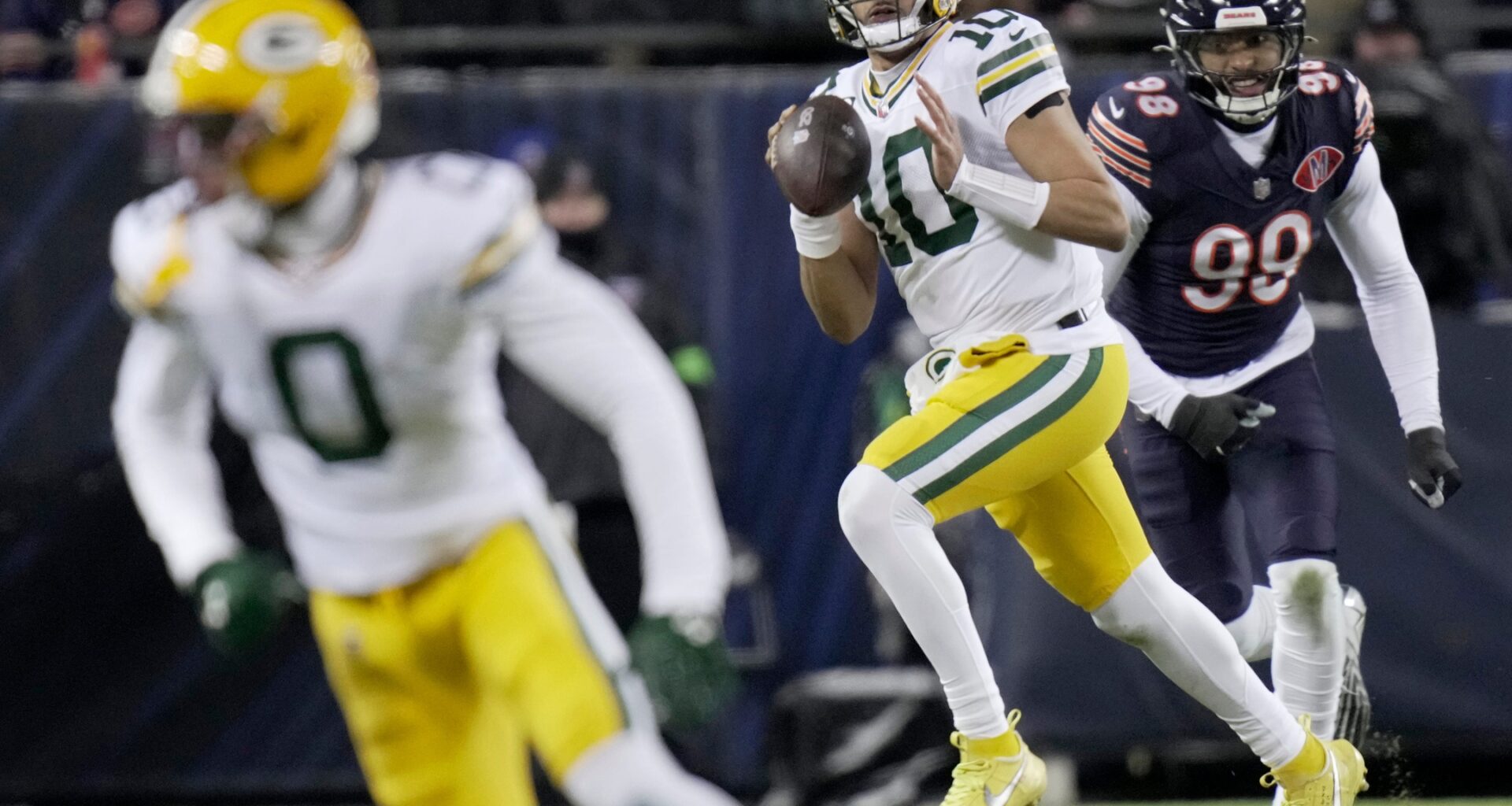
In hindsight, that feels like the highlight of the wideout’s first year with the Pack. OK, Golden did finish the season on a high note, catching four passes for 84 yards and his first NFL touchdown in Green Bay’s Wild Card Weekend loss at Chicago…. In Weeks 8 through 18, the rookie caught a grand total of 11 passes for 112 yards.
The numbers are the numbers, but when the Packers threw Golden’s way in his rookie campaign, he made plays. He didn’t have many sequences or individual plays where he made catastrophic errors. Dropped passes were never an issue. Golden’s biggest problem was that he landed on a team that always brings along pass catchers at a super slow speed.
The most bizarre part was that Jayden Reed exited in Week 2 and didn’t return until Week 13, while Christian Watson missed the first six games of the season rehabbing a torn ACL. The Packers had a crowded wide receiver room, but it was also missing key contributors for large chunks of the season.
Looking at the pass-catchers as a whole, when tight end Tucker Kraft went down for the year halfway through the season with a torn ACL, they lost Jordan Love’s most effective weapon. Still, Golden could never get Matt LaFleur’s attention enough to be incorporated into the game plan in a significant way. If the group had been healthy from start to finish, it would’ve made some sense, but that was not the case.
If you want to label Golden’s season a dud, have at it. But there needs to be some consideration of the context, because he was solid when the ball came in his direction.
Second-round pick Anthony Belton played in 14 games and started seven of them, primarily at right guard. Belton logged 487 total snaps, 392 at right guard. Coming out of North Carolina State, Belton had played 40 games in college with 32 starts at left tackle.
Of course, the Packers saw some versatility with Belton and utilized it when injuries reshuffled the offensive line. Belton was mostly fine, given the circumstances. He was never a glaring weakness, which is a genuine accomplishment for a rookie offensive lineman playing out of position.
Next in line was Savion Williams in the third round. Like Golden, he was a wide receiver whom the Packers didn’t use much in the offense. Williams’ biggest role came on special teams as the kick returner, where he was fairly unspectacular. Yet again, his lack of production has more to do with the offense’s function than with Williams being a bust.
Green Bay doubled up on the edge in the fourth and fifth rounds. The latter of those two picks, Collin Oliver, played only one game after spending most of the season on the shelf. After just one year, it’s impossible to know what the Packers have with Oliver. As for Barryn Sorrell, the fourth-round pick, he played in 14 games but only logged 178 snaps.
It’s somewhat fair to look at Green Bay’s picks from last April and conclude that their collective Year 1 was less than ideal. Outside of Golden’s performance in the playoffs against the Chicago Bears, they didn’t make much noise. But that lack of impact is largely due to injuries (Oliver and Williams) and limited opportunities (Golden, Williams, Sorrell). The reality is that the merits of this group are largely to be determined, and Golden, Belton, and Williams should all have bigger roles in 2026.