
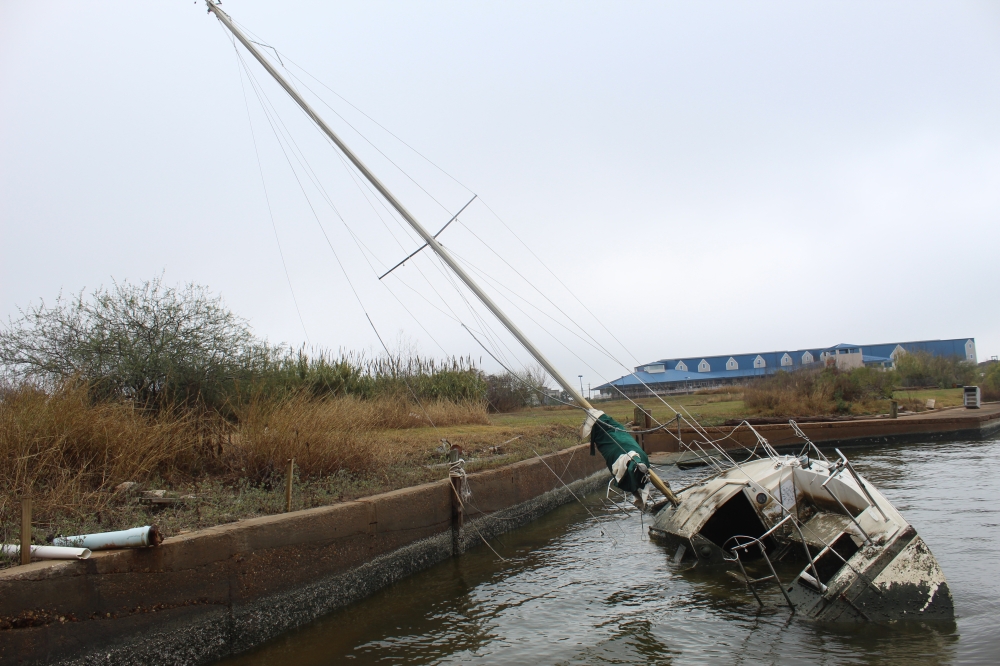
Clear Lake resident Russel Lavigne recalls seeing a sunken sailboat in a highly trafficked area of Clear Lake. All that remained visible of the boat was the mast towering above the water.
“On rainy days, on cloudy days, nighttime and foggy conditions, you could barely see it, and it was a highly trafficked area,” Lavigne said.
Current situation
Lavigne vented his frustrations on social media, where he learned that many others shared his concerns about abandoned boats, prompting him to call a public meeting.
“Lo and behold, 50 people showed up to the first meeting,” Lavigne said.
Eventually, that meeting transformed into an organization called Citizens Against Derelict Dumping, which later became Dead Boats Society, a 501(c)(3) nonprofit, in 2024.
Collectively, Dead Boats Society raised enough money to retrieve the sailboat for $5,000, which is half of what it normally costs, thanks to partnerships with local tow boat companies. It can cost as much as $20,000 to remove boats, depending on the type of boat, Lavigne said.
To date, the organization has helped remove seven boats, Lavigne said.
Failure to remove these boats results in dangerous, invisible hazards for other boaters, said Phillip “Capt. Pip” Bauerlein, owner of Tugboat U.S. Clear Lake and Galveston. For example, the disintegrated remains of a 40 foot houseboat now lie underwater, completely invisible from the surface but capable of damaging other vessels that might run over it.
The Oil Spill Prevention and Response Act of 1991 authorizes the Texas General Land Office to remove and dispose of abandoned and derelict vessels in Texas coastal waters. However, despite having the authority, it is not legally required to remove derelict vessels, according to the agency’s website.
The GLO does not receive specific funding to remove and dispose of abandoned vessels, which can cost upwards of $1,500 per foot, depending on the size, type and placement of the vessel.

Breaking it down

Measuring the impact
Bauerlein said pirates were responsible for how many boats were sinking, as well, because they strip abandoned boats for valuable items, such as batteries or the motor, leaving the boat to sink after it fills up with rainwater.
The process of removing these “dead” boats is paralyzed by state-level inefficiencies and a lack of financial support, Bauerlein said.
Even after the GLO determines a boat is abandoned, the agency must wait for the Texas Parks and Wildlife Department to issue a certificate to authorize removing the boat—a process that can take months.
In their own words
“Even though we may believe a boat is abandoned or derelict, the state’s lawyers still have the final say as to whether they believe that [it] meets their definition of abandonment,” Lavigne said. “We don’t always see eye to eye on that.”
“Since tracking began in 2006, the [Texas General Land Office] has tracked 1,857 derelict vessels in 18 coastal counties,” Texas GLO Press Secretary Samantha Wharry said.
“We ran all over the lake and growing up, we water skied out here. We swam. We played, and it just frustrates me to see these junk boats,” Bauerlein said.
What happens next?
Bauerlein, who grew up on Clear Lake and navigated the area’s waters for years, said
the COVID-19 pandemic triggered a massive increase in abandoned boats as more people wanted to get into boating as a hobby. However, they were unaware of the costs of maintaining and storing a boat, which Bauerlein said generally runs 10% of the boat’s value.
“When money gets tight, you know you’re paying for the house, you’re buying food, everything else is secondary,” Bauerlein said.
Lavigne said boat owners who can’t afford marina storage often give their vessels to someone who will live aboard full-time.
“They’ll come get it for free, and they won’t document it or have insurance or anything, and they’ll bring it out to the middle of the lake, and then they’ll anchor that boat,” Lavigne said.
In December, League City passed an ordinance creating a formal permit system for liveaboard boats requiring annual renewal and routine safety and sanitation checks in an effort to keep track of abandoned boats, according to previous reporting by Community Impact.
League City Mayor Nick Long said he toured the lake with the GLO and was told there were at least 26 abandoned boats at the time, prompting him to reach out to other coastal communities to work on a solution.
“We don’t want … those boats to be pushed out in the lake to where it becomes everybody’s problem, and so we’ve established the procedures behind that and established how we’re going to get ahead of this,” Long said.