
 Until Saturday Newsletter 🏈 | This is The Athletic’s college football newsletter. Sign up here to receive Until Saturday directly in your inbox.
Hey, you big star. This is a college football newsletter just for you. Let’s get right to it.
Big MAC: Sacramento State joined the … what?
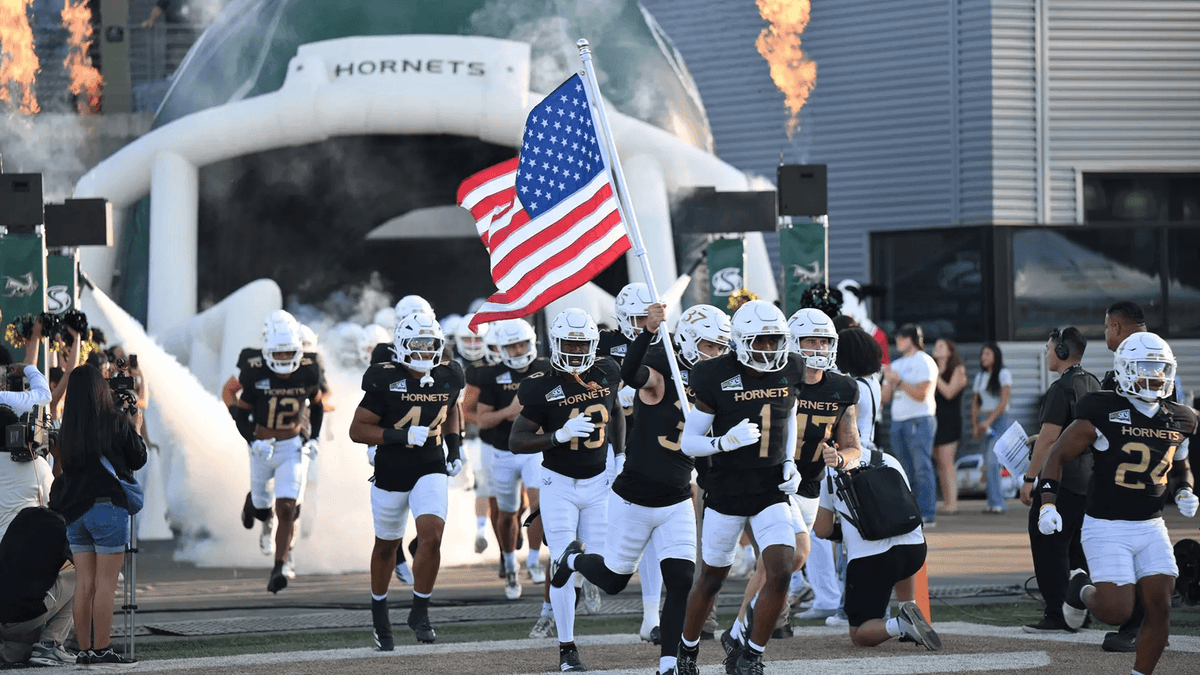
The MAC, a conference mostly based in and around Ohio, is adding Sacramento State from the FCS’ Big Sky Conference, as announced yesterday. It’s doing so on “a five-year term,” whatever that might mean. The Hornets seem to believe they’ll be in the NFC West by then.
As with Mountain West newcomer North Dakota State, Sacramento State’s move is happening immediately for the 2026 season, meaning it isn’t allowed to play in the FBS postseason for two years.
But unlike NDSU (and successful FBS newbies like Appalachian State and JMU), the Hornets were not big winners during their 33 years in FCS. Only two playoff wins, though both were in the 2020s. No semifinals since 1988, in Division II. After last season’s 7-5 finish, head coach Brennan Marion left to become Colorado’s OC. Local rival UC Davis has long been a superior program.
All realignment moves are ultimately about money, but this move is extremely about money. Sac State is expected to pay $18 million to join the MAC, $16 million more than Northern Illinois is paying to join the Mountain West. A key seven words: Yesterday’s MAC statement touted Sacramento State’s “record of investment” and “commitment to continued growth.”
For years now, Sacramento boosters have heavily promoted those investments, at one point trying to tempt the Pac-12 with talk of an Ohio State-sized NIL budget. 🤨
This week, school president Luke Wood claimed the MAC move will deliver “an estimated economic impact of $975M and national broadcast value of $675M over the next five years.” 🤨🤨🤨
(Joining the NFC West would add eight figures to the Hornets’ value, sure. But the MAC’s current ESPN deal reportedly pays about $8M per year … for the league’s 13 teams to split. Elite teams in the Big Ten and SEC might fall halfway short of $675M in five-year TV money.)
Beyond that diamond-eyed math, I can see some logic. Stakeholders believe they have the financial power to create a champion where there isn’t one, and they believe their metro population of 2.4 million people will begin falling in love with it. (Over the last few years, the Hornets have ranked around 12th in FCS in attendance, rarely selling out their 21,000-seat stadium.)
Neither the Pac-12 nor the Mountain West were interested enough to add Sac State, and the NCAA declined its request to join FBS without a conference invite. (In 2017, it approved such a request for Liberty, a program that had won a bit more consistently in FCS.)
So the idea appears to be: Buy a ticket into the weakest FBS conference, flood the field with NIL cash and quickly springboard into the Mountain West or Pac-12 and beyond. Money powered JMU’s rise, after all.
Sure. There is a dollar amount that could convince any five-star to move to the radiant city of Sacramento. And sure, gathering enough of those players on one roster would mean dominating the MAC. Maybe the Pac-12 and Mountain West will look silly for not buying in, then watch as the NFC West bids against the Premier League and Marvel Cinematic Universe for the Hornets.
But as “The Audible” discusses today, this whole thing just feels like a pyramid scheme.
Quick Snaps
🤨 “Once upon a time, extra years granted were strictly based on season-ending injuries. Now, athletes should be able to dissect loopholes within the archaic NCAA eligibility system.” FAQs about all these high-profile players suing their way back to school, answered.
🧢 It’s 2027 recruiting season! So far, Oklahoma and Texas A&M have impressed the most important teenagers. Everything to know, for now.
📈 “He was like what he is now, except 20 pounds lighter and goofier.” Bruce Feldman on how a two-star QB turned into a Heisman winner and likely No. 1 NFL Draft pick.
What’s the world’s hardest coaching job? In our panel on a variety of sports, Ralph Russo nominated Alabama, where every day means having to live up to Bear Bryant and Nick Saban.
📰 News:
“Yale football head coach Tony Reno has stepped down for health reasons, just months after leading the Bulldogs to a Football Championship Subdivision playoff win.”
“BYU expelled former football standout Parker Kingston from the university Friday night after he was arrested and jailed earlier this week on a felony rape charge.”
Cartography: Conferences have become total messes
With the MAC annexing part of California, almost every FBS conference has now added at least one team far outside its traditional geography. The MAC had begun to feel special for resisting the call to establish an outpost on a far-flung moon (though I suppose it’s time to remember that random blip when UCF was a MAC member).
The worst parts of this geographic jumbling happened in the last few years, when the SEC continued mudsliding into the Big 12’s old turf, the Big Ten devoured the heart of the Pac-12 (the biggest Rubicon, IMO) and the ACC sought every coast except the Atlantic. All of that is why the Mountain West claimed DeKalb, Ill., (elevation: 880 feet) and Texas State gets to frequently visit Pullman, Wash.
But this border gore has been ongoing for a couple decades. Compare the current setup to, say, 2004, when the ACC hadn’t yet taken northern schools from the Big East and the Big Ten hadn’t launched 2010s realignment by claiming Nebraska, one of several schools that told the Longhorns to shove it.
I calculated the geographic midpoint of each FBS conference, comparing 2004 to 2026. Using advanced technology (doodling in Paintbrush on Google Maps screenshots), I am sharing those midpoints with you. Tap to zoom.

That extremely well-designed map doesn’t account for the Mountain West’s Hawaii, an obvious geographic outlier, and it doesn’t display the Western Athletic Conference, which dropped football in 2012. RIP.
The point is: Almost every conference is slopping its way toward a soupy mishmash in the middle of the country, like they’re all sliding toward a hole in the earth. The ACC’s center is no longer Tobacco Road, but somewhere in Kentucky. The Big Ten drifted from Chicago to Omaha. The Pac-12’s new coast is on Great Salt Lake.
The Sun Belt is the only real exception, having now defined itself as FBS’ actual Southeastern conference, partly by losing its former oddballs like Idaho and New Mexico State. Thank you, SBC, for becoming FBS’ only honest league.
Also, don’t be fooled by the Big 12’s midpoint remaining basically unchanged. Its longest drive used to be Colorado to Texas A&M (14 hours) … and is now UCF to Utah (34 hours). Far away!
Technically, even Conference USA moved midward despite changing its entire roster in the meantime. But nobody should be mad at CUSA, merely a helpless passenger. (Its epic membership timeline is one of my favorite Wikipedia graphics.)
For over a century, college football had regional identities. Then we kept watching it change. We had no idea how great it was, since we never had reason to suspect there would one day be Washington-Maryland conference games, let alone that it would pressure smaller leagues into crafting their own bizarre artwork.
Anyway, end on a happy note: The top comment on every post (including ours) about Sacramento State joining the MAC is by someone celebrating the imminent Ball-Sac rivalry. What a Tuesday night kickoff at 5 p.m. PT that’ll be!
That’s it for today. Other than sports stuff, the only things I know about Sacramento are things I’ve learned from Tom Ziller, “Lady Bird,” Blackalicious and the Deftones. Email me at untilsaturday@theathletic.com if you have Sacramento lore the people should know about.
Love Until Saturday? Check out The Athletic’s other newsletters, too.