
The Washington Commanders need to get younger. They need to get faster. They need a better pass rush and a more reliable secondary. They need more pass catchers, a more consistent run game and more playmakers across the roster.
They need a rebuild, a buzzword that has been affixed to this team almost annually.
As general manager Adam Peters and coach Dan Quinn enter their third season in Washington, the stakes are higher than ever to correct the mistakes of 2025 and rediscover the team’s path from 2024, when it appeared to be a franchise on the rise.
The good news is that Washington has its quarterback and a solid offensive line, two of the most important positions for any contending team and two of the more difficult ones to fill with long-term solutions.
But nearly everything else on the roster needs work. Some of the biggest holes could be filled in free agency, which starts March 11. But the franchise’s future rests with its draft picks. The Commanders have only six picks this year, after giving up their second- and fourth-round picks to the Houston Texans in a deal for left tackle Laremy Tunsil.
It’s wayyyyy too early to know who Washington will select, or if it will cut a deal to trade back and collect more picks. Given the Commanders’ long list of roster needs, nearly everything should be on the table. Here’s my best guess at how the upcoming draft could go for them, without knowing how free agency will first unfold.
The exact order of the Day 3 picks will not be set until the league announces the compensatory picks, which begin at the end of the third round. So Washington’s exact pick spots in rounds 4 through 7 are still subject to change.
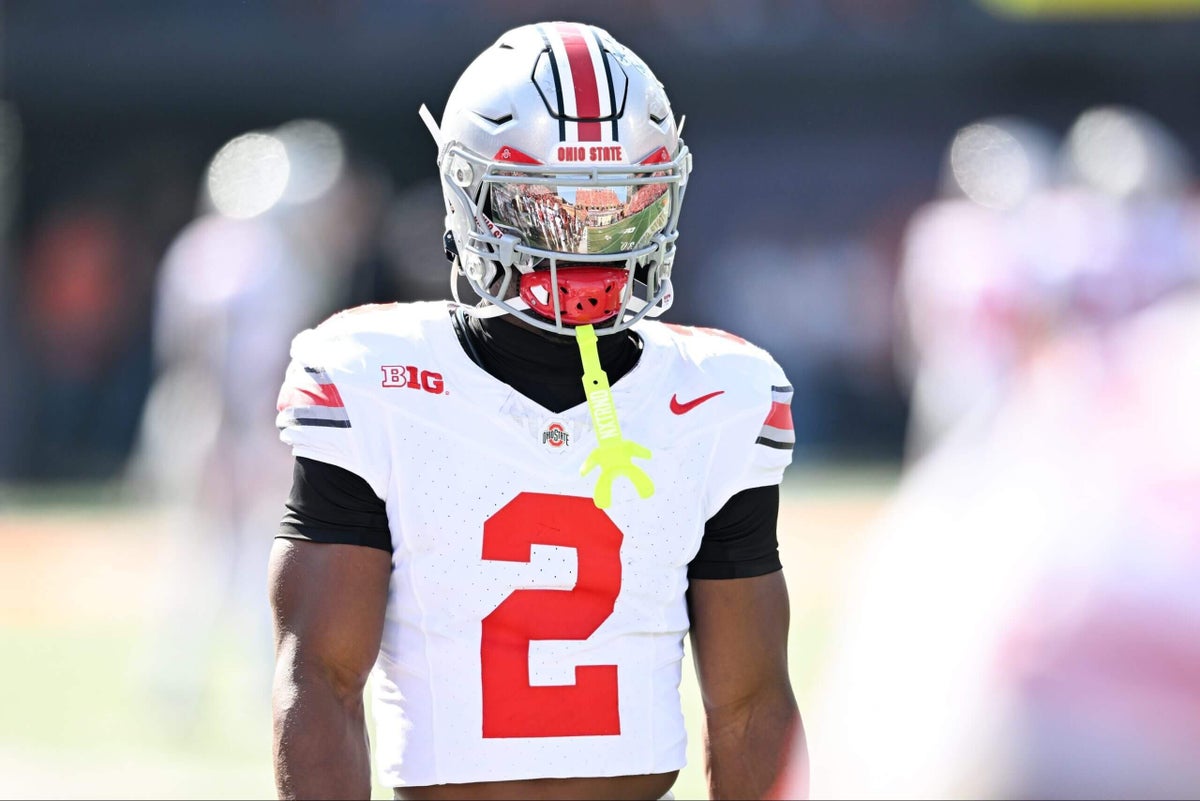
First round (No. 7): Caleb Downs, S, Ohio State
The Commanders need an elite pass rusher, and there are plenty of good ones to choose from in this class. There are also very good linebackers, and the likely exit of veteran Bobby Wagner would put Washington in the market for a good “Mike” backer who can be the quarterback of the defense. Maybe that becomes Jordan Magee’s role. Or maybe the Commanders turn to a player like Ohio State’s Sonny Styles, a 6-foot-4, 240-pound linebacker who has drawn comparisons to Fred Warner, the four-time All-Pro Peters helped draft in San Francisco.
But I’m going with Downs, an absolute game-wrecker whose impact can be, and has been, felt at all three levels of a defense.
The Athletic’s Dane Brugler describes the Ohio State star as a “human missile” because of his speed and aggression. A few scouts even told Brugler that Downs is the best safety prospect they’ve ever seen (remember that Eric Berry and Sean Taylor were drafted before many current scouts got into the league).
Downs is also a sound tackler, which Washington sorely needs after its defense missed 155 tackles last season, according to Pro Football Focus. The Commanders entered the 2025 season believing safety was among their stronger and deeper positions, but veteran Will Harris missed eight games because of a fractured fibula, and Quan Martin was benched twice for costly mistakes in coverage.
Downs’ play belies his size (6 feet, 205 pounds); he played 44 snaps at the line of scrimmage and 241 snaps in the box last season, according to PFF. When targeted in coverage, he allowed a mere 54.5 passer rating and zero touchdowns.
I considered having Washington trade back at this spot, but that requires a partner that wants to trade up. Teams trying to jump up into the top 10 are usually eyeing a quarterback or a player at another premium position. But the quarterback group in this year’s draft class lacks starter talent outside of Fernando Mendoza, and the edge rushers run deep. So I have the Commanders standing pat at No. 7.
Honorable mention
• Rueben Bain Jr., edge, Miami (although I’m not convinced Bain will be available at No. 7)
• David Bailey, edge, Texas Tech
• Carnell Tate, WR, Ohio State
• Sonny Styles, LB, Ohio State
• Arvell Reese, LB, Ohio State
Third round (No. 71): Derrick Moore, edge, Michigan
I doubt Moore will be available at No. 71, but let’s assume that unexpected things happen in the first two rounds (because unexpected things always happen in the draft) and he gets bumped down. The Commanders would be the beneficiaries here, acquiring a prospect who put on a show at the Senior Bowl last month. Moore is a Baltimore native. He attended powerhouse Saint Frances Academy and was the 2021 Maryland Gatorade Player of the Year before turning down offers from Alabama and Ohio State, among others, to join Jim Harbaugh’s program at Michigan.
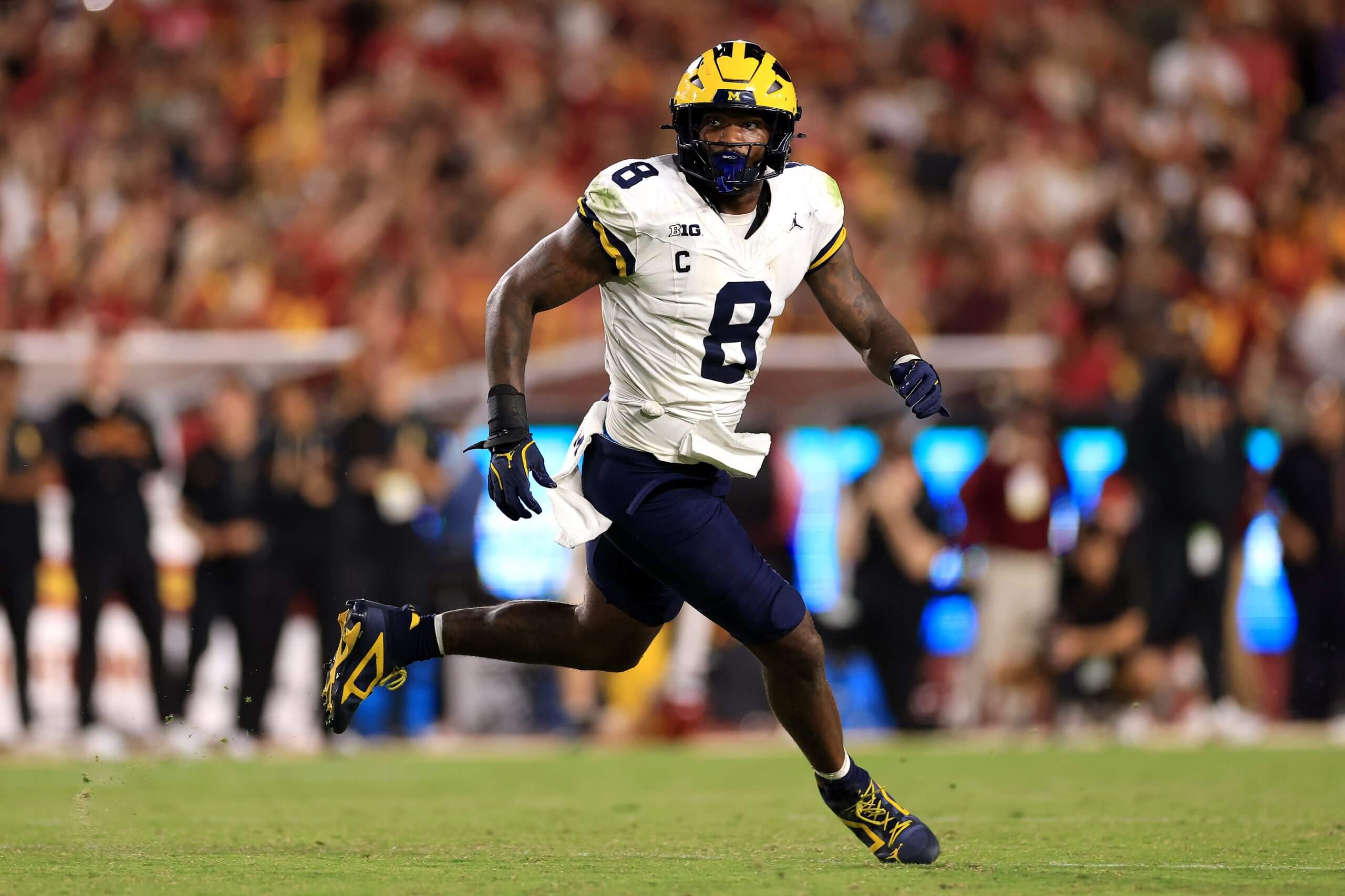
Michigan edge Derrick Moore would be a score for the Commanders in the third round. (Luke Hales / Getty Images)
He has the desired size and length (at 6-foot-3, 260 pounds), along with the get-off that Peters and Quinn covet. As a senior, he totaled 30 tackles, a team-high 10 sacks, three passes defended, two forced fumbles and a fumble recovery.
Moore put his physicality and quickness on display at the Senior Bowl, where he literally ran over offensive tackles.
Fifth round (No. 145): Ted Hurst, WR, Georgia State
This is where losing their second- and fourth-round picks will hurt the Commanders (though I still think it was worth it to get Tunsil). Washington needs help across the board, yet it has only one pick between Nos. 7 and 145. That’s 136 prospects — more than half of the entire draft class — who will land elsewhere, unless Washington manages to collect additional picks by trading back.
Luckily, this year’s receiver group is deep (Brugler’s latest top 100 rankings include 17 players at the position), which means Washington has a chance to find quality talent. The Commanders always seem to have a bevy of slot receivers, but rarely anyone with the size to create mismatches. Enter Hurst, who spent two seasons at Valdosta State before transferring to Georgia State in 2024. In his first season in the Sun Belt, he had 56 catches for 961 yards and nine TDs.
Hurst was a deep-ball machine last season, with 11 catches of 20-plus yards, according to PFF. He also totaled 18 forced missed tackles and averaged 5.3 yards after the catch.
Sixth round (186): Davison Igbinosun, CB, Ohio State
Washington needs help at corner, both in starter talent and for depth. Igbinosun could provide the latter, at least to start. The New Jersey native began his college career at Ole Miss, but transferred to Ohio State after his freshman season. He immediately became a starter for the Buckeyes, helping them to their 2024 national championship.
Sixth round (197): Malachi Lawrence, edge, UCF
Have I mentioned how much the Commanders need pass rushers? They need pass rushers. They need elite ones, but also rotational players. Lawrence fits the latter category.
The 6-foot-4, 270-pound pass rusher totaled 40 pressures and seven sacks last season to earn first-team all-Big 12 honors.
Seventh round (223): Tanner Koziol, TE, Houston
It might not be a great draft for starting-caliber tight ends, but Washington’s tight ends corps is fairly open. Zach Ertz is recovering from an ACL injury and headed for free agency, Ben Sinnott has yet to blossom into Ertz’s successor and John Bates is primarily a blocking tight end. The tight end with the most promise may be Colson Yankoff, a well-rounded athlete with limited experience at the position.
It’s a prime opportunity for a late-round pick like Koziol, who had 20 contested catches in 2025, the most among all tight ends with at least 25 targets.