

SAN FRANCISCO — If anyone attending Super Bowl week festivities earlier this month wondered about the scope and scale of the NFL’s investment into flag football, all they had to do was walk into the convention center to be totally immersed.
There, an entire ground-floor ballroom was converted into a regulation-sized flag football field with giant video boards and surrounding bleacher seats. This “NFL Flag Fieldhouse” hosted packed events all week: a live-streamed game featuring YouTube personalities and other celebrities; a high school girls flag football showcase of the best teams in the country; a glow-in-the-dark matchup between some of the sport’s rising women players, with NFL stars in attendance.
It also hosted the Pro Bowl — where NFL players, now approved by clubs to eventually try out for the inaugural 2028 Olympics team, were asked to play by the sport’s official rules — and an exhibition game between the U.S. and Mexican men’s national teams. Flag athletes wearing their USA Football kits frequented sets along Radio Row, bumping elbows with the NFL stars and celebrities who frequent the week of broadcasts. National team safety Amber Clark-Robinson even hit a basketball shot for $50,000 during a live stream of “The Pat McAfee Show.”
“It’s amazing,” said Isabella “Izzy” Geraci, a receiver/defensive back for USA Football’s women’s national team (and one of the best players in the sport; think Mike Evans if Evans also played safety). “I was at the Super Bowl last year and we did Radio Row. We were in our uniforms and people didn’t really even recognize — like, we had the ‘U-S-A’ on our chest but no one knew what sport.
“This year, we’re in our uniforms and people know exactly who we are. It just goes to show how much the sport is growing and how excited people are about it.”
The NFL is all in on flag football. Its push to integrate the rapidly growing sport into signature events such as the Pro Bowl is just one of many initiatives over the last year that underscore its investment — which reached a new high point during the events around Super Bowl LX. The league has brought aboard key partners such as YouTube and Toyota and has turned high-profile players, Pro Football Hall of Famers and personalities into flag football ambassadors.
“Simply put, when (the NFL) puts all of their energy behind something, amazing things can happen,” said Scott Hallenbeck, the executive director of USA Football.
It’s not difficult to connect the dots. Flag football’s debut in the 2028 Summer Olympics in Los Angeles is a vessel through which the NFL can continue to spread its own international brand (“equipment football,” as flag players refer to the more traditional version of the game, is not an Olympic sport). Hallenbeck said that USA Football works with every NFL team on international events in addition to domestic efforts. While Hallenbeck and the sport’s partners study how global soccer pipelines were built for the top teams in the world, they also work with NFL teams to sponsor leagues across the U.S. — many of which now play in regular tournaments at NFL team facilities.
Through flag football, the NFL can access markets it is interested in strengthening: Women can be professional flag football players. In January, the NCAA added flag football as an Emerging Sport for Women, meaning it’s a step closer to officially becoming a championship sport, and the NCAA said as many as 60 schools could sponsor programs in 2026. The NFL said in 2025 that 47 percent of its audience were women; flag football can close a massive gap in participation equity for girls and women who are interested in playing (although the two sports are very different). The sport is expanding at a breakneck pace across the United States at the youth, high school and now collegiate levels — and girls flag football participation specifically was up 60 percent year-over-year, according to the latest National Federation of State High School Associations survey.
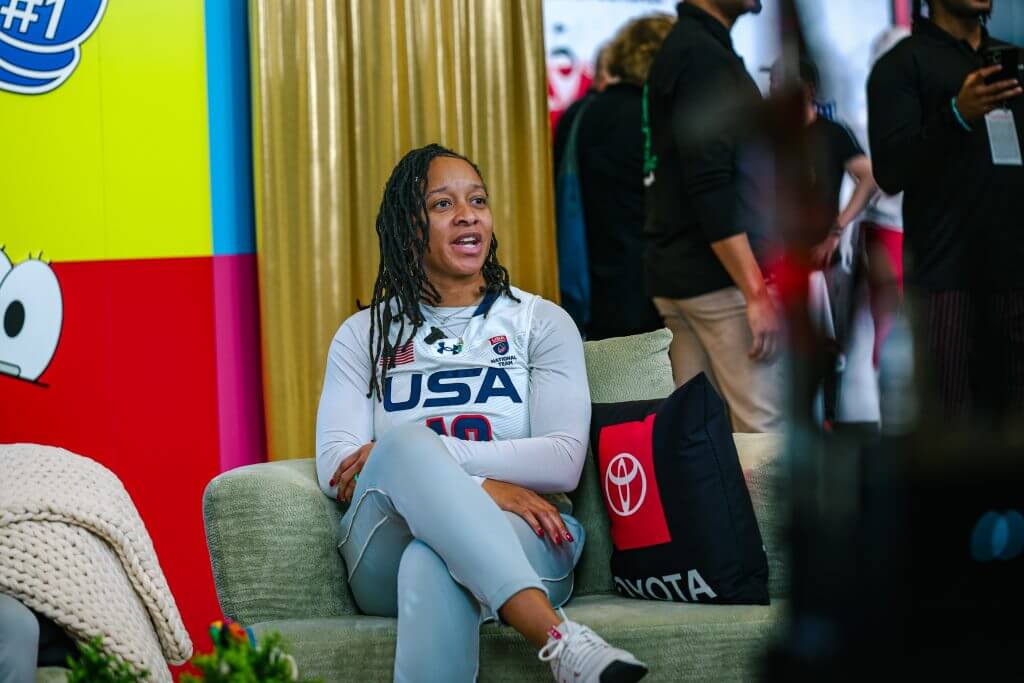
U.S. women’s flag football safety Amber Clark-Robinson and her teammates were Radio Row regulars at the Super Bowl. (Kelli Tolar / USA Football)
More growth pipelines unearth better players. Professional players have noted that the level of international competition is also rising steadily at world tournaments and suspect it will continue to do so leading up to the L.A. Summer Games.
When a behemoth such as the NFL throws its endless resources behind something and subsequent growth happens so quickly, gimmicks hoping to siphon off a piece of the action are bound to pop up.
In September, future Hall of Fame quarterback Tom Brady — now a Fox analyst and part owner of the Las Vegas Raiders — announced “The Fanatics Flag Football Classic,” a tournament held in Saudi Arabia that will be hosted by comedian Kevin Hart and live-streamed. So far, the marketing for the event feels more akin to that of a shallow entertainment product than an Olympic sport. During a recent appearance, Brady bantered back and forth with combat-sports personality Logan Paul and claimed the event — which he said will feature several NFL current and former athletes and other personalities — will be “competitive,” plus played by Olympic regulations. Brady also said it would be “way better” than last week’s Pro Bowl.
At the Pro Bowl, players were asked to adhere to flag football’s official rules. This might have been a well-intended gesture by the NFL to help uninitiated viewers get more familiar with the sport, but the results were mixed at best and perhaps were even a small setback in the league’s efforts to get its players more excited about flag football.
Former San Francisco 49ers quarterback and Pro Football Hall of Famer Steve Young, an ambassador for flag football and coach of his daughters’ team, coached the Pro Bowl’s AFC team. Young excitedly told the ESPN broadcast of his Pro Bowlers, “…these guys now need to realize, ‘Do you want to go get a gold medal in 2028? If you do, this is where you show it! The NFL players need to demand, by their play, that they want to go get a gold — and they talked about it. All the guys in the locker room (are) saying, ‘I’m in. I’m in for a gold medal.’”
Yet the players for both AFC and NFC teams (and even some of the commentators in the broadcast booth) struggled with the new sport. As the game began, players incurred frequent penalties that seemingly stemmed from a lack of understanding of the rules, such as how defenders could cover offensive players or even where flags are supposed to sit around the waist. Cincinnati Bengals quarterback Joe Burrow gleefully ran in a touchdown himself but noted to a sideline reporter a few minutes later that he didn’t really know the rules of the sport. While there were fun moments, such as a touchdown by Denver Broncos offensive lineman Garett Bolles, the pace was nowhere near the speed at which professional flag football is played. Players were understandably protecting their bodies after a long season and treated the event as the casual fun it was intended to be; still, they often looked unsure of themselves.
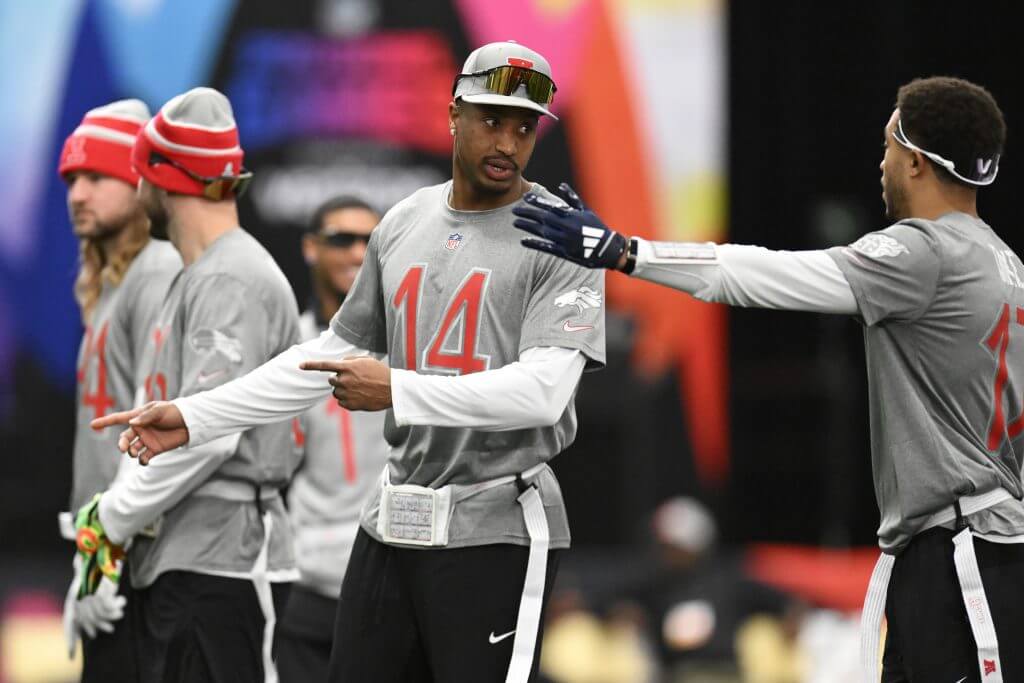
Courtland Sutton of the Denver Broncos, left, and Chimere Dike of the Tennessee Titans talk during a practice before the Pro Bowl. (Eakin Howard / Getty Images)
The flag football athletes — and their on-field play — remain the best ambassadors for the sport for those actually interested in learning more. The exhibition game between the U.S. and Mexico men’s teams proved a great example, with the speed and strategy of the sport on full display. The athletes hip-dipped (a technical move to avoid a flag pull in which a player sinks and flips their hips as low to the ground as possible while continuing to run at full speed) and broke the in- and out-cuts of their routes with exacting precision. Excited fans packed the bleachers and waved flags for their home countries as the speakers thudded with music between snaps.
The contrast between the skill level on display throughout that game and the Pro Bowl was dramatic, though likely not intended by the NFL to look quite so stark. What flag football players already know became clearer to a broader public: NFL players can’t simply come in cold and expect to compete at a high level. (Active NFL players must also clear other hurdles such as getting permission from their teams to participate in a non-club activity that leaves them susceptible to injury and demands time away from their standard offseason programming.)
That’s not to say they can’t learn. Mike Daniels, a former West Virginia safety who began playing flag football professionally only about three years ago, is a star defensive back and receiver for USA Football’s men’s national team. Before he hit the whirlwind competitive circuit, Daniels played flag football in Miami beach leagues as a way to keep up his cardio after college. A coach for the national team noticed Daniels and invited him to try out for a team traveling to compete in an international tournament.
Daniels has since spent his training overhauling longtime habits learned over years of playing competitive equipment football and even changed the way he uses his body to compete. Instead of regularly lifting heavy weights as he did when he played college football, for example, Daniels focuses much of his training on flexibility for his hips, knees and ankles as well as plyometrics. A defensive back can’t be physical with receivers in flag football by rule, and he is defending shorter areas of the field at a faster pace and no longer has as many other players helping him in coverage (it’s five-on-five versus 11-on-11). Daniels had to retrain his eyes, footwork and spatial manipulation over time to better fit a sport that is predicated on speed, quickness and leveraging small amounts of space.
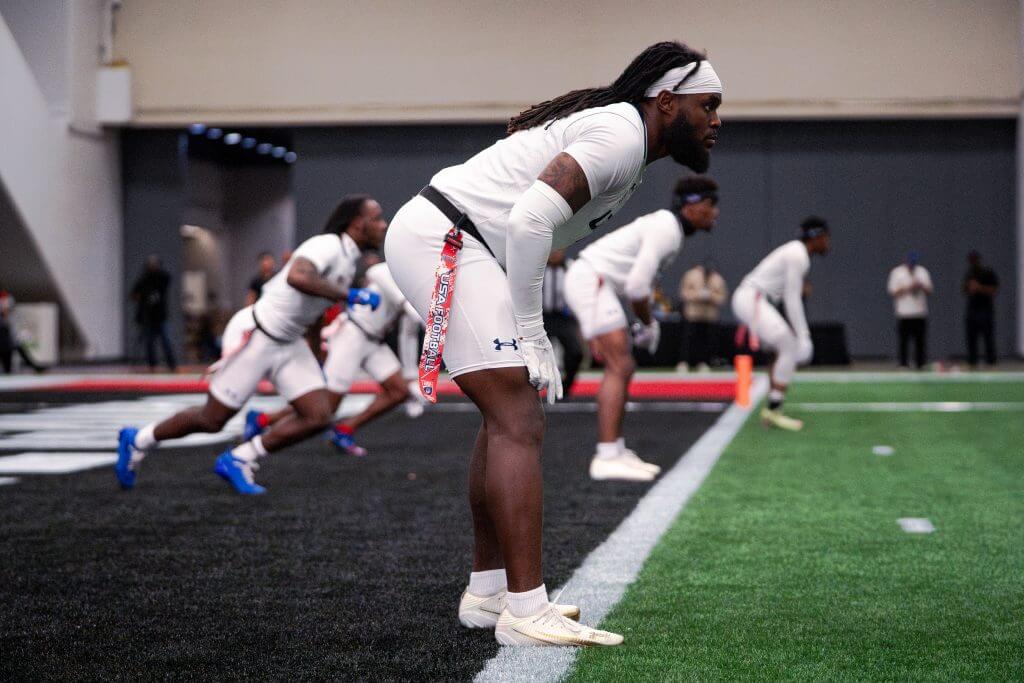
Team USA cornerback Mike Daniels during an exhibition against Mexico at the Super Bowl Experience in San Francisco. (Mina Creamer / USA Football)
“Coming from football, these coaches in these programs instill in your mind ‘You have to be physical, physical, physical.’ Competition is all about physicality. And then you come to a sport where yeah, it’s high intensity, it’s highly competitive, but you’re not allowed to be physical,” said Daniels. “How do I compete at a high level without showing how physical I am?”
The NFL throwing its significant weight behind flag football is applauded by those inside the sport. By the 2028 Summer Games, flag football and the NFL will be more intertwined than ever — even if no active NFL player is on the U.S. team.
Over the next two years, Team USA’s men’s and women’s rosters will be built meticulously through Olympic trials, world tournaments and multiple roster cutdowns. Current players are already training for upcoming world competitions. If NFL players want to get on board, they had better start training — and learning the rules — soon. Coaches and other officials throughout the sport have been clear in conversations with The Athletic over the last several months that while flag football is casting a very wide net across multiple sports to bring the best athletes into their growing game, no one will get placement simply for the sake of promotional opportunities or because they are fast and can catch the ball. By 2028, Team USA has to represent the best of flag football.
“I think if those guys put in the work — they would have to learn it; not saying that they can’t, but it just wouldn’t be a switch that you can just flip on and off. It’s something that takes time to develop,” said Darrell “Housh” Doucette III, the current starting quarterback for Team USA and an Olympic hopeful. “Until they are willing to learn it, it’s just going to look different.”
Forget the Pro Bowl: Doucette believes the best way to get NFL players who are excited about the sport more aware of its technicalities is some sort of camp or tournament where flag football players can compete with — and teach — them.
“Get on the field with those guys, show our speed and our techniques and the different nuances that we know about flag football versus them,” he said. “I think that would show (them) it’s different. It’s not the natural football game that people are accustomed to watching.”
Doucette thinks such an event could draw significant buzz. Why not try it, if the goal for flag football is both continued growth — and gold?