
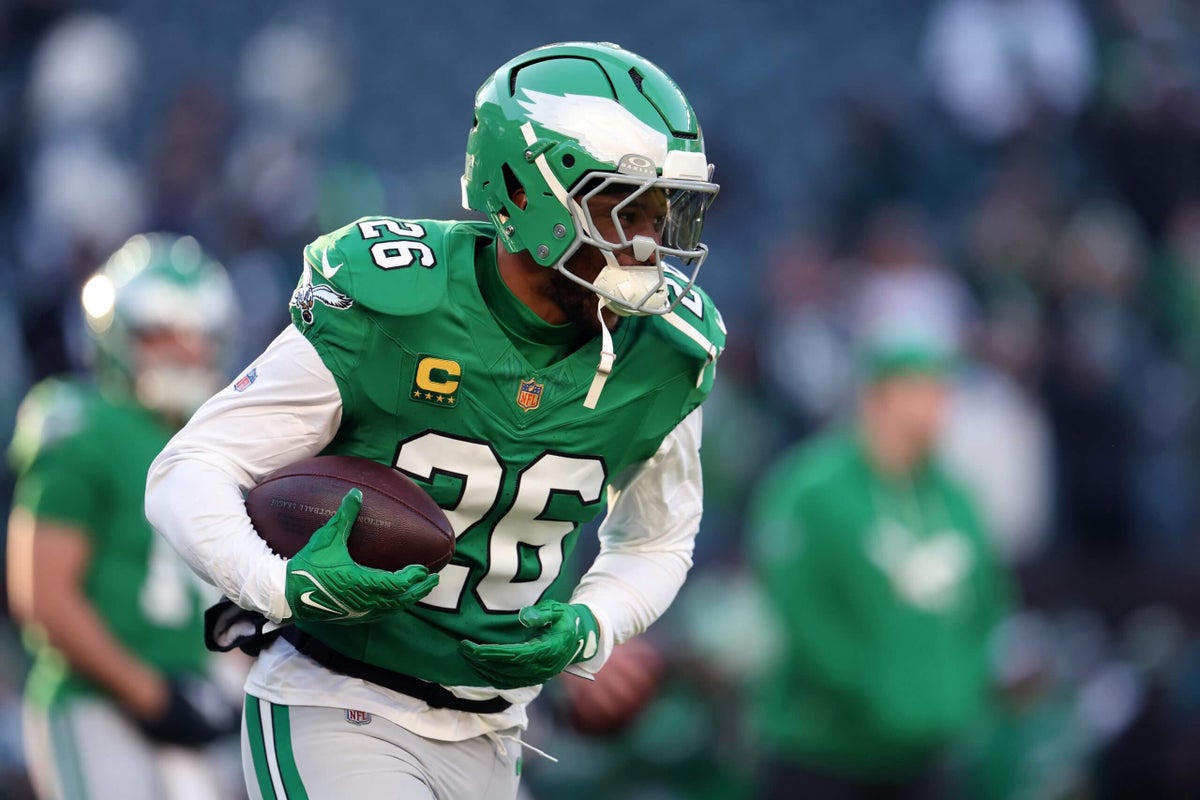
Old-school football is back. The ability to run the ball and stop the run in January is more important than it has been in a long time. In the wild-card round, the run game will certainly determine several matchups.
Can the San Francisco 49ers stop down an up-and-down Philadelphia Eagles run game? The Green Bay Packers run defense is getting destroyed without Micah Parsons. The Los Angeles Rams defense has regressed since losing nickel Quentin Lake. Can they regain their form in the playoffs? Here are the key matchups in each of the NFC wild-card games.
San Francisco 49ers at Philadelphia Eagles (4:30 p.m. ET Sunday)Key matchup: 49ers two-deep defenses vs. Eagles run game
The 49ers’ injury-riddled defense has struggled to stop the run and wide receivers. Though the Eagles run game has greatly regressed from last season, it still created explosive rushes at the 10th highest rate in the NFL. The offensive line has dealt with injuries, and the weight of grueling playoff runs has taken its toll on defending champion Philadelphia. Jalen Hurts hasn’t run as much on designed runs and scrambles, which has hurt the Eagles shotgun running game, so they’ve run the ball more from under center, where they get most of their explosive rushes. However, they don’t pass much from under center (30th in dropbacks from under center), which makes them predictable.
Last season, the Eagles only had one game under 100 rushing yards, in Week 18, when they rested their starters. This season, they’ve had nine games under 100. Notably, they struggled to run the ball against some of the league’s worst run defenses, such as the Washington Commanders, Buffalo Bills and Dallas Cowboys. As mentioned, the 49ers run defense has struggled in the last few weeks, but it has a shot at stopping the Eagles run game. The Bills did so by confusing their blocking schemes with line games and run blitzes, and 49ers defensive coordinator Robert Saleh did the same to the Seattle Seahawks in Week 18 after getting gashed on the ground early in the game. Still, anytime you have Saquon Barkley in the backfield, the threat of the big run always looms.
The Eagles faced the seventh-highest rate of two-deep safeties, which limited Hurts’ ability to throw outside to A.J. Brown and DeVonta Smith. Despite all the two-high shells they faced, they struggled to run the ball consistently. 49ers cornerback Deommodore Lenoir has struggled as of late, and Renardo Green is just coming back from injury. If the 49ers are forced to play one-high coverage because of the run, it’ll be a lot to ask Lenoir and Green to cover Brown and Smith one-on-one, especially with their nonexistent pass rush. With right tackle Lane Johnson possibly returning from injury, it’ll be even more difficult to get to Hurts and make the run game a bigger threat.
Although Saleh is a single-high coach, he has shown a willingness to go to two-deep coverages in certain games, as he did early against the Seahawks. With the star receivers that the Eagles have on the outside and their inconsistencies running the ball, the better choice should be to start the game in two-high and see if you can disrupt the run game without an extra defender in the box.
The 49ers have leaked yardage, but they’ve been very good at stopping teams in the red zone, ranking fifth in touchdown percentage allowed in the red zone. Against the Seahawks, they forced four field goals. They’ll have a much bigger challenge against an Eagles offense that ranks first in red zone touchdown rate (70.5%), which is the one area that it’s actually better in offensively than last season. The 49ers can’t rely on tightening up the red zone. Stopping the run from two-high alignments and not allowing them to get to the red zone frequently will be key.
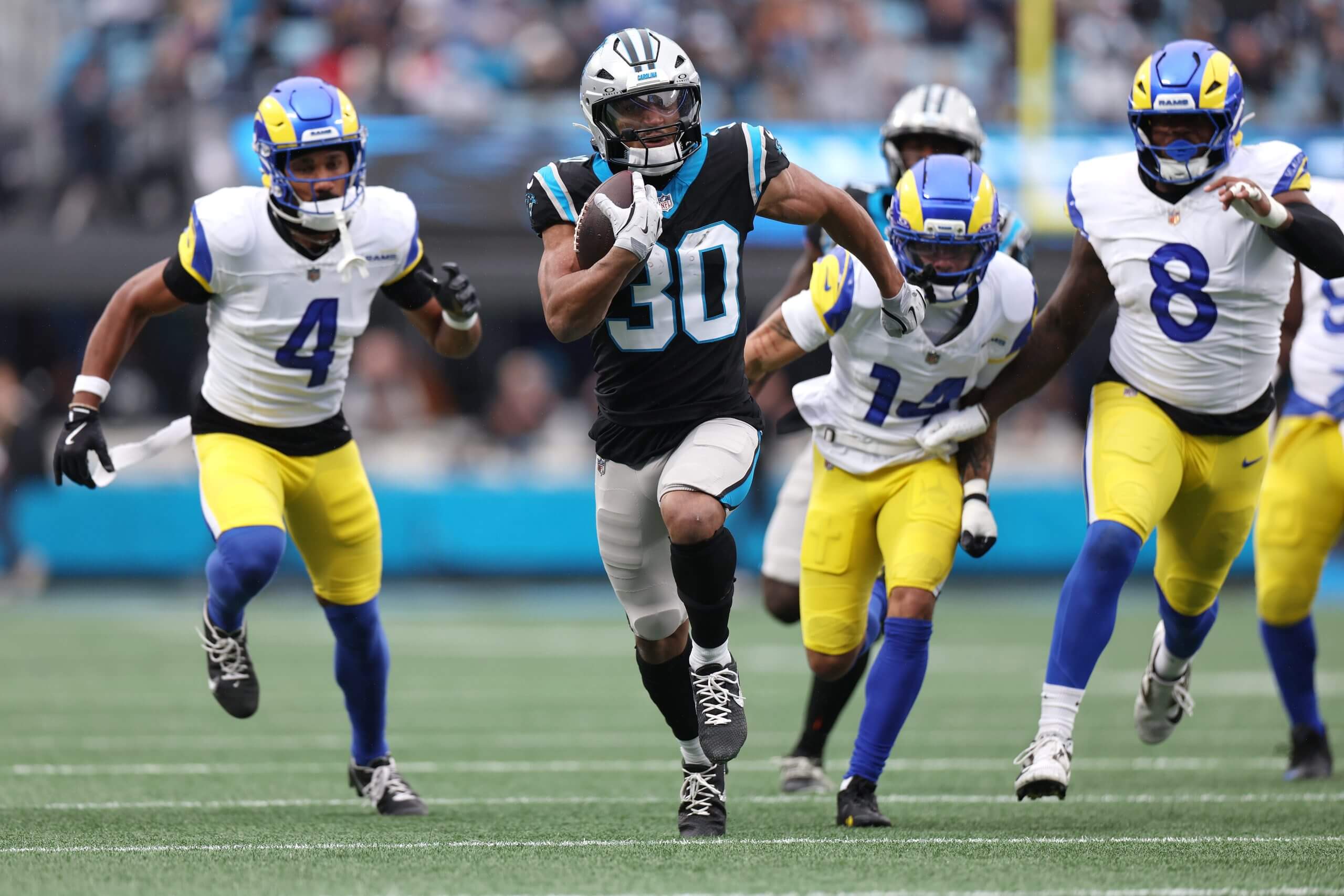
The Panthers upset the Rams 31-28 on Nov. 30. Could they do it in the playoffs?
Los Angeles Rams at Carolina Panthers (4:30 p.m. ET Saturday)Key matchup: CB Emmanuel Forbes Jr. vs. WR Jalen Coker/WR Tetairoa McMillan
In the Panthers’ upset win over the Rams in Week 13, they went after Forbes at cornerback. Whenever the Panthers needed a big play, they targeted Forbes, who gave up two long touchdowns in man coverage on fourth down. Forbes ultimately gave up the game-winning catch to McMillan, but they were clouding him for most of the game. It was Coker who had his best game of the season against the Rams (four catches for 73 yards and a touchdown).
After a hot start to the season, Forbes has regressed and has been frequently targeted by opponents. Coker has benefitted from one-on-one coverage when McMillan gets extra attention. This will be a matchup to watch out for in the fringe red zone. According to Pro Football Focus, Forbes is allowing the eighth-highest yards per reception (15.3) among qualifying corners this season.
Lake will likely make his return after getting injured in Week 11. As a nickel corner, Lake makes a massive difference for the Rams defense. His physicality allows the Rams to stay in sub personnel (five or more defensive backs on the field). They are much more effective at stopping explosive passes from sub personnel than base personnel (four or fewer defensive backs on the field). The Rams increased their percentage of snaps in base by 5% after Lake was hurt. When the Rams are in sub, they rank eighth in explosive pass rate allowed (10.2%). When they are in base, they rank 32nd (20.6%). If Lake is back, it’ll allow them to be more diverse in their coverage and allocate more help to Forbes. Still, there will be critical situations when Forbes has to cover one-on-one. How he fares in those situations could swing the game as it did in Week 13.
Green Bay Packers at Chicago Bears (8 p.m. ET Saturday)Key matchup: Packers defensive tackles vs. Bears three interior linemen
In the two games (Week 16 and 17) after Parsons got hurt (Packers rested key starters in Week 18), Green Bay gave up 457 total rushing yards. One of those opponents was the Bears, who ran for 150 yards, averaging 5.8 yards per rush. Without Parsons’ disruption, this Packers front gets pushed around.
Green Bay’s defensive tackle room was already thin before Jordan Riley, who was signed off of the New York Giants’ practice squad to replace Devonte Wyatt, who was put on injured reserve after getting hurt on the road against the Baltimore Ravens. Simply put, the Packers are getting shoved around on the interior, getting blown back, and huge holes are being punctured in their front. No matter what alignment Packers defensive coordinator Jeff Hafley tries to get into to slow down the run, there just isn’t a lot you can do when your defensive tackle play is this bad.
In Weeks 16 and 17, the Packers gave up 3.56 yards before contact. To put that in context, the Giants, who rank last in the league in that category, are giving up 1.95 yards before contact.
The first thing Ben Johnson did when getting hired by the Bears was revamping the interior with guards Joe Thuney and Jonah Jackson and center Drew Dalman. Can former sixth-round pick Karl Brooks and Colby Wooden hold up against the Bears’ star-studded interior? How Brooks and Wooden perform will determine if the Packers defense can slow down the Bears offense. In a Week 16 win against the Packers, the Bears had some early miscues like a botched snap in the red zone in the first quarter and fell behind by double digits, but in the wild-card round, expect Johnson to emulate what the Ravens did against Green Bay in a Week 17 win and run early and often.