
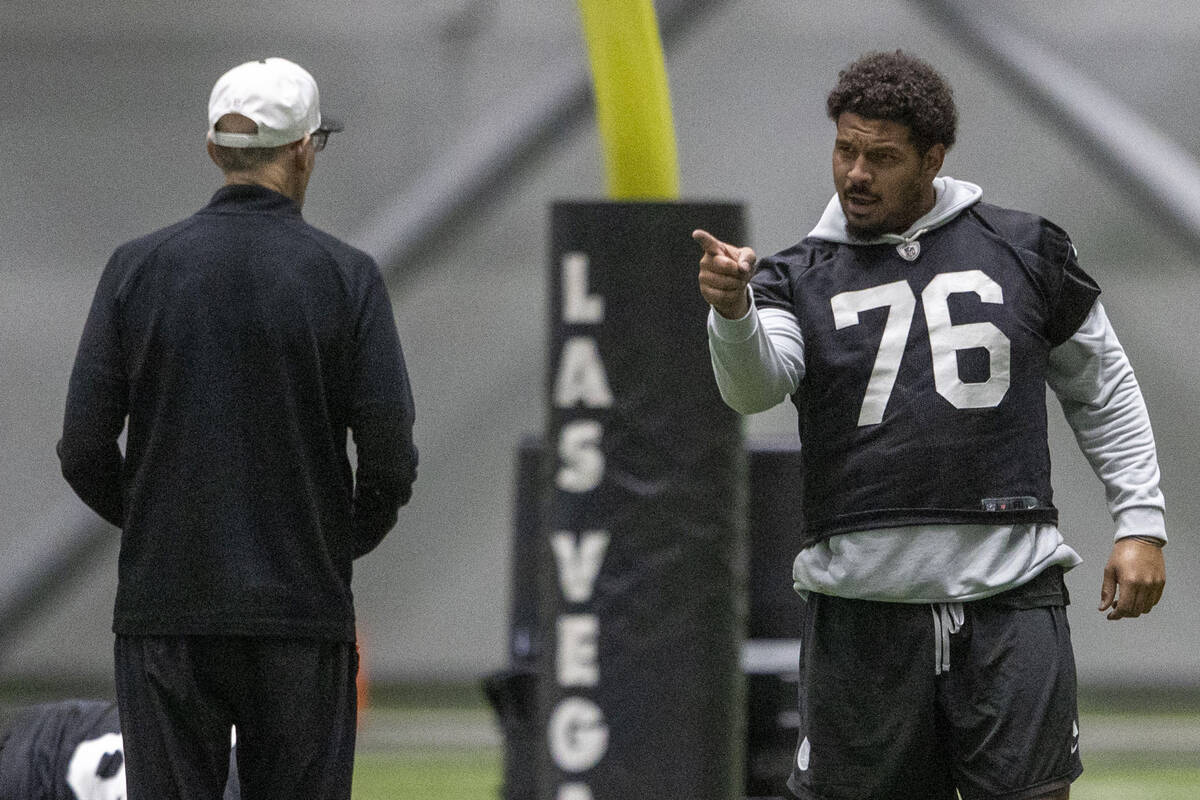
The message Caleb Rogers shared with his coaches during exit interviews on how he thought he was developed was not what some would expect.
Rogers was no longer mad about being held off the field for so long as a rookie or upset about the times he thought his number would finally be called only to be relegated to the bench once again.
The Las Vegas Raiders offensive lineman was instead appreciative of how far he had come in his first season.
“The timeline they had for me absolutely helped me,” he told the Las Vegas Review-Journal after the season. “I told the coaches that I don’t think they messed up with me.
“I think they did a really good job of doing what they had to do to keep me in the right mindset I needed to be in to push past any adversity. The way everything happened is how it was meant to happen.”
His late-season emergence is one reason the cupboard may not be as bare as it may look from the outside as the Raiders try to rebuild their offensive line.
While the results were not what anyone wanted this season for any position group with the Raiders, no unit took more heat and criticism than the big boys up front on offense with cries of incompetence and nepotism often directed at position coach Brennan Carroll.
The son of fired head coach Pete Carroll was not retained by the new staff, and the organization is expected to make significant upgrades to the room through free agency and the draft.
Conversations with several players and coaches reveal a slightly rosier picture than public perception may indicate.
Investment in personnel is paramount, without question. There may, however, be a better foundation than it appears at first glance.
The Raiders could actually be just a couple elite pieces away on the offensive line from not only having a strong group but also a deep one to run new coach Klint Kubiak’s offense under the direction of Rick Dennison, who is expected to coach the offensive line.
Signing a potential starter at right tackle and one more on the interior along with a project or two in the draft could have them in a very strong position.
But to understand exactly where they are, it’s important to look at how a disappointing season put them in this spot.
Looking back
While fans will want to forget the 2025 season as quickly as possible, it wasn’t exactly a lost season in terms of preparing for the future.
The returning group is smart and maintained great attitudes in a year of development despite not getting the results all the time.
Rogers is a prime example.
His progress is very encouraging and could give the Raiders at least one long-term answer on the interior of the line, either at guard or eventually center.
The team should also have a healthy Jackson Powers-Johnson, who could be another impactful piece in the middle should he be able to turn his highlight reel of spectacular blocks into more consistent play on a down-by-down basis.
“Right up until he was injured, he was really getting it, and he was starting to look really good,” veteran left tackle Kolton Miller said of Powers-Johnson.
The same could be said of Miller, an anchor on the left side and by far the best player and leader of the group, who missed all but four games this season.
He was hurt late in a home game against the Bears that is widely seen as a turning point of the season. The offensive line delivered its best performance of the year with 240 rushing yards in a game the Raiders lost to an eventual playoff opponent when a last-second field goal attempt was blocked.
The Raiders could have been 2-2. Instead, they lost the game and Miller for the rest of the season. A position group that was finally coming together had to figure out how to cope without its star and leader.
Miller was referred to by one person close to the team as a multiplier, meaning his loss weakened the rest of the group because they had to try to cover for his absence and all he brings to the unit.
“I know I got better this year,” Miller said. “We had meetings and things for us to work on. (Brennan Carroll) saw some things in my game that helped me realize where I could improve, and there are areas I did improve.
“They wanted the best out of us. I think with guys trying to learn new positions while learning a new system, you didn’t always see our best ball on the field. But there was improvement.”
Injuries to the offensive line were a huge factor in their struggles, but it went beyond that. Star tight end Brock Bowers was hurt early in the season and mostly played through it. Then the team traded top receiver Jakobi Meyers just as Bowers was starting to get somewhat healthy, putting even more pressure on the line to hold up longer in pass protection for young receivers to get open.
Offensive coordinator Chip Kelly’s system simply did not generate what the Raiders had hoped. His firing did not fix much, however, as his complex scheme is so uniquely his own that altering it much after he moved on midseason would have been a daunting undertaking.
Miller admits that progress may have been difficult to see because of all the struggles, though those were not unique to the offensive line.
Criticism was justified. The group often failed to generate lanes for rookie first-round pick Ashton Jeanty, who eclipsed 100 yards only twice. Geno Smith was sacked 55 times, tied for most in the league. Miller, however, believed some of the attacks were unwarranted.
“It’s not the season we wanted, and I get it,” he said. “People are going to be upset. We were 3-14, and we’re going to try to fix it. But there are constructive ways of looking at it, and then there is throwing crap everywhere and saying, ‘Look at this mess.’”
The players-only meetings
One particular critique that was pushed back on by Miller and others who were interviewed by the Review-Journal were details brought to light in one national story about the offensive line meeting with Jeanty and Smith, among others, without coaches present.
Multiple sources said those meetings were first recommended by the coaching staff, and their schedules were even moved around to foster those conversations in the hopes of building trust and accountability among the group.
“It was something the coaches suggested and encouraged,” Miller said. “It was a step they wanted us to take to be connected as a room.”
Whether that helped or not is up for a debate. It certainly didn’t show up in the standings.
A large part of the issue was being torn between a veteran head coach who never wavered in a commitment to competing and an organization that clearly needed to focus on the future.
“There was a plan, and that’s the way we were trying to push it,” Miller said. “There are these teams we beat or barely lost to that made deep playoff runs. We did have a team that could compete. But with injuries and things coming together, it takes time. You can’t solve it all at once.”
Moving forward
Getting Miller and Powers-Johnson healthy would be a great start, but the ability Rogers showed late in the season certainly provides another case for optimism.
While fans and media clamored for much of the season that his shot was long overdue, the third-round pick felt the same way and often wondered when it would finally happen.
He got his first start against the Chargers in Week 13, playing 17 snaps in a rotation and performing well enough to play 100 percent of the snaps the final five weeks.
Rogers showed promise, enough that cynics wondered whether taking so long to put him in the lineup was a blunder by a coaching staff that faced scrutiny all year long.
“My first 12 weeks was just me getting better, and there was plenty of support for that,” he said. “I think they could have put me out there, and I would have done some good things and some bad things, but I do think a reason why I played well the last five games was that I didn’t play the first 12. Some people go out there and get torn up, and it tears them down. That wasn’t my path. Maybe if I played every game, I would have played great in all of them. I don’t know. But I think this is how it was supposed to go, and now I’m in a great position going into my second season.”
Rogers and Powers-Johnson give the Raiders two potential young building blocks in the middle of the offensive line should the new administration believe they fit the outside zone running scheme set to be employed. They both have the kind of mobility and intelligence crucial to operate the system.
Both could also be capable of playing center, which was a big problem in 2025. Jordan Meredith is a smart player and a great locker room guy who blew the coaching staff away last offseason as a center.
His inability to live up to that same standard once games started was one of the first big issues the team faced, particularly because of Powers-Johnson’s publicly stated desire to play there and a swell of fan support in that direction.
If Rogers and Powers-Johnson remain at guard, the door is open for the acquisition of a more established center in free agency. Either way, they have solid interior options even with four-year starter Dylan Parham set to hit free agency.
Then there is the untapped potential of Charles Grant, who spent the season adding weight and strength after coming into the league undersized from William &Mary.
His tools are evident, however, and along with Rogers could prove to be a strong haul of offensive line talent from general manager John Spytek’s first draft class.
“Caleb was put out there, and he answered the call,” Miller said. “The amount of notes he takes and the amount of detail he puts into everything is impressive, and he really improved. … He was going against great competition and had a big role, and I think he’ll continue to improve. But you could say the same about Charles. He was raw, but getting snaps and the coaching he was getting, you could see it in his confidence, and he improved. …He’s blowing guys off the ball in the run.”
That could mean DJ Glaze could also be tried at guard after an inconsistent season at right tackle, the other offensive line position that could be a primary focus in free agency.
Rogers credits the organization and the coaches from last year with much of that.
“I don’t think I’m an All-Pro right now, but I think I’m fully intentionally committed to what I do and the position I play, and they led me through a great year of learning the business, learning to get on the field, learning what it takes,” Rogers said. “It’s not about my status. If I was so satisfied with being a starter, I would have stopped getting better. But that’s not what mattered. And now I have an opportunity to get even better. …
“I know a lot of people didn’t agree with the process, but honestly I thought it went great,” Rogers said. “I’m excited for the offseason and to get to Year 2.
“My rookie year was great. I can’t wait for the next one.”
Contact Adam Hill at ahill@reviewjournal.com. Follow @AdamHillLVRJ on X.