
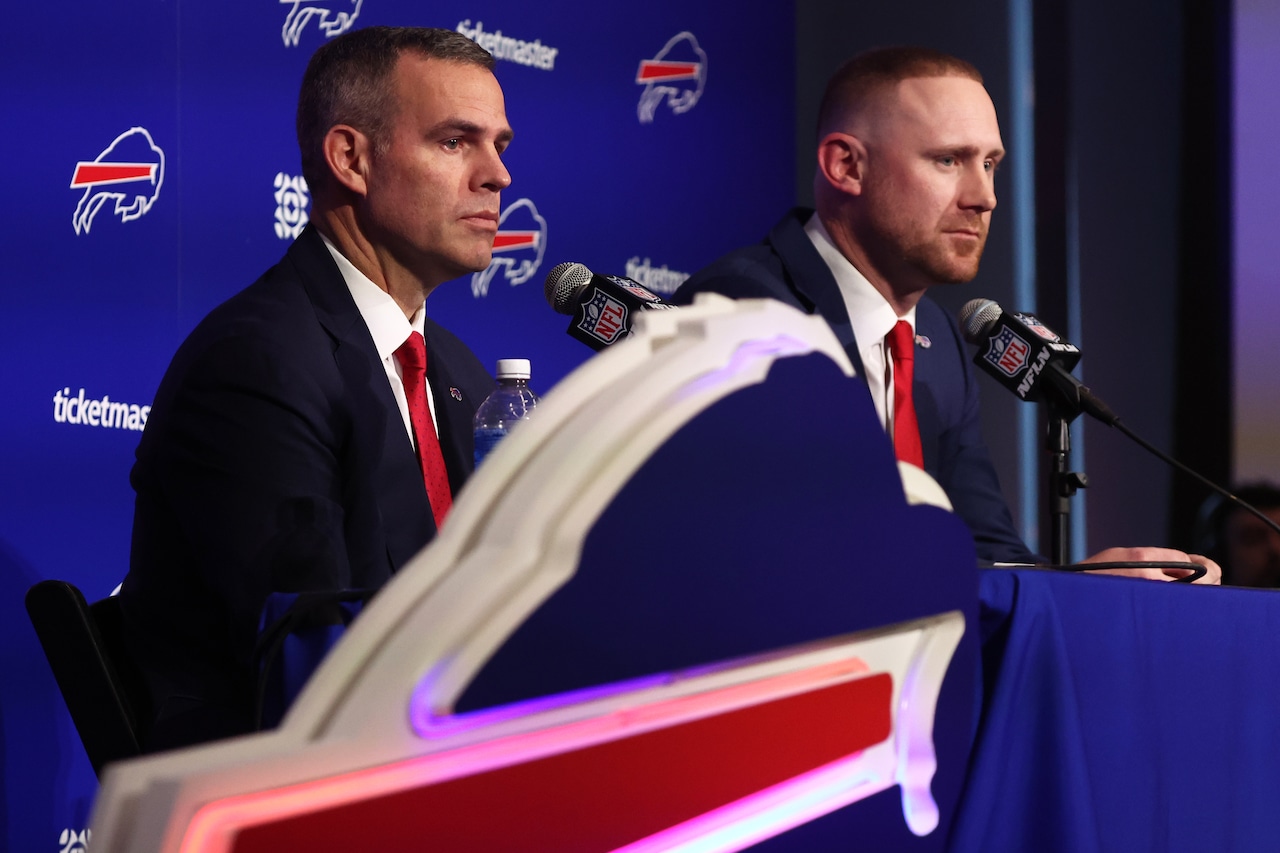
Buffalo Bills president and general manager Brandon Beane has more work to do than most NFL decision-makers to prepare the franchise to be competitive in free agency when the market opens next month.
The NFL informed teams that the 2026 salary cap is projected to fall between $301.2 to $305.7 million. The Bills currently have $321.6 million in contracts on their books for next season, according to Spotrac.com. Buffalo is estimated to be around $11 million over the salary cap. NFL.com posted a story this week with cap rankings of teams with the most space to the least. The Bills ranked near the bottom of the league at 28.
Beane has work to do to open up enough space to operate when the new league year begins on March 11. Buffalo has 21 unrestricted free agents from last year’s team, including starting center Connor McGovern and guard David Edwards. Both offensive linemen are expected to command big money, and it’s unclear if the Bills will be able to meet their contract demands.
So what does Beane need to do to give the Bills a chance to add valuable players to their roster? We’re outlining five moves Beane can make that would generate enough cap savings to allow Buffalo to reshape the roster.
The following moves are levers Beane can pull to open up the most cap space, but there are plenty of other player decisions that could come into play. We’ll detail some of those at the end of the story.
1. Restructure Josh Allen’s contract
Added cap space: $12.1 million
Allen signed a new six-year, $330 million contract extension last March. His 2026 cap hit of $56.38 million is set to count for nearly 20% of the Bills’ total cap. Beane can convert Allen’s base salary in 2026 into a signing bonus. The bonus is then prorated over the remaining years of the contract, spreading out the money and counting toward the cap in future seasons.
Allen’s current deal runs through 2030 and Beane can hypothetically keep pushing money into future years to give some cap relief. Allen’s 2027 cap hit is $53 million and his 2028 cap hit is $59 million. In 2029, Allen’s cap hit soars to $86 million.
2. Restructure right tackle Spencer Brown’s contract
Added cap space: $10.4 million
The Bills gave Brown a massive new contract in September of 2024 after the former third-round pick became their starting right tackle. Brown turns 28 later this month and figures to be a franchise leader over the next few seasons. Beane can restructure Brown’s contract similar to what he’ll do with Allen’s deal. Brown’s deal runs through the 2029 season and Beane can reassess the status next offseason and even consider a potential extension.
3. Sign left tackle Dion Dawkins to a contract extension
Added cap space: $12.7 million
The Bills have made it a priority to spend money on their offensive line over the past few seasons, particularly on the outside at the tackle position. Some difficult decisions loom with the potential exits of McGovern and Edwards, and third-year guard O’Cyrus Torrence could be in line for a contract extension this offseason.
Dawkins is in the second year of a three-year deal that comes with a $24.8 million cap hit in 2026. Beane has some options with Dawkins’ deal. He could do a similar conversion to what he may do with Brown, or he could give Dawkins an entirely new contract extension. That move comes with the most cap benefits. A new deal for around $60 million over the next three seasons would cut Dawkins’ cap figure in half to $12.1 million.
The only holdup would be if the Bills have concerns about Dawkins’ long-term viability as a top tier left tackle. He’ll turn 32 in April and an extension would tie Dawkins to the Bills likely through his age 36 season. If the Bills have doubts, they could opt to trade Dawkins now with his value still quite high. It wouldn’t give any pre June 1 cap relief but a haul of draft picks could help the Bills retool their line and more.
The most likely outcome is an extension. Finding good tackles is hard in the NFL and we’ve seen teams move on from good ones and struggle. No better example than the Houston Texans with the Laremy Tunsil trade in 2025.
4. Release receiver Curtis Samuel
Added cap space: $5.2 million
This is the easiest and most likely move of the bunch. Samuel has been a disappointment after signing a three-year deal in free agency back in 2024. He hasn’t been able to stay healthy and managed just 334 total receiving yards and two touchdowns with the Bills. Buffalo will take on a $3.45 million dead cap charge to release Samuel, but the savings make the deal make sense.
5. Release safety Taylor Rapp
Added cap space: $2.2 million
Rapp was a solid starter for the Bills in 2024 but an injury cut his 2025 season short. The Bills had six different safeties start next to young starter Cole Bishop, and Beane could choose to remake the entire room. New defensive coordinator Jim Leonhard will run a different defense than Sean McDermott. Moving on from Rapp comes with just a $666k dead cap charge.
Total projected salary cap space to begin free agency: $32.4 million
The Bills will likely need to open up more space if they want to aggressively shape the roster in the post-McDermott era. These five moves are a start for Beane so he can operate during free agency without many restrictions.
McGovern is expected to command roughly $16 million per season on a new deal and Edwards could get around $20 million. One or both could be gone and if Beane is able to land one of them, perhaps that player may consider a hometown discount, taking a little less to stay in Buffalo.
A few other moves that Beane could make to open up space are extending defensive tackle Ed Oliver, releasing or trading tight end Dawson Knox or releasing kicker Tyler Bass.
Beane said earlier this month that he expects Bass to be the kicker in 2026, but releasing him would give the Bills around $2 million in cap space.
Oliver is entering the final year of his contract and has a $23.9 million cap charge in 2026. The question on Oliver, 28, is whether he can be the tackle in Leonhard’s hybrid 3-4 scheme. If the Bills think he can do it, they should consider extending him. A new deal for Oliver at around $20 million per season would drop his 2026 cap hit in half and give the Bills about $11 million in cap space.
Knox is entering the final year of his deal and has an untenable $17.8 million cap charge in 2026. The big contract he was given has been an overpay in hindsight. Now Beane has to figure out the best path forward. He could release him outright and gain $10.4 million in space or could look to renegotiate the contract and bring down the cap number in 2026 and perhaps spread some into next season on a new deal. Knox is extremely close with Allen and may be open to a pay cut. If the Bills released him, Beane could get him back on a new deal in free agency.
All contract figures are courtesy of Spotrac.com