

One position the Pittsburgh Steelers need to overhaul in 2026 under new head coach Mike McCarthy is wide receiver. WR DK Metcalf is the top player at the position, and rightfully so. Yet the rest of the depth chart is full of questions. WR Calvin Austin III is a pending free agent. WR Roman Wilson hasn’t caught on yet.
The Steelers need to bring some talent in. That could be through free agency, the draft, trades, or some combination thereof. So, what does Mike McCarthy like in his wide receivers? Let’s take a look at his draft history and what he’s said to see if we can come up with some sort of idea.
Physical Traits
The first thing I did to answer this question was look at all the wide receivers drafted during Mike McCarthy’s head coaching tenures with the Green Bay Packers and the Dallas Cowboys.
Over 18 seasons as head coach (13 years with the Packers and five with the Cowboys), McCarthy’s teams drafted 23 wide receivers. That gives us a good sample size to see if there are any patterns in what McCarthy might look for in his ideal receiver.
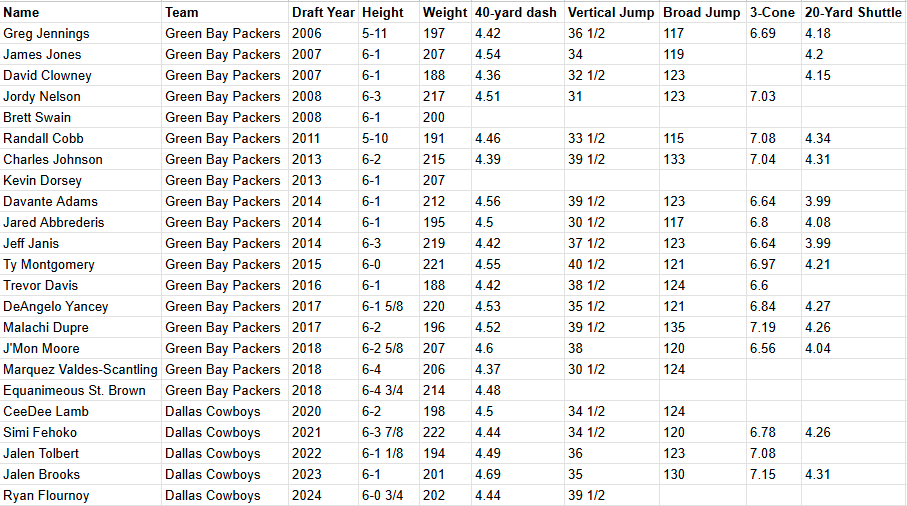
(Numbers courtesy of MockDraftable.com)
A few things jump out immediately. Of the 23 wide receivers drafted under McCarthy, only two were under 6-feet tall (Greg Jennings and Randall Cobb). On the other side of the height spectrum, only five receivers were 6-3 or higher (six if you give J’Mon Moore three-eighths of an inch more). The weight spectrum had some interesting variance as well. Eight receivers weighed under 200 pounds, and only two of those weighed under 190. At the other end, three receivers weighed at least 220 pounds.
What about the more athletic traits? Does McCarthy value burners at the position? Well, he wants some level of speed, but he isn’t necessarily looking for track athletes. Only three of the 21 receivers we have data for ran a 40-yard dash under 4.4 seconds, but only two ran 4.6 seconds or higher. According to MockDraftable’s aggregate statistics for wide receivers, the mean (average) 40-yard dash for the 1,053 wide receivers the site has data for is 4.499, essentially a 4.5. Ten of the 21 receivers ran a 4.5 or slower.
What about some of the explosive metrics? The mean vertical jump for 1,019 receivers is 35.557. Twenty of the 23 receivers drafted under McCarthy had vertical jump scores, and five of them had verticals of 34 inches or lower. Two more receivers came in under the mean. So, once again, McCarthy isn’t against drafting receivers who may not jump out of the building at the Combine or at their pro days.
As for the broad jump, the mean of 984 receivers was 121.353. Four receivers of the 20 for whom we have broad jump numbers were under 120 inches. Two more were exactly 120 inches, while two others were at 121 inches, below the mean. So eight of the 20 were below the mean. Once again, below-average numbers do not necessarily preclude a wide receiver from being selected. Meanwhile, only two wide receivers posted broad jumps longer than 130 inches.
When it comes to the three-cone drill, we only have data on 15 of the 23 receivers. The mean of 552 receivers on MockDraftable is 6.959. Five of the 15 receivers ran a three-cone in 6.7 seconds or faster. Meanwhile, six receivers ran a three-cone drill in seven seconds or slower.
So, what does it all mean? Well, Mike McCarthy doesn’t want super-slow receivers, but he isn’t necessarily hunting for the track stars, either. He wants receivers who are NFL fast, not 100-meter dash fast. He also isn’t looking for towering targets at the position, but he wants them to be big enough targets to help his quarterback.
However, does this data match up with what Mike McCarthy has said about what he wants in receivers? Let’s take a look.
What Does McCarthy Say?
Not long after the Steelers hired Mike McCarthy, he spoke about the wide receiver position and how he wants receivers who can line up all over the field. That means outside receivers need to have the route-running ability to work in the slot, while the slot receivers need to have the size to work against outside corners. Perhaps that’s why we see a lack of super short and super tall receivers in his draft history.
That also feeds into McCarthy having a basis in the West Coast offense. While he shies away from calling his offensive scheme a West Coast offense, it’s steeped in that philosophy. That means receivers need to be quick enough to get open.
We can see that McCarthy does value wide receivers who gain separation, thanks to NFL NextGen Stats. Even though the stats only go back to 2018, you can see McCarthy’s receivers throughout the list. For instance, WR Marquez Valdes-Scantling averaged 3.3 yards of separation as a rookie in 2018. Getting open quickly makes life easier for a quarterback, so it makes sense McCarthy would value that.
Another part of McCarthy’s philosophy is on what the most beneficial routes are for a receiver.
“[Do] they attack the interior routes?” McCarthy said. “That’s where the money is at. The fastest way to the end zone is through the post [over the middle of the field]. Fastest way to the end zone is up the seam.”
So, while receivers who can run outside the numbers and pull away from corners are great, those throws are harder to hit consistently. Corners can use the sideline as another defender. This dovetails with McCarthy’s idea of making the quarterback’s life easier.
“I think you’re always looking for bigger targets,” McCarthy said. “It makes sense, doesn’t it? Bigger catching radius, completion percentage. I think any quarterback would prefer to throw to a bigger target.”
Since McCarthy and the Packers drafted Ty Montgomery in 2015, McCarthy’s teams have only drafted a wide receiver shorter than 6-1 once. That was Ryan Flournoy, a late-round selection in 2024 who was 6-0 3/4. In fact, prior to that stretch, McCarthy’s teams only drafted one receiver 6-3 or taller (Jordy Nelson in 2008). Since Montgomery, McCarthy’s teams drafted three receivers 6-3 or taller (and a fourth at 6-2 5/8).
Final Thoughts
While I’d love to say that it would be easy to pick the next Steelers wide receivers out of a lineup based on their height, weight, and 40-yard dash time, it isn’t. In truth, the physical traits could be more useful in eliminating potential receivers than picking the next one. However, it does seem like McCarthy is trending toward taller receivers, so I doubt we would see a 5-10 receiver joining the Steelers anytime soon.
What I would say you would want to look at are receivers who have experience playing both inside and out and are good at creating separation. That fits McCarthy’s philosophy on receivers and offense in general. They also better be pretty good at running post routes, too.