
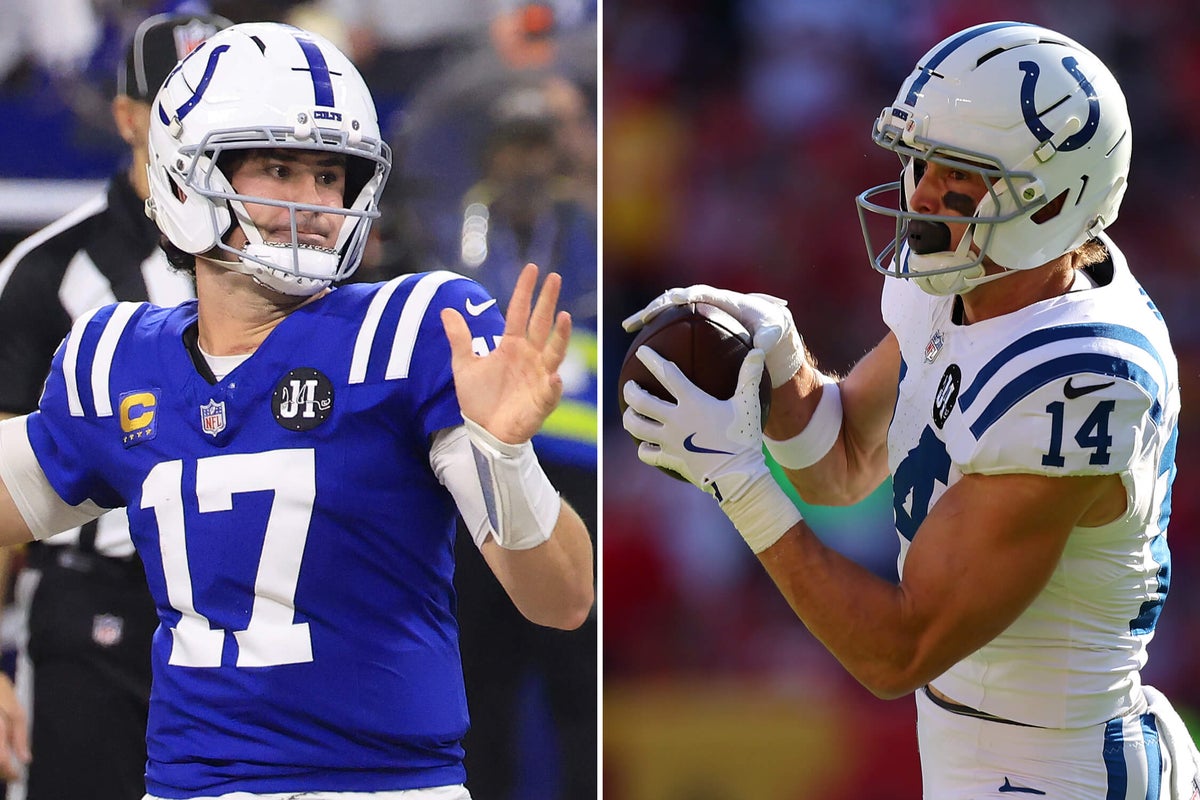
The NFL’s franchise tag window is officially open and runs through March 3 at 4 p.m. ET. This two-week period puts the Indianapolis Colts at an early crossroads during what is shaping up to be a pivotal offseason.
Realistically, the Colts have two players to choose between if they plan to use the franchise tag this offseason: quarterback Daniel Jones and wide receiver Alec Pierce. Both were vital to the Colts’ offensive success in 2025, and both will surely be welcomed back in 2026. However, Indianapolis can guarantee that only one of those impending unrestricted free agents will be in a Colts jersey next season.
As we await Indianapolis’ decision, I dove into what the franchise tag entails, while examining why Jones and Pierce each have a unique case to be tagged. Let’s dive in.
Tag, you’re it
The Colts have three tags to choose from: the non-exclusive franchise tag, the exclusive franchise tag and the transition tag.
The non-exclusive franchise tag is the most frequently used in the NFL. If the Colts placed this tag on Jones or Pierce, the player would receive a one-year, fully guaranteed salary that is either the average of the top five salaries at their position over the last five years or 120 percent of their previous year’s salary, per NFL rules. Whichever is greater is the one-year salary that the player would be awarded. In this scenario, Jones would make a projected $47.3 million in 2026, per Over the Cap, compared with $28.8 million for Pierce. The player would also be allowed to sign an offer sheet from another team, though Indianapolis would have an opportunity to either match that offer or receive two first-round picks as compensation if it allows that player to join the new team.
The exclusive franchise tag ensures that a player who receives it can’t field offer sheets from another team. However, it is usually a little pricier than the non-exclusive franchise tag because the one-year, fully guaranteed salary for this tag is determined by taking the average of the top five salaries at that player’s position over the last year (as opposed to the last five years) or 120 percent of their previous year’s salary, whichever is greater. Jones and Pierce are projected to receive the same salary on the exclusive tag in this scenario, per Over the Cap, though the NFL has not yet determined the official salaries.
Lastly, there is the transition tag, which is the cheapest. A player who receives this tag gets a one-year, fully guaranteed deal for the average of the top 10 salaries at their position over the last five years or 120 percent of their previous year’s salary, whichever is greater. In this scenario, Jones would make an estimated $40.8 million, per Over the Cap, compared with $25 million for Pierce. The risk is that if a player signs an offer sheet with a new team and its current team does not match it, that team is not entitled to any draft compensation, as it would be with the more expensive non-exclusive franchise tag.
For this exercise, we’ll proceed as if the Colts would only use the non-exclusive franchise tag because that is the most likely route they would take to retain Jones or Pierce.
Indiana Jones
Jones signed a one-year, $14 million prove-it deal with the Colts during last year’s free agency and quickly made good on that investment. He helped Indianapolis win its first season opener since 2013, improve to 2-0 for the first time since 2009 and climb to 8-2 atop the AFC standings. The Colts averaged 3.17 points per drive through their first 10 games, which was the fourth-highest mark this century, per TruMedia.
Jones’ promising campaign took a downward spiral after he popped up on the injury report with a fractured left fibula in Week 12 and tried to play through it. He ultimately tore his right Achilles tendon in Week 14 and was ruled out for the rest of the year. Jones totaled 19 passing TDs against eight interceptions, plus five rushing touchdowns in 13 games. He also tied for the second-highest completion percentage (68.0) in a season in franchise history.
Despite Jones ending the season on the sideline and his extensive injury history, Colts general manager Chris Ballard called Jones the team’s short- and long-term answer at QB during his end-of-season news conference, and Jones expressed interest in staying with the franchise as well. The No. 1 reason the Colts would consider franchise-tagging Jones is the importance of his position. Simply put, Indianapolis doesn’t really have another option at QB, especially after shipping off its next two first-round picks in a November trade to land star cornerback Sauce Gardner from the New York Jets. The only QBs the Colts have under contract in 2026 are 2025 sixth-round pick Riley Leonard and 2023 No. 4 pick Anthony Richardson, who ended the 2025 season on injured reserve with impaired vision caused by an orbital fracture suffered during a pregame warmup accident.
In theory, perhaps the Colts’ biggest competition for Jones in free agency would be the Minnesota Vikings, with whom Jones signed for the rest of the 2024 season after he was released by the New York Giants. J.J. McCarthy, the 2024 No. 10 pick, was the Vikings’ QB1 last year, but he had a tumultuous 2025 campaign that has likely made the franchise consider other options in 2026. But after Jones ruptured his Achilles tendon, Minnesota and any other potential suitors may not be as bullish on his recovery as Ballard and Colts coach Shane Steichen. The veteran QB will turn 29 in May and expects to be ready for training camp in July.
Big-play Pierce
Pierce was the Colts’ second-round pick in 2022, and after a nightmarish NFL debut in which he dropped what would have been his first touchdown reception, he has rebounded and improved each season. The former University of Cincinnati standout was always known as a deep threat who makes contested catches, but he expanded his route tree in 2025 to become a complete receiver.
Pierce, who turns 26 in May, totaled 1,003 yards and six TDs on just 47 catches this past season. His breakout campaign marked the first 1,000-yard receiving season of his career. He also led the league in yards per reception (21.3) for the second straight year while supplanting veteran Michael Pittman Jr. as the Colts’ No. 1 target. Pierce’s ascension couldn’t have come at a better time, as he’s solidified himself as arguably the second-best receiver on the forthcoming free-agency market behind Dallas Cowboys star George Pickens, who is also a franchise-tag candidate.
The argument for tagging Pierce appears to be tangential to Jones’ Achilles injury and how it will likely affect his forthcoming contract negotiations. Had Jones stayed healthy and led the Colts to the playoffs, it would be a no-brainer for the Colts to tag him because he’d likely have his pick of QB-needy teams, like Sam Darnold had last season before he chose to join the Seattle Seahawks. However, because Jones may be viewed as damaged goods and, therefore, has a smaller market, that may be all the more reason to keep Pierce from going anywhere by tagging him. Unlike Jones, Pierce doesn’t have any injury questions, and he’ll surely have a long list of suitors.
The Colts have used the franchise tag just once through the first nine years of Ballard’s tenure, and it was for a receiver. Ballard, who has referred to the tag as “a tool,” used it on Pittman during the 2024 offseason. Pittman did not play on the tag, which would have paid him a fully guaranteed $21.8 million in 2024, as both sides agreed to a three-year, $70 million contract extension with $46 million guaranteed a few days later.
Ironically, Pittman has declined in recent years, and his contract situation has likely opened the door for Pierce to land a lucrative payday. Pittman has a $29 million cap hit in 2026. The Colts could release Pittman and create $24 million in cap space for next season while carrying just $5 million in dead money. Those financial incentives make it very likely that Pittman has played his last game for the Colts, a possibility he acknowledged at the end of the 2025 season, unless he restructures his contract to take a significant pay cut. Either way, the money created from Pittman’s contract situation would likely come in handy in Indianapolis’ effort to retain Pierce.
Which one should Indy tag?
If I had to choose between tagging Jones or Pierce, I would choose the latter because of his health and field-flipping deep-threat skills. Pierce is projected to make $20.2 million annually on his next deal, per Spotrac, though I’d lean toward his salary being more in the $25 million range, given this year’s class of free-agent receivers. The only red flag on Pierce is that he has just one season of true No. 1 receiver production, but aside from that, he’s shown marked improvement each year while being relatively durable and never complaining about his role.
Jones is highly respected for his workmanlike approach, too, but he has a lot more deterrents on his resume than Pierce. The main one is his extensive injury history. Ballard is banking on a healthy Jones leading the Colts to the playoffs in 2026 and ending the team’s five-year playoff drought, but I wouldn’t bank on that literally by franchise-tagging him. Jones was likely in line for a raise like Darnold, who signed a three-year, $100.5 million deal with the Seahawks last offseason before leading them to a Super Bowl victory, but Darnold wasn’t coming off a devastating injury. Jones, for what it’s worth, has played only one full season through his first seven years in the NFL.