
If it weren’t for the awesomeness of Edgerrin Cooper, the Green Bay Packers’ linebacker corps would be viewed as a far more urgent offseason need.
Looking ahead to 2026, the depth chart is thin. The Packers only have three linebackers under contract: Cooper, Ty’Ron Hopper, and Isaiah McDuffie. Hopper will be entering Year 3 and has yet to firmly break into the starting lineup. Meanwhile, McDuffie has struggled in coverage — the area where modern linebackers are expected to contribute most.
On top of that, Quay Walker, Nick Niemann, and Kristian Welch are set to hit free agency, which could further thin out the group if the Packers don’t add linebackers. With that in mind, today’s focus is on one of the most athletic prospects in this draft class. They need a player who projects as a movable piece across the front seven and could give Jonathan Gannon further flexibility in how he structures Green Bay’s front: LSU linebacker Harold Perkins Jr.
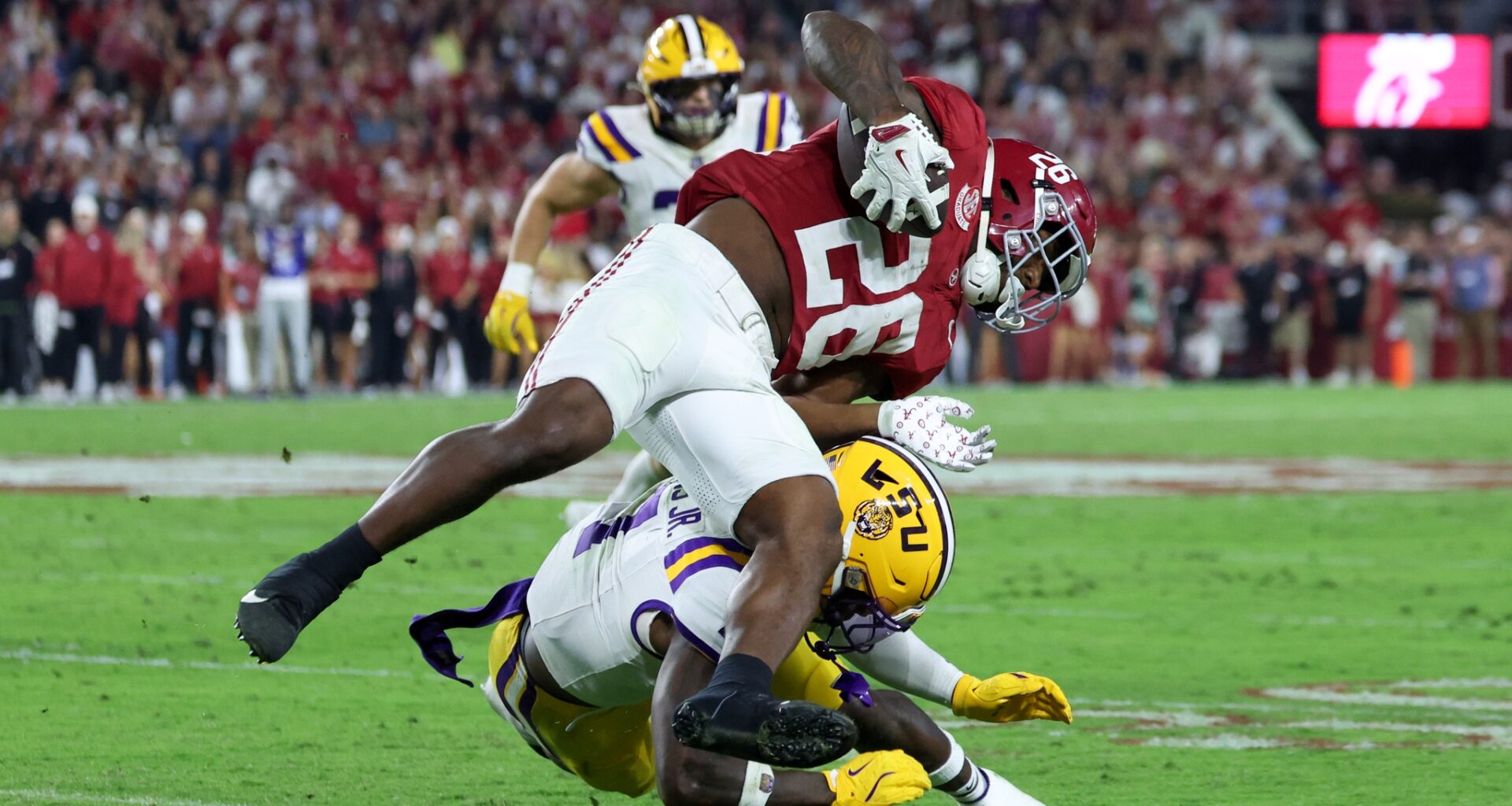
During his time at LSU, they shifted Perkins from a primary edge/pressure role to a hybrid linebacker and space-defender role. Rather than rushing frequently off the edge, he was aligned more often off-ball and in coverage structures. The usage change shows in the snap data. He logged 325 pass-rush snaps across his first two seasons, compared to only 124 over his final two, while his coverage workload moved in the opposite direction — 421 coverage snaps in his first two years, including 340 in 2025 alone.
Perkins profiles as one of the most versatile second-level defenders in the class, with a skill set that translates across multiple fronts and sub-packages. He’s an impact pass-rushing linebacker who consistently threatens the edge and interior gaps with burst, and he pairs that with strong in-box play. Perkins’ processing speed and instincts to the football show up against the run and on pressure design.
7 Minutes of Harold Perkins Jr Being A Game Wrecker 🐯 pic.twitter.com/XHh1tcPc0t
— Boppa 🧟♂️ (@ihatebbls) February 3, 2026
His deployment with the Tigers underscores true positional flexibility rather than projected versatility. He logged 366 snaps in the box and 250 snaps as a slot corner in 2025. That usage translates to real coverage and matchup value, giving a defense flexibility in sub-packages and pressure looks while keeping athletic speed on the field across multiple fronts.
It’s also important to note that he suffered a torn ACL in 2024, which sidelined him for most of that season and further reduced his pass-rush volume. Even with the role change and injury, his efficiency as a pressure weapon remained one of his strongest traits when they turned him loose as a rusher.
When Harold Perkins beat Arkansas basically by himself pic.twitter.com/eUqM0HCXqE https://t.co/m4qJGdIKj0
— BJ DPOY SZN❤️🩹 (@BJDpoy) January 25, 2025
From a risk-assessment standpoint, Perkins also carries measurable projection concerns. His listed weight of 222 lbs. gives him a more acceptable baseline for an off-ball linebacker role, but there are still projection variables tied to his build and usage. Perkins doesn’t have a naturally thick frame for consistent trench-heavy work, and his game is built on burst and range more than on play strength at the point of contact. That can create durability and workload questions if a defense expects him to handle high snap counts inside.
There are also play-style risk factors. Perkins’ aggressive trigger and pursuit speed are major strengths, but they can occasionally work against him. He will occasionally overrun plays or lose leverage by attacking too fast downhill. Combined with a recent ACL tear and role volatility during his college tenure, the overall risk profile remains significant. For a threshold-driven front office like the one led by Brian Gutekunst, the medical, role, and projection flags could push him down the board despite the upside.
Harold Perkins sits around No. 116 on the consensus board, and the Packers hold pick No. 124, which puts him well within realistic range. From a value perspective, the board could easily fall in their favor. However, given the medical history, role volatility, and projection questions, it’s reasonable to expect the red flags to outweigh the green ones and lead the team to pass if those concerns remain in his medical and grading evaluations.
If that happens, the alternative outcome is easy to picture: Another team — potentially a division rival — bets on the traits, the knee checks out long-term, and Perkins develops into one of the more dynamic defenders in the class. That risk/reward split is exactly what makes his evaluation so polarizing.