
Want more ways to catch up on the latest in Bay Area sports? Sign up for the Section 415 email newsletter here and subscribe to the “Section 415″ podcast wherever you listen.
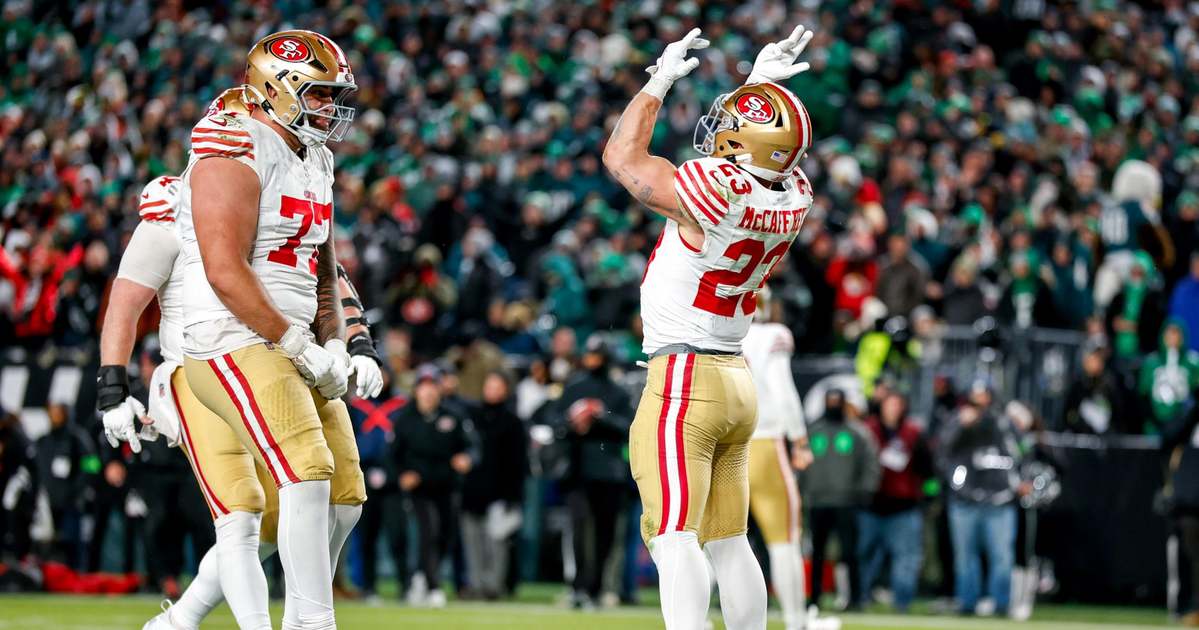
Perhaps the most complex statistical challenge exiting the 2025 season is parsing Christian McCaffrey’s performance.
Despite preseason pearl-clutching from outsiders regarding his health, McCaffrey didn’t miss a game and amassed a career-high 413 touches. He racked up more than 1,000 rushing yards and more than 100 catches. When it comes to sheer volume, this was a performance for the ages.
But it was not a particularly efficient season for the superstar. McCaffrey managed just 3.9 yards per carry, the worst output since his rookie season, And the fact that he was by far the 49ers’ leading receiver wasn’t necessarily a good thing, considering the offense suffered a prodigious drop in passing explosiveness.
Two things can be true at once: McCaffrey saved the 49ers’ season amid roster decimation, but their dependence on him was too great to take it the distance. A historically good Seahawks defense smothered the 49ers’ limited attack twice over their final three games.
For context, McCaffrey’s 2.75 yards after contact per attempt ranked No. 25 of 28 qualifying backs. While backup Brian Robinson Jr. didn’t have enough carries to qualify, he would’ve ranked No. 19. (In 2023, when the 49ers’ offense was historically good, McCaffrey ranked No. 4 at 3.35 yards after contact per attempt.)
Pro Football Focus’ measure of elusive rating, which uses a more complex formula to measure a back’s rushing efficiency, had McCaffrey at No. 26 and Robinson at No. 10. (In 2023, McCaffrey ranked No. 8.)
McCaffrey turns 30 this offseason, so the knee-jerk conclusion here is that age might be catching up to him — especially after bilateral Achilles tendinitis and a subsequent PCL tear limited him to just four games in 2024.
2 days ago

5 days ago

Friday, Feb. 13

But that would be overly simplistic — and likely incorrect — analysis.
Just take McCaffrey’s most statistically celebrated season, which came in 2019 when he became just the third player in NFL history to exceed 1,000 rushing and 1,000 receiving yards. In that season, McCaffrey averaged even fewer yards after contact per attempt — 2.62 — than he did in 2025. He also ranked near the bottom of the league in elusive rating.
Of course, no one would argue that McCaffrey was past his prime in 2019. He was just 23 then.
It would, however, be fair to say that McCaffrey was operating within the context of a severely limited offense in 2019. His Panthers ranked No. 28 in expected points added (EPA) per play.
This is a reminder that it’s impossible to disentangle individual production from team performance — and especially at a position as blocking- and space-dependent as running back. Even statistics designed to isolate a back’s performance are massively dependent on the situation around him. It’s a lot easier to break tackles when would-be tacklers are more occupied trying to cover other offensive threats.
The 2025 49ers’ offense, which finished No. 6 in EPA per play, was obviously better than the Carolina attack from 2019. But given the 49ers’ anemic finishes this season in the explosiveness and space-making departments, it’s fair to say that their offensive production far exceeded their level of available weaponry.
Coach Kyle Shanahan deserves huge credit for that. So do both of the 49ers’ quarterbacks, Brock Purdy and Mac Jones. And so does the most-used weapon, McCaffrey, who pushed his body to the limit to keep the 49ers churning — even with defenses keying on him more intently than at any point of his 49ers tenure.
That’s most evident in the level of receiving efficiency that McCaffrey was able to sustain despite all the defensive attention.
For comparison, Robinson — a pending free agent — averaged just 0.36 yards per route run, third-worst of running backs with at least 10 targets. One of the two backs ranked beneath him was former 49er Jordan Mason, who managed only 0.32 yards per route run with the Minnesota Vikings.
It’s clear that the 49ers couldn’t afford to take McCaffrey off the field because their passing game, already down so many capable receivers, would crater without him.
The optimal path forward involves pairing McCaffrey with a bona fide receiving threat. Pittsburgh’s Kenneth Gainwell and the New York Jets’ Breece Hall, both of whom made the YPRR leaderboard above, are both scheduled to be free agents next month. Kenneth Walker III, who won Super Bowl MVP at Levi’s Stadium, might also become available because Seattle likely won’t slap the franchise tag on him.
Is it time for the 49ers to go all-in on offense, spending be damned? Fans might prefer that route to, say, drafting another running back in the third round. None of those experiments have worked and McCaffrey is still waiting for a credible counter-threat.
Isaac Guerendo, who’s endured some ball security issues, is still on the team. So is Jordan James, who enters his second season as a back with adaptable potential.
But unless the 49ers are sure one of those players can reliably move the needle in 2026, they can’t wait around forever. McCaffrey’s 30th birthday is a looming reminder of that. So is the fact that he’s only under contract with the team for two more seasons. That means 2026 almost certainly marks a defining inflection point.
History tells us that McCaffrey’s versatility can be the lynchpin that pushes a properly stocked offense over the top. His jaw-dropping volume of production in 2025 indicates that there’s still gas left in the tank.
Get the man some proper help — both in the backfield and on the perimeter — before it’s too late. And stay healthy. Outside of McCaffrey, the 49ers didn’t do that in 2025. As a result, his mighty contributions stabilized the offense, but they couldn’t propel it to title-winning heights.