
INDIANAPOLIS — Greetings from the combine. Over the next week, we will have boots on the ground to gather information about the Los Angeles Chargers’ offseason plans.
General manager Joe Hortiz and head coach Jim Harbaugh have plenty of work to do in the coming months to put the Chargers in a position to contend. Hortiz and Harbaugh are two years into their tenure. They do not have a playoff win. Whatever moves they make and do not make through free agency and the draft will determine if they can get the Chargers and quarterback Justin Herbert over the hump. The Chargers have not won a playoff game since 2018.
With that in mind, let’s set the stage for this week in Indy. Here are five questions I will be looking to answer in my travels and conversations around the city.
Is Tyler Linderbaum a real possibility?
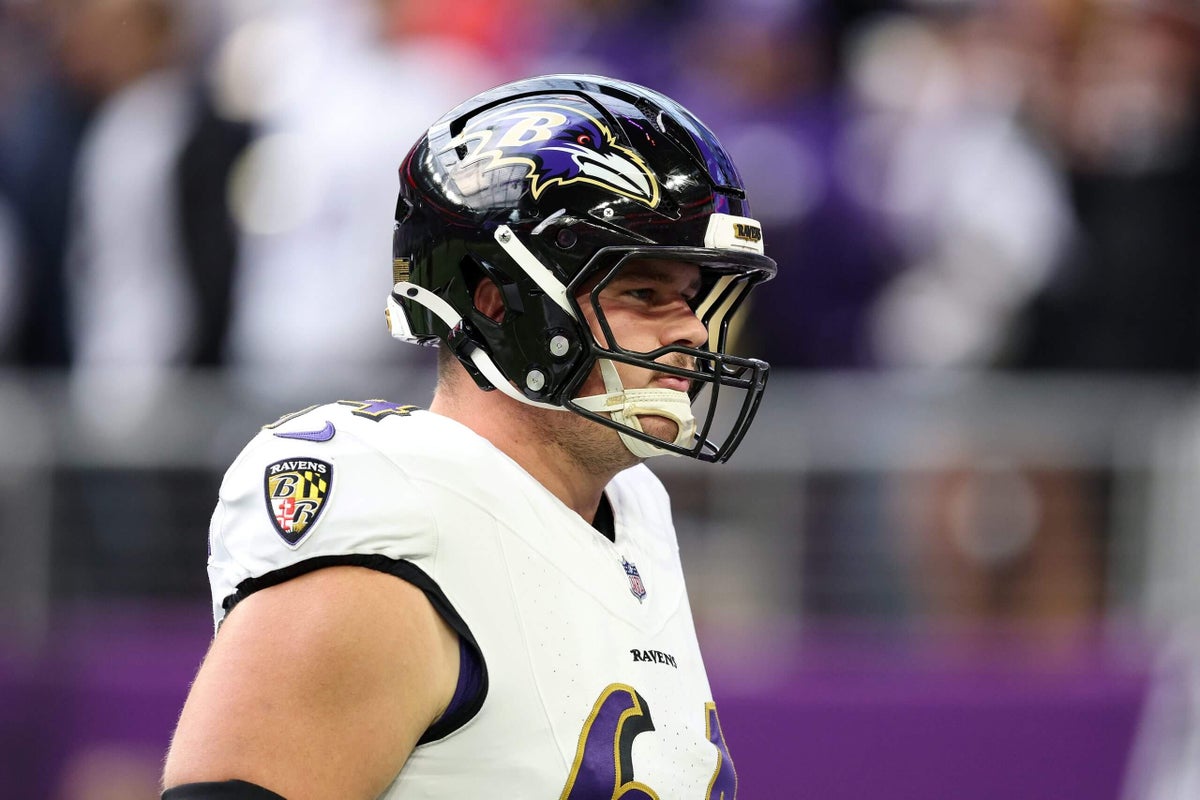
Los Angeles needs to upgrade at center. Bradley Bozeman played poorly in 2025, and he is not a fit for new offensive coordinator Mike McDaniel’s scheme. The most obvious solution is signing Baltimore Ravens center Tyler Linderbaum, whom Hortiz had a hand in drafting when he was in the Ravens personnel department.
That said, the most obvious solution is not necessarily the most realistic one.
The Chargers have the third-most cap space in the league, according to Over the Cap. Even after they sort through their internal free agents, they will have the operating space to make an aggressive offer for Linderbaum. However, it is quite possible that Linderbaum never hits the open market and re-signs with the Ravens on an extension.
A lot of my focus this week will be devoted to gauging Linderbaum’s market. Is he truly available? Will he actually test the open market? If so, are the Chargers the primary contenders? Or is all this speculation meaningless because Linderbaum is inevitably returning to Baltimore?
The Chargers will have other free-agent center options if Linderbaum is off the table. Three players I like: the Buffalo Bills’ Connor McGovern, the Carolina Panthers’ Cade Mays and the New Orleans Saints’ Luke Fortner.
What is the plan for the top three internal free agents — Khalil Mack, Odafe Oweh and Zion Johnson?
Edge rushers Khalil Mack and Odafe Oweh and left guard Zion Johnson should be the Chargers’ top three internal priorities.
Are the Chargers functioning as though all three of those players will be returning?
When we last spoke with Hortiz on the record after the season, he seemed very open to bringing both Mack and Oweh back while also extending Tuli Tuipulotu to a market-rate extension. Tuipulotu is eligible for an extension after completing his third NFL season, and we will dig into that situation below. Committing three high-priced contracts to one position room presents some challenges from a roster-building standpoint. But when asked last month if he would allocate those resources to the edge room, Hortiz said, “The easy answer is yes because they’re impact players, all three of them.”
If the Chargers let Johnson walk, they could be looking for three new starters on the interior. The roster puzzle fits together more easily if they can re-sign him, but he will have a sizable market. How high will the Chargers go to hang onto Johnson? If Johnson ends up in the $16 million-$17 million range in average per year, that makes some sense. If the market gets closer to $20 million APY, that changes the conversation.
Where do things stand on the Tuli Tuipulotu extension?
Tuipulotu is coming off a 13-sack season, and he is in line for a payday. Right now, I think his extension ends up in the $25 million-$30 million range, but I will be curious to check in more thoroughly on where those talks stand.
This extension is unlikely to create any cap savings for the Chargers. Tuipulotu is slated for a $6.1 million cap hit in 2026, according to Over the Cap. At best, the Chargers could maintain that cap hit for 2026 on the extension. More likely, that cap hit will increase for 2026 due to the size of the contract.
How will the coordinator changes affect the personnel approach?
The Chargers have new coordinators on both sides of the ball. They hired McDaniel as offensive coordinator after firing Greg Roman, and they hired Chris O’Leary to replace former defensive coordinator Jesse Minter, who took the Ravens head-coaching job.
Will the style of players change now that the Chargers have two new play-callers?
Defensively, O’Leary will be running the same system Minter did, so the archetype of player should be very similar — if not identical — when assessing scheme fit. The change defensively could show up in the talent investment on that side of the ball. Minter proved he could do more with less talent. As a result, the Chargers devoted a lot more of their resources, particularly early in the draft, to offense. I could see the Chargers shifting that investment to the defense to try and give O’Leary, a first-time play caller in the NFL, more to work with as he gets his feet under him.
Offensively, the scheme will change pretty significantly under McDaniel. Do they look for more speed at the skill positions, primarily running back and receiver? How do the Chargers attack the offensive line, knowing that they could require more athleticism for McDaniel’s horizontal and misdirection-based running scheme?
Who stays and who goes among the cap-cut candidates?
The Chargers have four primary cap-saving cut candidates. They will save $9.7 million if they cut right guard Mekhi Becton, according to Over the Cap. Bozeman ($5.875 million in savings), tight end Will Dissly ($4 million) and edge rusher Bud Dupree ($3.49 million) can also provide some additional relief if cut.
I want to find out who is part of the Chargers’ plans and who is not. My expectation right now is that Becton will be cut. I also expect the Chargers to move on from Dupree. The other two are more up in the air.