
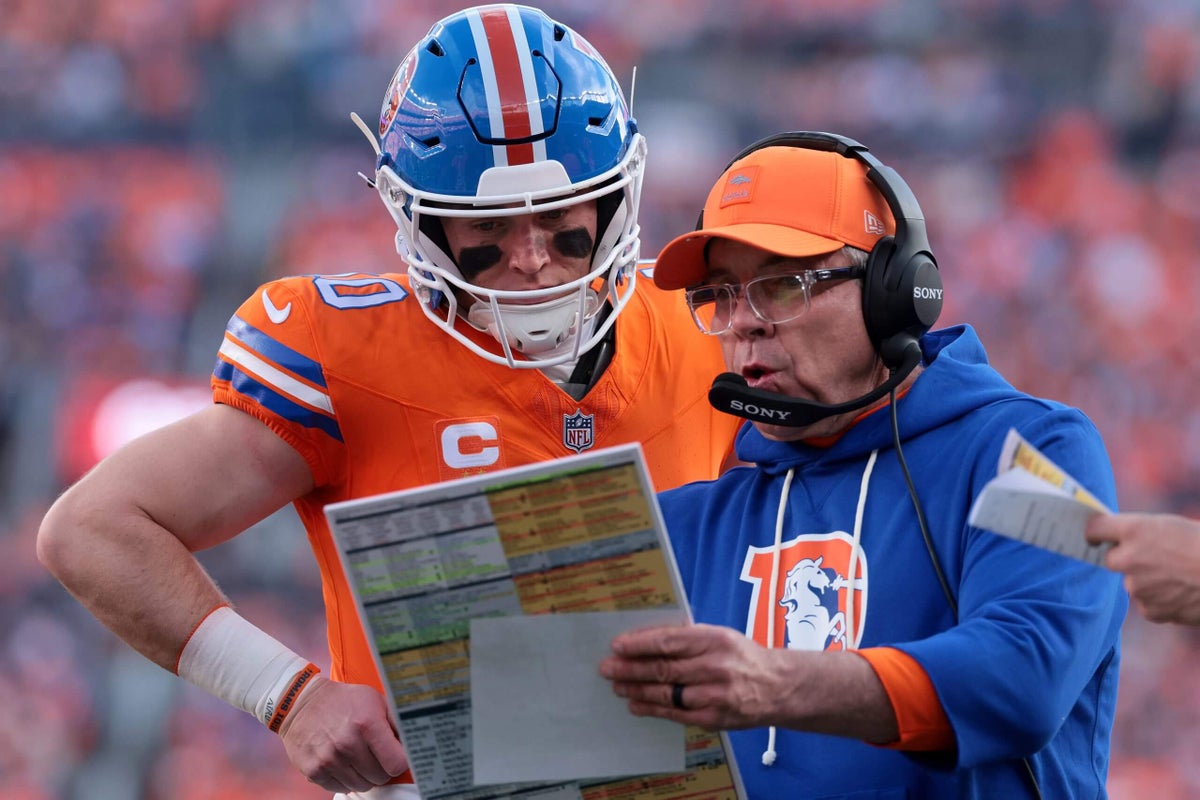
The question has hung in the air for weeks without input from the man who will ultimately answer it.
Will Sean Payton actually hand off offensive play-calling duties next season?
The 62-year-old head coach of the Denver Broncos figures to address whether he’ll pass that dutyto new offensive coordinator Davis Webb, in some fashion, at the NFL Scouting Combine in Indianapolis this week. It is a question that has arisen largely because of the potential opportunities Webb passed up elsewhere to remain in Denver on Payton’s staff. Factor in Payton’s introspection about his role ahead of the playoffs — “It was said as you get older, maybe you don’t drive in the rain at night … I can’t let that happen as a play-caller,” he said at the time — and there is a hearty dose of intrigue surrounding the Broncos this offseason.
In reality, though, the play-calling situation is just one component of a broader question for Denver, one that is at the heart of its quest to turn last month’s heartbreak in the AFC Championship Game into a Super Bowl rebound in 2026: Can Payton and the Broncos finally produce a consistently dynamic offense?
There were plenty of reasons the Broncos amassed only a single touchdown in a 10-7 loss to the New England Patriots that left them on the cold doorstep of the Super Bowl. It began, of course, with the fact that starting quarterback Bo Nix missed the game with an ankle injury he suffered the prior week. There were two missed field goals and a short field goal opportunity Payton passed up in favor of a fourth-and-1 play in the red zone that ultimately failed. There was a driving snow in the second half that quite literally put a white wall in front of Denver’s comeback bid.
Still, the final score illustrated where the Broncos must improve in Payton’s fourth season. The Broncos wanted to run the ball effectively against the Patriots. They believed entering the game that they had put together one of their best run plans of the season. They ran for only 79 yards on 24 carries and produced no rush longer than 9 yards. The team’s running backs averaged only 2.8 yards in the game, mirroring the position group’s flameout in the previous season’s playoff loss in Buffalo.
It leaves the Broncos entering another offseason in need of a consistent lead back. For 10 weeks, it appeared they had found one in J.K. Dobbins, the veteran they signed in the late stages of free agency last spring. He was on pace to produce the best single-season performance for a Broncos running back in more than two decades. Then, Dobbins went down with a Lisfranc foot injury that ultimately ended his season, the latest in a long line of unfortunate injury setbacks since he entered the NFL in 2020.
RJ Harvey’s rookie season in Denver featured promising moments. He had three monstrous runs of 38 yards or more, two of which went for touchdowns. He caught 56 passes for 424 yards, including his playoff contributions, and he scored 12 total touchdowns. He averaged only 3.3 yards per carry, though, in the nine games after Dobbins went down. Harvey remains an intriguing, young piece for the Broncos’ offense, but the team will spend the offseason searching for the right back to complement last year’s second-round pick. Dobbins, an unrestricted free agent, has expressed a strong desire to return to the Broncos next season, but the team figures to be aggressive in evaluating outside players, too.
Breece Hall is a tantalizing option. He is arguably the best offensive player currently scheduled to hit the free-agent market and profiles as the kind of do-it-all-weapon out of the backfield that was a staple in some of Payton’s top offenses in New Orleans. Hall rushed for a career-best 1,065 yards with the New York Jets last season, and he has averaged 56 receptions and 474 receiving yards the past three seasons. In short, Hall has been a consistent playmaker even while operating within one of the NFL’s least-consistent offenses. That’s why it’s an enticing exercise to imagine him operating within the support system the Broncos could offer, which includes an established, yet still-improving quarterback in Nix, one of the league’s top offensive lines and an offensive architect in Payton who has ample experience successfully utilizing backs with diverse skill sets.
Kenneth Walker, the recently crowned Super Bowl MVP, could also represent a splash play for the Broncos. He has a similar run profile to Dobbins — compact build, low center of gravity, patient approach — but is 2 years younger and has missed only 10 combined games in his four-year career because of injury. He played in all 20 games for the Seahawks during the 2025 season, playoffs included, and rushed for 135 yards in Seattle’s Super Bowl rout of the Patriots. He could create a strong pairing with Harvey that resembles what he has had in Seattle with fellow back Zach Charbonnet.
The quest to improve their running game will require schematic adjustments as much as personnel ones. Payton, in the days after the AFC Championship Game loss, met with Zach Strief, the team’s offensive line coach and run-game coordinator. It represented the start of a search for “a series of answers” to some of the issues that plagued Denver in 2025. Webb’s input into how the Broncos pair the running game with Nix’s mobile traits will also be critical.
“I feel like we’re far enough along with the RPOs and some of that, but when we want to run it under center and control a game, we’ve been able to do it a few times, but not as much as I’d like,” Payton conceded at season’s end. “That’ll be an important study and with urgency. … I want to play from the gun, but I also will always want to play with a two-back or multiple-tight end mindset, have that flexibility.”
Payton professed faith in the receiving weapons on Denver’s roster, all of whom remain under contract next season. The Broncos have selected a wide receiver with an early fourth-round pick or higher in each of the past three seasons — Marvin Mims (second round, 2023); Troy Franklin (fourth, 2024); Pat Bryant (third, 2025) — and signed veteran Courtland Sutton to a four-year contract extension last fall. That’s a significant investment in the wide receiver group. Payton moved on from position coach Keary Colbert after the season and is set to replace him with Ronald Curry, one of his former assistants in New Orleans, a move he believes will be key to developing what the Broncos already have in their building.
“Look, we’ve drafted to it, and I like who we’ve drafted to it,” Payton said. “Yes, there were too many (drops), even down the stretch. The thing with the draft, man, we’ve invested, and I like the players in that room. We’ve got different (traits). We have speed. We have size. We have all the things I’m used to (and) you’d want to have in a good offense.”
Still, the expectation is that the Broncos will spend their time in Indianapolis closely evaluating options at wide receiver, from meetings with a crop of prospects who could be available with Denver’s first-round pick (No. 30) to internal discussions about some of the free agents they could target. This is true at tight end, where veteran Adam Trautman is a free agent. Even if the Broncos bring back the player who has led the position in snaps the past three seasons, and work to find more opportunities for Evan Engram following his up-and-down first season in Denver, there is a need for more talent at the position.
“We have one of those quarterbacks,” All-Pro left tackle Garett Bolles said at the end of the season as he began listing reasons why he believes Denver will be a top free-agent destination this offseason. “We have a great running back room. We have great receivers. Obviously, we need some key players to come in and do what they need to do by getting points on the scoreboard. We have a phenomenal defense. We have everything we need. We just need a couple more playmakers and the sky’s the limit for this team.”
Changes are afoot. They always are for NFL teams this time of year, even one preparing to bring back the core of a team that won 14 games last season. The Broncos arrive in Indianapolis with a clear priority. They must make the additions and tweaks necessary to build a championship-worthy offense, regardless of who calls the plays.