
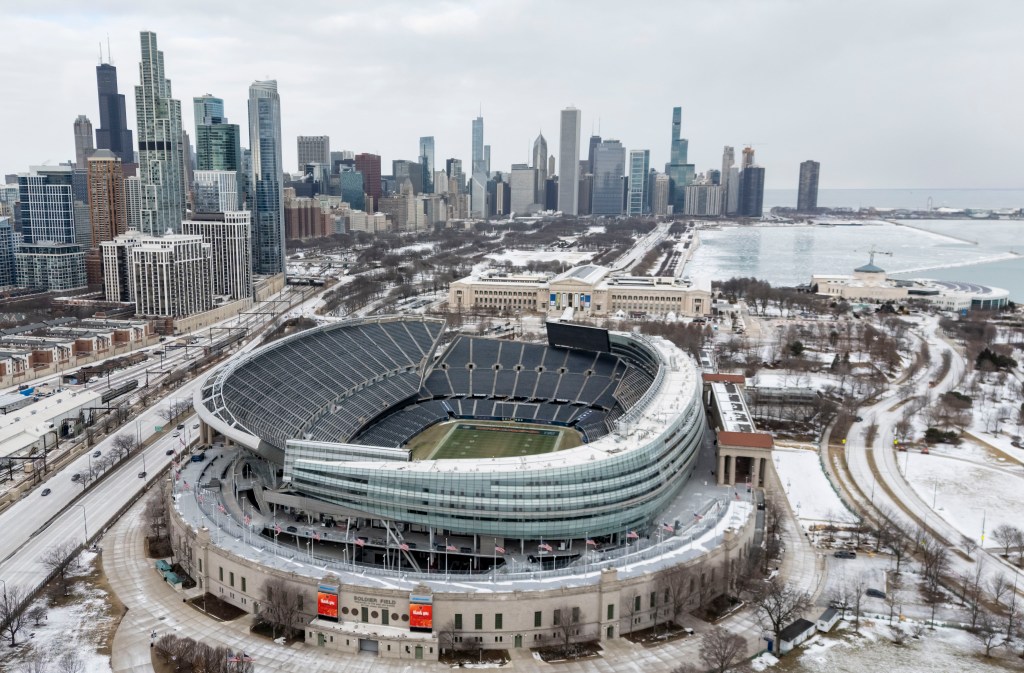
SPRINGFIELD — While the Chicago Bears consider legislative proposals from Illinois and Indiana lawmakers to decide which state should be home to its new stadium, the Chicago Park District has proposed a more than half a billion-dollar plan to revamp Soldier Field for when the team moves on from there.
The Park District, which owns the lakefront stadium that has been home to the Bears for more than half a century, pitched state officials on converting the 61,500-seat venue to a destination for concerts and other special events, a transformation that could cost about $630 million, according to a source with knowledge of the matter.
What to know about the Chicago Bears’ possible move from Soldier Field
The proposal would include improvements to Soldier Field’s sound system and other amenities, as well as infrastructure adjustments to roads and other areas around the stadium to accommodate the conversion, the source said.
The source declined to be identified because they weren’t authorized to speak to the news media about the plan, which was first reported Sunday by WFLD-Ch. 32 Chicago.
The Park District declined to directly address its latest proposal for Soldier Field, instead issuing a lengthy statement on Monday about how the agency has maintained a partnership with the team since the Bears began playing there in 1971.
“At the same time, as stewards of public land and public resources, our responsibility is to ensure that Chicago’s lakefront stadium continues to serve as a strong public asset that supports park programming and maintenance across the city, vital public services, and the broader tourism economy anchored by the Museum Campus,” the Park District said. “That fiduciary responsibility guides the District’s stewardship of Chicago’s lakefront stadium and surrounding public assets.”
“Soldier Field is the Chicago Park District’s largest non-tax revenue source and a year-round, multi-use venue that generates tens of millions of dollars annually for the District, with more than 80% of that revenue coming from non-NFL events such as major concerts, international sporting events, and large civic gatherings,” the statement continued. “The stadium hosts hundreds of events each year that create jobs, attract visitors, and drive economic activity for Chicago’s hospitality, cultural, and tourism sectors.”
The debt for the 2003 Soldier Field renovation stands at a principal of $356 million and $111 million in remaining interest, for a total of $467 million, according to the Illinois Sports Facilities Authority.
The Bears rent Soldier Field for about $7 million a year. But the team and the Chicago Park District do not pay a penny toward the debt for the stadium. Instead, it is supposed to be paid by Chicago’s 2% tax on hotel room rentals. But that revenue has been insufficient to pay the annual debt, forcing the city to pay nearly $6 million last year, and a total of nearly $52 million over the past four years.
Because political leaders repeatedly refinanced the bonds for Soldier Field to push the payments farther into the future, the annual amount owed will balloon in coming years, from $54 million this year to $90 million in 2032.
Word of the Park District’s proposal comes days after Democratic Gov. JB Pritzker acknowledged publicly last week that wherever the Bears decide to build their new stadium, it likely won’t be within Chicago’s city limits.
For Pritzker and Illinois lawmakers, that would mean, given the lack of movement on any stadium projects near Soldier Field or elsewhere in Chicago, the state’s only viable option is the land the Bears own in northwest suburban Arlington Heights.
However, also last week, Indiana lawmakers took another step toward potentially luring the Bears across the border to Hammond, as a key Indiana House committee approved a plan to create an agency to build a new stadium. But Indiana lawmakers are running out of time to pass the bill through its whole legislature that is scheduled for adjournment on Friday.
Although neither state’s stadium plans are guaranteed, Indiana officials have tried to portray last week’s moves as giving them the leg up in wooing the charter NFL franchise from the Land of Lincoln to the Hoosier State.
Illinois lawmakers who represent Chicago have been reluctant to incentivize the Bears to leave the city. But the legislature is mulling a bill that would make it easier for the Bears to negotiate more easily with local taxing bodies on their property tax rate if they were to move to the site of the former Arlington International Racecourse, which the team purchased a few years ago for $197 million.
That bill is slated to be called for consideration in the Illinois House Revenue and Finance Committee in Springfield on Thursday.
In a statement, Pritzker spokesman Matt Hill said Monday the Bears and the Illinois General Assembly “continue to make progress” on an agreement that addresses “affordability, infrastructure, and property tax fairness.”
“Governor Pritzker has always been clear that he wants to keep the Bears in Illinois, ensure we are responsible stewards of taxpayer dollars, and preserve opportunities to attract economic activity,” Hill said.
Yin and McCoppin reported from Chicago.