
The Pittsburgh Steelers could select a quarterback in the 2026 NFL Draft. Today’s goal is to look at some accuracy metrics for this year’s combine invites at the position. The data in this article is from Pro Football Focus (PFF), starting with completion rates and adjusted completion rates.
The latter is “aimed passes” (taking out things like throwaways and spikes), and the formula is completions + drops / aimed passes. The goal of adjusted completion rates is to provide a more accurate gauge of a quarterback’s accuracy than the generic completion rate stat. Here is how the class stacks up:
NOTE: North Dakota State’s Cole Payton is not included because PFF does not track smaller schools.
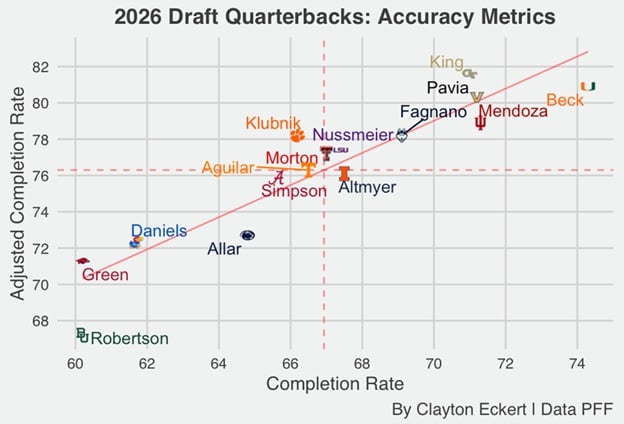
Players above the trendline (diagonal line) land above the mean in adjusted completion rate (y-axis) compared to their completion rate (x-axis). Looking at the players on the top right, five are comfortably above average in both stats. Those names are Carson Beck (Miami), Fernando Mendoza (Indiana), Diego Pavia (Vanderbilt), Haynes King (Georgia Tech), and Joe Fagnano (Connecticut).
Those men had the top-five completion rates in the class, with each having a healthy 70-plus completion rate except for Fagnano (69.1 percent). Three of them had an adjusted completion rate above 80 percent: King (81.6 percent), Beck (80.9 percent), and Pavia (80.3 percent). So they were the cream of the crop in both accuracy stats.
You need additional context, though, such as the average depth of target (ADOT). Pairing a healthy ADOT with the initial accuracy metrics adds value. Meaning, a quarterback with a higher ADOT remained accurate even when pushing the ball downfield more. Looking at the top five names in completion rate, Mendoza had the healthiest 9.4 ADOT. Of the top three players in adjusted completion rates, Pavia had the strongest 9.3 ADOT.
Here is a rankings table of the stats to digest everything more fully:
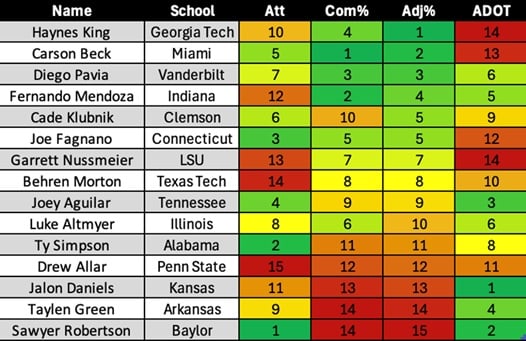
There are numerous other stats out there, but this paints a good picture for the goal of this article – accuracy. King and Beck are atop the list, but they are examples of strong adjusted completion rates with lower ADOT. They are more dink-and-dunk compared to their peers. Pavia and Mendoza have a better balance of accuracy and ADOT, though the latter had fewer attempts.
Klubnik saw a notable jump in the ranks from completion rate to adjusted completion rate, but had a below-average ADOT. Fagnano can’t say the same, with identical ranks in both accuracy stats and an even lower ADOT. Nussmeier, who was next-to-last in ADOT with fewer pass attempts, is similar.
On the bottom half of the adjusted completion rankings, we see a more expected result. With greater passing distance comes an expected dip in accuracy for most quarterbacks. Daniels, Robertson, Aguilar, and Green in particular. A player who landed poorly in all regards was Allar.
The pro game is obviously a vast increase in competition level, and the numbers shed some light on some overall weaknesses in the 2026 QB class. Excluding attempts, it is probably no surprise that potential number one pick Fernando Mendoza provided the best balance of accuracy and pushing the ball down the field. A name I wasn’t as sure of that jumped out positively was Diego Pavia of Vanderbilt, seemingly a Day Three prospect.
In terms of pure accuracy, Haynes King, Carson Beck, and Joe Fagnano had quality final collegiate seasons. But what that could look like in the NFL should come with tempered expectations, in my opinion. Of course, Mendoza would be anyone’s first choice in this quarterback class. From this study, Pavia is an intriguing name to learn more about, while the rest of the list is lackluster in one aspect or another.