
Editor’s note: This article is part of the Bracket Central series, an inside look at the run-up to the men’s & women’s NCAA Tournaments, along with analysis and picks during the tournaments.
The NCAA men’s basketball selection committee gave us actual, verified evaluations of the teams at the top rungs of the tournament field, then the teams went right out and rearranged the picture.
That made the 10th annual NCAA release of the top 16 seeds unique, and so did this: Committee chair Keith Gill gave the best, clearest answers on questions related to committee decisions … ever? If the field of 68 can be expanded despite strong opposition from an overwhelming majority of people who care about the sport and the fact that the NCAA has about a thousand more important things to do, can we expand Gill from one year as chair to 10?
The official top 16 seeds as of Feb. 21 gave hints at the bracket to come, and so did Gill. One thing he said that relates to this edition of Bracket Watch is that Connecticut was a No. 1 seed as of Wednesday, fell after the loss to Creighton, but stayed ahead of Houston because UConn’s three best wins (Illinois and Florida at neutral sites, at Kansas) are better than Houston’s three best (at BYU, Texas Tech at home, Arkansas at a neutral site).
That tells us how close and subject to change things are, and reminds us of how the conversation in the room starts with the metrics and then goes much deeper on every team considered. Those three best wins on each side outweighed predictive metrics that were clearly in Houston’s favor.
The main takeaway I had from doing a mock media selection 11 (!) years ago at NCAA headquarters is that each team is scrutinized based on this question: “What can you do against this field?”
It’s great to see the NCAA doing the mock selections again, and there’s no question its process has improved from a decade ago, when it still had this awful thing called the “RPI” in play.
The team sheets now include seven metrics that the committee uses. The resume metrics are the KPI, ESPN’s Strength of Record and Wins Above Bubble. The predictive metrics are Ken Pomeroy’s efficiency rankings, Bart Torvik’s efficiency rankings, the NET and ESPN’s BPI. Start there. Then discuss.
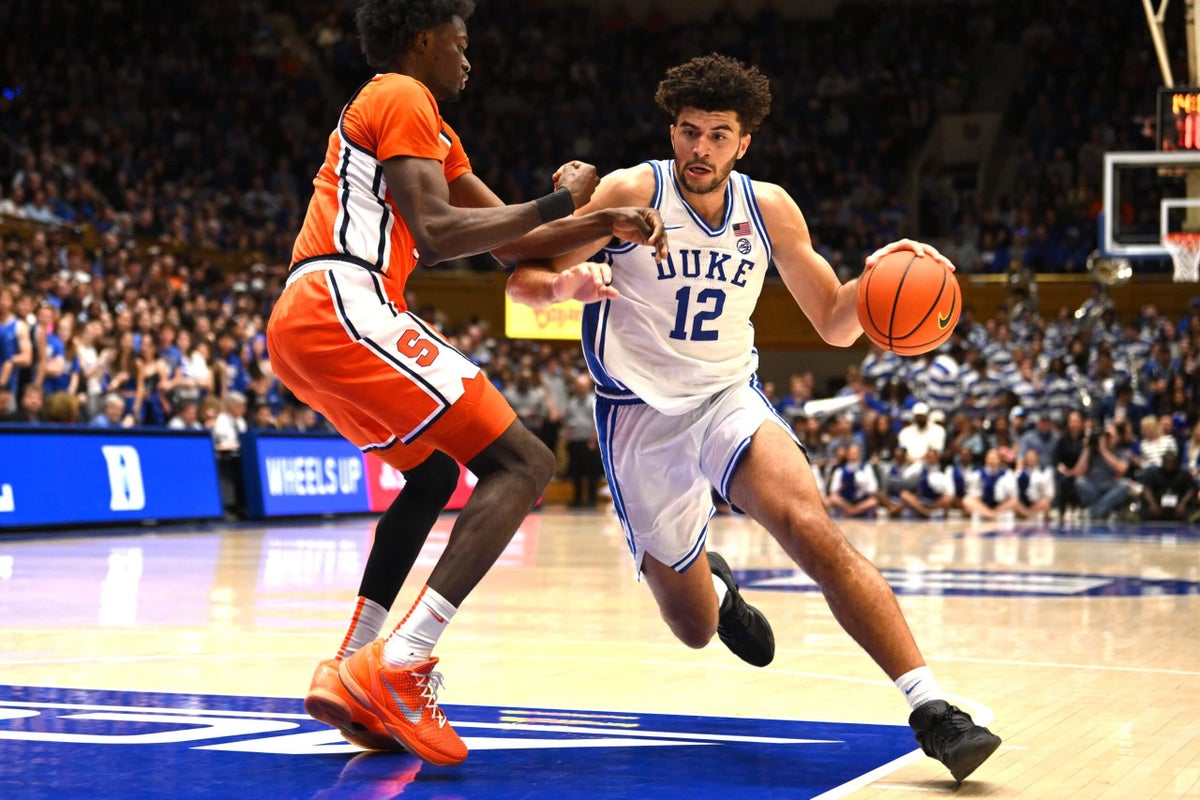
All that said, here’s what changed from Saturday’s official top 16 to the top 16 you see on this bracket: Duke jumped Michigan for No. 1 overall after beating Michigan (and yes this matters, because the top seed will be lined up to play the fourth No. 1, and also Michigan will get to start in its preferred destination of Philadelphia if it can reclaim that spot by Selection Sunday); UConn won at Villanova, Iowa State lost at BYU, Houston lost at home to Arizona and UConn jumped right back to the top line; Vanderbilt lost at home to Tennessee, and Alabama, which Gill said was No. 17 as of Saturday, took Vandy’s spot on the four line.
There are changes at the bottom of the at-large pool as well. Another thing that emerged in the media exercise — which was attended by The Athletic’s CJ Moore — is that Wins Above Bubble is a critical metric when splitting hairs between teams. This is represented in the choices. For a comprehensive look at the bubble, make sure to check out Jim Root’s Bubble Watch.
First four outNext four outLast four inLast four byes
New Mexico
San Diego State
Santa Clara
Auburn
TCU
Virginia Tech
Ohio State
Indiana
Cal
Seton Hall
Missouri
UCF
VCU
Cincinnati
USC
UCLA
Multi-bid conferences
Big Ten
11
SEC
11
ACC
8
Big 12
7
Big East
3
WCC
3
The Bracket Central series is sponsored by E*Trade from Morgan Stanley. The Athletic maintains full editorial independence. Sponsors have no control over or input into the reporting or editing process and do not review stories before publication.