

As free agency approaches, Breece Hall’s future with the New York Jets remains unclear.
After setting a career high in rushing yards during the 2025 season (1,065) and serving as the Jets’ lone consistent offensive weapon all season long, it is expected that Hall is looking for a long-term deal that will pay him among the NFL’s top running backs.
However, he doesn’t decide his future in the Big Apple; the Jets do.
As Jets X-Factor’s Nick Faria broke down, the Jets could also keep him on a transition tag at $11.7 million or franchise tag him for $14.5 million.
If the Jets apply the transition tag to Hall, he would be permitted to explore the open market and gauge his value against offers from other teams. Should he receive a contract offer elsewhere, New York would retain the right of first refusal, either matching the deal to keep him or declining to do so and allowing him to depart.
As with any roster decision, though, the financial implications are paramount.
As Hall’s future remains in limbo, the first domino in the running back market fell on Saturday as Javonte Williams and the Dallas Cowboys agreed on a three-year, $24 million extension that included $16 million in guaranteed money.
That deal will certainly impact the Jets’ looming decision with Hall.
How does Javonte Williams’ extension affect Breece Hall’s value?
When comparing Williams and Hall’s 2025 rushing statistics side-by-side, we can see that Williams surpassed Hall in many categories.
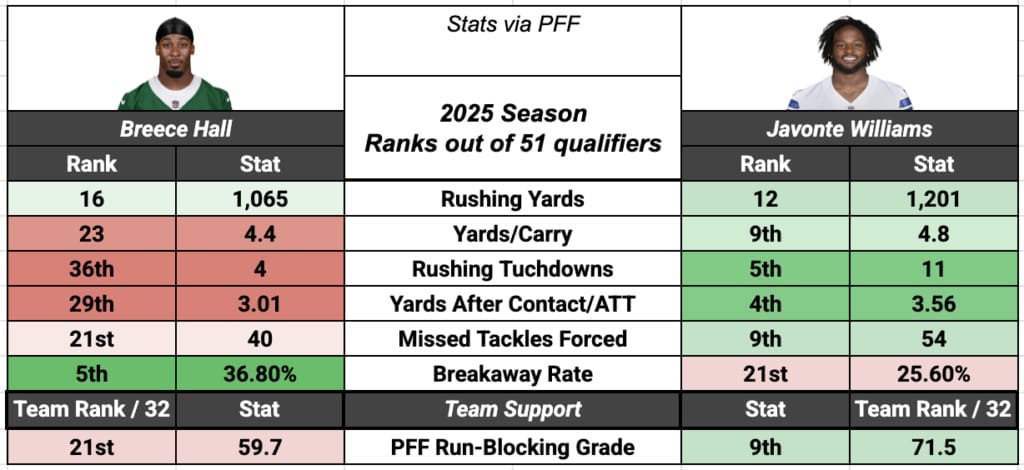
Among the categories we listed above, the only category where Hall ranked ahead of Williams is breakaway rate (percentage of a player’s rushing yards gained on carries for 15+ yards), as Hall’s 36.8% breakaway percentage ranked fifth among 51 qualified running backs, while Williams’ 25.6% rate ranked 21st.
However, context is key.
Williams was running behind the Cowboys’ offensive line, which finished the 2025 season with a stellar 71.5 run-blocking grade, ranking ninth in the league. On the other hand, Hall was working behind an O-line that ranked 21st in that same category with a 59.7 run-blocking grade.
Beyond that, Hall also makes far more of an impact in the passing game.
In 2025, the Iowa State product hauled in 36 of his 48 targets for 350 yards and a touchdown. Meanwhile, Williams logged just 137 receiving yards and two touchdowns across 51 targets and 35 receptions.
It is also worth noting that 2025 marked the lowest target total of Hall’s three full NFL seasons (excluding his rookie season, when he played in just seven games before tearing his ACL).
That drop in usage is notable considering what he produced in the two years prior.
From 2023-24, Hall totaled 1,074 receiving yards and seven touchdowns, which established him as one of the league’s top pass-catching running backs.
Hall’s receiving production, coupled with his worse circumstances in New York, should make him worth at least $2 million per year more than Williams.
With Williams already securing a deal worth roughly $8 million per season, the market for running backs is clear this offseason.
If the Jets, or any team, were to give Hall a multi-year deal this offseason, his price would likely check in around the $10 million per year range, due to his big-play ability and proven production as a pass catcher out of the backfield.