
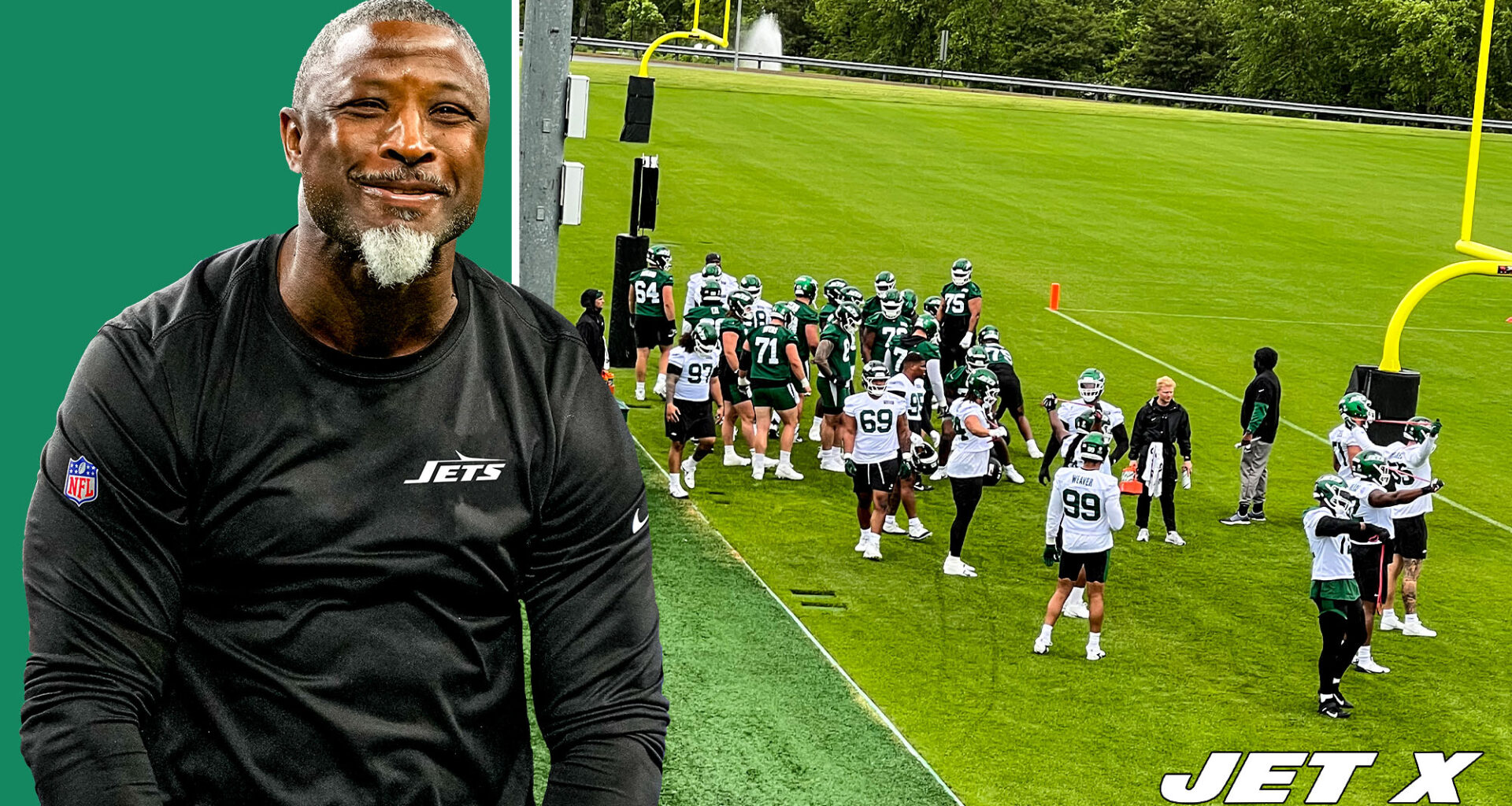
Reporting from New York Jets headquarters in Florham Park, NJ—Yes, for those who root for the professional football team that wears green and white in the Garden State, there’s a new sheriff in town.
The 2025 New York Jets greatly contrast with what came before, and not even a training camp glimpse is required to understand that reality. Jets fans care most about whether or not that results in wins, but the inner workings en route to potential wins are transparently different.
It’s all about Aaron Glenn.
The Jets’ head coach adheres to a particular set of principles when leading his football team, which naturally bleeds into practice.
5. The offense is who we thought it was
The offense is who we thought it was, which lends to Glenn’s post-OTA words about selectivity. For Glenn, “fitting” is not nearly enough.
“We’re going to be selective in everything that we do,” Glenn told the media when asked about safety Andre Cisco. “I don’t want this to be an outfit where everybody fits, and that’s just what it is. Every guy has to have some type of characteristic that fits what we do and what we’re about.”
Akin to why the Jets selected speedster Arian Smith in the fourth round of the 2025 NFL draft, there’s a plan behind each acquired player. Thus, each depth chart role is wholly aware of its responsibility—as communicated by the coaching staff.
Watching the offense on Wednesday confirms that this team is intent on rushing the ball early and often, and it starts with quarterback Justin Fields.
Two seasons ago, the Chicago Bears finished second in the NFL in rushing. Did they genuinely deserve No. 2-ranked rushing status? Of course they didn’t; it’s instead all about the quarterback.
Armand Membou’s selection as the right-side mauler, the Fields free-agent signing, and the trio of backfield horses in Breece Hall, Braelon Allen, and Isaiah Davis, lay it all on the table. What was witnessed on Wednesday at OTAs confirmed it.
7v7 starts with a nice session from Justin Fields. Found Garrett at least twice, Lazard for a big one as well. But I think the takeaway is this: The concepts the offense ran were pretty damn perfect for the coverages the D was in. How intentional that was from the coaches, not…
— Robby Sabo (@RobbySabo) May 21, 2025
Oh, and by the way, Arian Smith can play.
Though his value will travel well beyond targets and receptions—with his speed taking the top of the defense and allowing more room for Garrett Wilson underneath—this kid is much smoother in the route-running game than most believe.
4. A semi-Bear Bryant view
Joe Namath was just one of many who so fondly (and perhaps nervously) explained how Bear Bryant assumed his up-in-the-sky role during practice. One of the greatest football coaches in history often watched practice from a tower, ensuring that his players knew eyes were always open.
Although Glenn isn’t elevated, some comparisons exist.
Assumptions would lead many to believe Glenn constantly mixes it up with players on the field, yet that wasn’t exactly the case on Wednesday. He instead maintained his distance a bit, attempting to gain a broader, more general perspective.
Make no mistake: It’s not as though Glenn doesn’t chat it up at all. It didn’t seem as rampant as one may have thought heading into the day.
3. Attention to detail
Perhaps the most startling difference between an Aaron Glenn practice and Robert Saleh’s before him lies in the little items. Glenn’s insistence on attention to detail is ultra apparent.
When breaking the huddle, the offense hustles to the line of scrimmage. They do not fool around, nor are they ever sluggish. Fields and company cleanly break the huddle before carrying a clear intent on getting into position.
Pretty much what you’d expect so far. Helmets only, some teams work (with team on team, same level, best on best while the focus is clearly on design and responsibility, as opposed to anything hard).
Still, the intent the offense has by way of running up to the LOS after every…
— Robby Sabo (@RobbySabo) May 21, 2025
On defense, the core adjustments are swift and purposeful. Remember, this is May; these are OTAs. It is noteworthy to see such cleanliness when working with a new team and brand-new scheme.
The offense motioned a tight end from a balanced look into a dual-tight end set on one particular rep. Not only did the defensive line bump down via adjustment, but it did so quickly.
It’s clear as day that Glenn is communicating how important he feels it is that his players are ready well before the snap.
2. No roster spot is safe
Let’s just say this: One player who all Jets fans believe is starting this season may (or may not) be in that familiar role.
Granted, it’s May, and yet again, these are OTAs. Therefore, trying to take anything of serious note regarding the current depth chart at this current time is a dangerous game.
At the same time, keep an eye on how specific position battles unfold this summer. When the Jets ran through best-on-best team sessions Wednesday, a major surprise (or two) immediately punched us in the mouth.
Learning from the school of the Big Tuna (Bill Parcells), it shouldn’t surprise anybody if/when Glenn challenges players by mixing up the depth chart order at times.
1. No cheating the fundies
The moment a football team or player becomes too cool for school, the plot is lost. Even the most professional professional is—at his or her core—a human, which means repetition and down-to-earth reminders are essential.
Jets head coach Aaron Glenn is most definitely not too cool for school.
Unlike previous years, New York ran through base-level drills that scream fundamentals.
Just Fields and Garrett Wilson connecting in a drill. What to take away from Aaron Glenn so far in this: He’ll never take shortcuts around the fundamentals. Pros or not, these guys are humans, and embracing the surface level parts of the game is a thing with this Jets regime. pic.twitter.com/6ubkS9HDCr
— Robby Sabo (@RobbySabo) May 21, 2025
When they weren’t honing in on the fundies, they were going through team sessions intent on grasping the scheme and concepts each coordinator implemented. At one point, it appeared like they were rolling through things at about 75 percent (walkthrough status).
At other points, they were going 100% via a helmet-only session, which means no tackling, obviously. (No shoulder pads means no thumping or wrapping; thus, this session focused on scheme, concepts, and fundamentals.)