
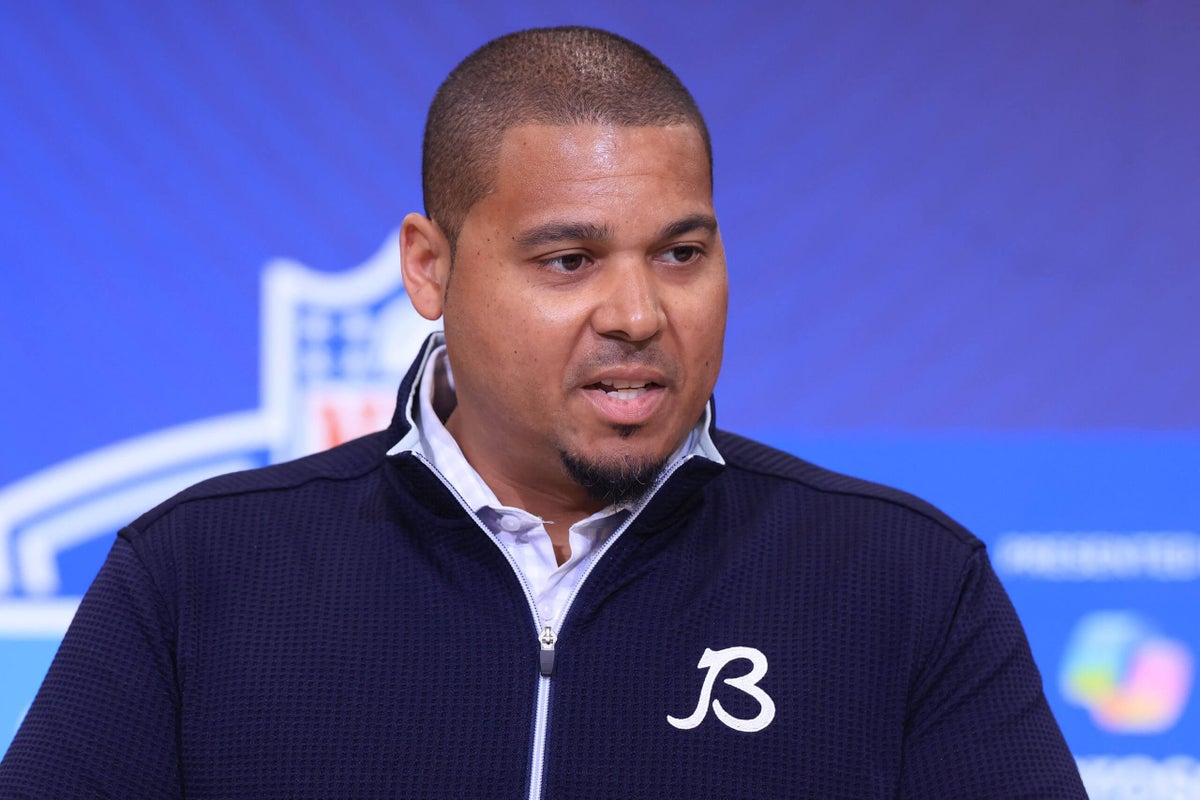
INDIANAPOLIS — Chicago Bears general manager Ryan Poles has had to answer questions at the NFL combine about whom to cut or trade and how to best manage the salary cap.
It’s different this time around.
Usually, February cuts for the Bears are obvious. Guys who didn’t play up to their contracts get released, not so much because the team needs salary-cap space but because it’s time to move on.
It now gets more difficult. The Bears have no choice but to get cap compliant in the next two weeks before the 2026 league year begins.
“This is a unique situation where we’ve gotten our roster in a position where we have a lot of talented players, a lot of guys getting paid well, and that puts some constraints on the cap,” Poles said Tuesday at the Indianapolis Convention Center. “So we got to make some tough decisions. … When we win games, you create these relationships. There’s leadership guys or guys that were captains that mean a lot to our organization. But when you’re kind of put in a corner, that’s what league’s been and has been.”
That comment came in response to a question about linebacker Tremaine Edmunds, who’s entering the final year of his contract with a cap hit above $17 million. It might make sense mathematically, but that doesn’t mean it’s easy for Poles.
It’s a new normal for the Bears, trying to sustain success by making the right moves this winter and spring. Part of that is figuring out which contracts to restructure and what that looks like in the future. Restructuring a contract provides cap relief in the short term, but it is the ultimate “kick the can down the road” maneuver for NFL front offices.
“I’m really fortunate to have (vice president of football administration) Matt Feinstein. I think he’s one of the best cap guys in the league,” Poles said. “He gives us a lot of different scenarios for us to operate in, but also showing us the short-term and long-term effect of each one of those decisions, because we want to stay in that sweet spot where we have maximum amount of flexibility as we move on, not only for this year but three years down the road.
“I hope eventually to have a quarterback situation, too, where we’ve got to pay a young quarterback, so that comes into play as well. I think we’re getting closer and closer to clarity on that side of things, which helps us start to build those models to make sure that, again, we’re doing the right thing for us moving forward and we’re not putting ourselves in a situation where we’ve got to make really tough or bad decisions down the road that hurt us.”
At this time next year, we could be asking Poles about the Bears’ plan for a contract extension for quarterback Caleb Williams. That would be a good thing. For now, they have to balance knowing he’s still on his rookie deal in 2026 at least, while being aware that if things go well, his next contract will add an extra challenge to building a competitive team around him.
It’s the win-now versus build-for-the-long-haul tug of war that every GM in every sport has to consider. It just happens to be new for Poles, coming off his first playoff appearance as a general manager.
Since Poles got the job in 2022, he has wanted to do one thing: build a consistent winner. He knew the Bears’ history.
“It’s just the sustainability,” he said. “How can we stay flexible and how can we be successful, take advantage of — we talked about this quarterback window — take advantage of that but also set ourselves up to continue to win.
“I mean, I got a head coach that wants to sustain success and win for a long period of time. I have a quarterback who continues to progress, and he wants to be one of the best to ever do it and win a lot of championships. So with that model, we have to be very conscious of how we put this team together, but we want to win championships now. We want to be able to have that flexibility to continue to win down the road.”
Poles is aware of what can happen if they restructure too many contracts.
“There’s philosophical things that we believe in, in terms of not getting to this place where we’re kicking the can down the road on a bunch of guys, and then at some point you got to pay that bill,” he said. “And you don’t want that to be the reason why you’re not flexible and able to do unique things or take advantage of opportunities with your roster.”
What does that mean for the 2026 offseason? Poles certainly doesn’t sound like a GM who would be jumping at the opportunity to trade for a contract such as Maxx Crosby’s, but he also isn’t going to be satisfied with doing the minimum.
He alluded to the situation he inherited when the GM who preceded him took some big swings that didn’t pan out.
“You got to win the first one, right? Like, you got to get started,” he said. “But what are you willing to sacrifice to do that? There’s some things you can do to … you all have seen that before I got here. You can accelerate it, and then after, it goes away pretty quick. So we got to balance both.”
Ryan Pace’s trade for Khalil Mack worked great for the 2018 season but became a challenge in the subsequent seasons as the Bears lacked draft capital and cap space, coming to a head in the 2021 season. Poles took over a team that needed to shed bad contracts and virtually start over.
That doesn’t mean Poles won’t take a shot if the right situation presents itself, but he’s acutely aware of how it can backfire.
“Our mindset is to do both — win now and then be able to sustain that and have flexibility. It’s not gonna be easy, you know what I mean?” he said. “I can guarantee you, we’ve been really good with dead money. At some point that’s gonna go up, too, because that’s just the nature of playing this out over a long period of time and having tough decisions to make.”
Coach Ben Johnson is part of those conversations. It’s natural for a coach to be laser-focused on the upcoming season and doing what he can to put the best roster on the field to win. Johnson also understands straddling that line.
“You might have an off-the-wall idea that you’ve kind of got to talk through of what consequences might be if you went down that road, and so that’s this time of year,” he said. “You’re trying to accumulate the best 90-man roster you possibly can. We need it to be as competitive as it’s ever been so that we take the next step. I know Ryan, and I see our current roster, the guys that are under contract, very much in the same lens, and we’re totally committed to whatever it takes to get better.”
Is an “off-the-wall” idea trading for one of the best pass rushers in football? Or maybe it’s trading away a highly productive receiver? Either way, Poles and Johnson have to be cognizant of avoiding — as best they can — setting up the 2027 and 2028 Bears to be in predicaments that this offseason creates.
Of course, if the 2026 Bears keep building off last season and the franchise becomes a consistent playoff contender, those will be welcome predicaments.
After free agency, trades, veteran cuts and restructured contracts comes the NFL Draft, where the roster-building involves the 25th pick as opposed to the top 10, where the Bears were the past three Aprils.
The same philosophy for Poles applies — staying disciplined and not wanting to do something that puts the team at a disadvantage down the line.
“I think if you look at some late-round action, historically I think you want to just stay disciplined with taking good football players,” Poles said. “I think you can take a little risk and you can go get a flashy guy that may not (have) the wiring in terms of culture fit. (That) isn’t the right thing to do.”
Some teams draft in the late 20s year after year. The Bears want to be one of them, and they can learn from how those franchises used not-so-premium picks to keep reloading.
“I think taking good football players at 25 — I think back to the Steelers, I think back to the Ravens and some of these teams that just were able to put really good rosters together and draft well late — those guys aren’t sexy,” Poles said. “They’re just good, hearty football players. So that’s what we’re going to focus on. I think that will put our team in the best position to be successful.”
Change is a given. That begins this time of year. Part of the roster-construction exercise means building a roster that isn’t the same as the one that went on the 2025 ride to the divisional round.
“I’ll say this is one of the closest-knit groups I’ve ever been a part of, last year’s team. That’s hard to replicate,” Johnson said. “I wish there was some magic stick you could just float on out there to make that happen, and yet, you know, we had a lot of high-character players that came together, and they wanted what was best for the team and for their buddies. That’s a hard thing to replicate.
“We have to do what is best for the team, and as we stack back up the 90-man roster again, we’ve got numerous holes to fill, and I know Ryan and I are committed to making it the most competitive roster we can.”