
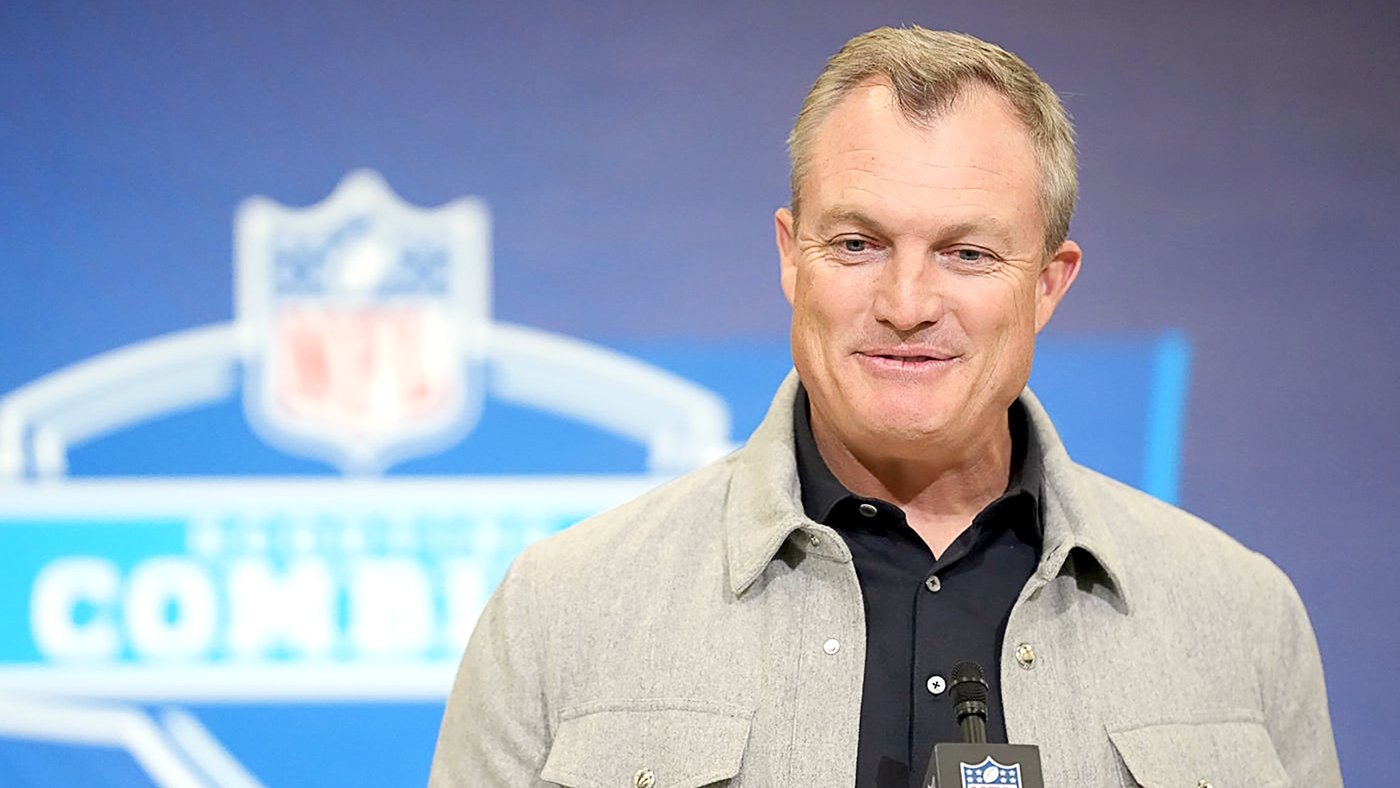

When Lynch took the podium in Indianapolis, he did what experienced general managers always do this time of year. He spoke broadly, carefully, and without giving competitors anything actionable. But if you listened closely, he offered something more valuable. He revealed what the 49ers have learned.
And those lessons tell you exactly how this offseason will unfold. This is a team evolving with intention, not reacting with emotion.
This Is About People, Not Just Prospects
Early in his remarks, Lynch talked about NIL and transfers. Years ago, a transfer was a red flag, but now it is normal.
He acknowledged that reality, but he made something else clear. The question is no longer why a player transferred. The question is why they moved, and that difference is the key.
They are not looking for players who chase opportunity. They are looking for players who respond to adversity, who lead, who can handle money, movement, and pressure before they ever step into an NFL locker room.
When Lynch later spoke about tape being most important but immediately pivoted to the person, that was not accidental. The league is hard, and the mental side determines who survives.
The 49ers are not hunting raw traits; they are hunting temperament. Their locker room culture has been their backbone, and every draft decision now flows through that filter.
The Trent Williams Conversation Was Strategic
Ninety minutes before Lynch spoke, reports surfaced about challenges in Trent Williams‘ contract talks. Then Lynch stepped up and had to address it directly.
He confirmed substantive meetings and emphasized mutual respect. He spoke about Williams’ legacy. Then he mentioned age and the need to thread the needle.
That was not careless wording. What we saw was a negotiation happening in public.
Williams has no guaranteed money left, and the 49ers have cap decisions to make. Both sides want a deal, and neither side wants to lose leverage.
By referencing age, Lynch reminded everyone that this cannot be sentimental. By referencing the rafters, he reminded Williams that this is about legacy.
They have reworked his contract before, but this time feels different. San Francisco needs flexibility to improve the roster, while Williams wants security.
That needle is real, and the fact that Lynch addressed it so directly suggests both sides know it must get done soon.
The Defensive Front Is the Foundation
When asked where improvement is needed, Lynch mentioned several areas. But he did not linger there; he went back to the defensive front.
“We’ve always prided ourselves on our defensive front and getting after people.”
That sentence says everything.
For years, the 49ers used to dictate games with their front four. Pressure changed coverage, protected linebackers, and forced mistakes.
Over the past two seasons, the pressures were there at times, but the sacks were not. And when quarterbacks stayed upright, the rest of the defense absorbed the consequences.
Lynch knows that.
The defensive front is not one unit among many. It has been the engine of their identity ever since Lynch and Coach Shanahan arrived.
If they invest heavily in one area this offseason, count on it, it starts there.
Raheem Morris and Adaptation
Lynch praised Raheem Morris for his experience and variety. He made it clear that the core system remains intact, but he also mentioned exposure to other concepts, including what Morris implemented with the Rams. That right there was acknowledgment without overreaction.
The wide nine is not disappearing. But offenses have studied it, and adaptation is required. Cue, Raheem Morris.
Morris brings familiarity and a broader perspective. His exposure to different systems and even time on the offensive side of the ball are key elements in this hiring. He understands how offenses attack, which enables him to adjust.
The message to fans was simple: We are not abandoning what works. We are expanding it.
Folks, that is evolution, not reinvention.
Free Agency and the Salary Cap Reality
Fans saw players leave last year and assumed inactivity. Lynch disagreed, and rightfully so.
He pointed out the record-setting cash spent on extensions for Brock Purdy, Fred Warner, George Kittle, and Colton McKivitz. The aggressiveness happened internally.
The 49ers were one of the oldest teams in the league. They needed to get younger, and that means hard choices.
There is no unlimited spending in a capped league. You cannot sign everyone. You cannot extend everyone. You cannot chase every free agent splash.
Lynch was clear. You get the feeling that they may spend on a key free agent or two, but not a big splash. Free agency will be targeted, and the draft remains the lifeblood.
That is discipline.
Trade Conversations Have Already Begun
When Lynch acknowledged that trade discussions typically begin in Mobile and accelerate at the Combine, he confirmed what most insiders know.
The phones are active, and the in-person meetings are happening. That applies to veteran players, draft positioning, and potentially wide receiver help.
Which brings us to the next point.
The Receiver Room Is Under Evaluation
Lynch named names.
He spoke about Jauan Jennings being a free agent, Jacob Cowing needing to get on the field, and their need to find a way to keep Ricky Pearsall healthy. He also noted Jordan Watkins must take big steps.
That was bold because it was not praise, but rather accountability.
With Brandon Aiyuk no longer in the picture, and Pearsall, not his fault, suffered an injury that lingered and kept coming back because he never gave it a chance to fully heal. That type of injury ended Christian McCaffrey‘s season the previous year.
Without them, the offense lacked separation last season. Without consistent threats outside, defenses compressed the field.
McCaffrey saw more attention, and the quarterbacks faced tighter windows. Separation is not optional in today’s NFL.
At pick 27, finding a true difference-maker at wide receiver is uncertain. That increases the likelihood of exploring trades or targeted free agency.
Lynch left every option open. That is not accidental.
The Quarterback Lesson
Near the end, Lynch compared one player who played a ton of college football (Brock Purdy) to one who did not (Trey Lance).
You live, and you learn, he said. With that, I saw a reflection moment.
The Lance experience and the Purdy emergence changed how this organization views evaluation: Tape volume, experience, and durability actually matter.
The 49ers have hit on late-round players because they trust their evaluation process. But even they acknowledge growth.
This offseason feels different because the lessons are fresh.
The Bigger Picture
The 49ers are not rebuilding; they are just tightening their standards.
What we can infer is that they want pass rushers who finish, receivers who separate and stay on the field, prospects who have endured real adversity, and veterans who fit financially and culturally.
The real question now is how they check off everything on that list.
John Lynch did not outline a blueprint in Indianapolis. He revealed the principles guiding it.
And if you listen carefully, you can already see where the priorities lie.