
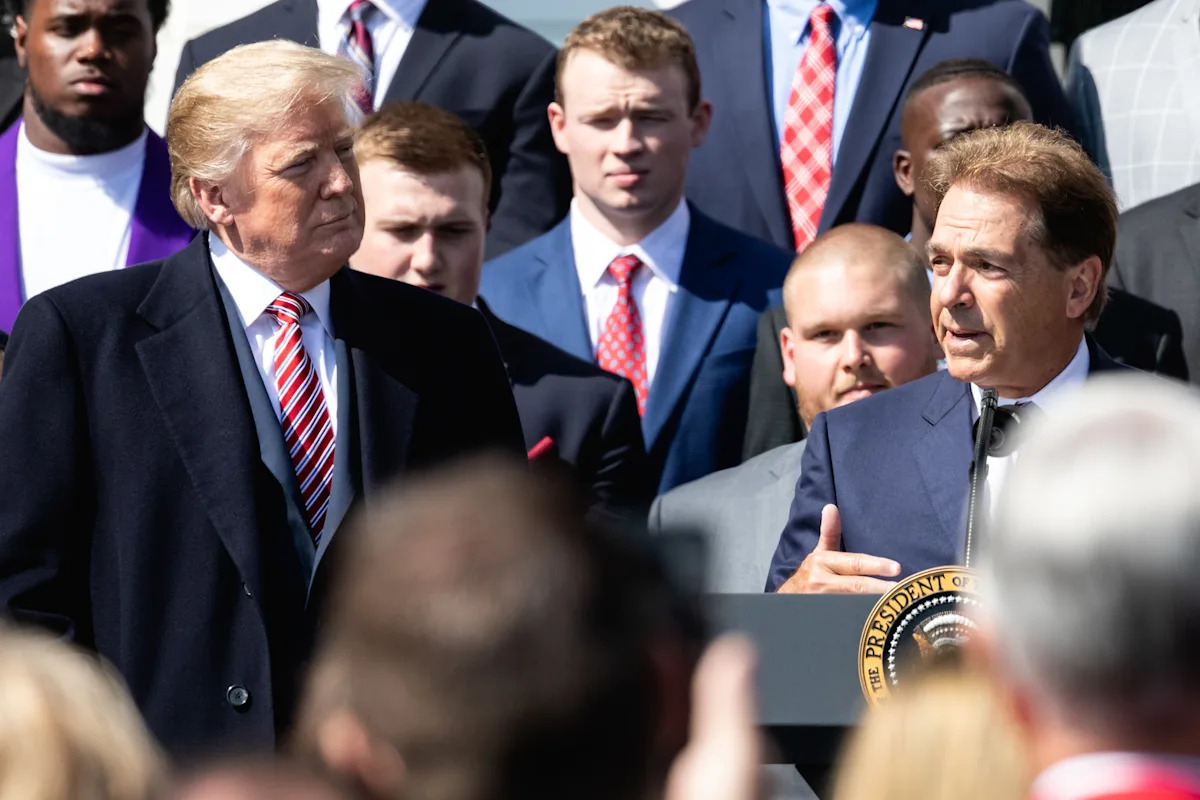
The fight over the future of college athletics is reaching its most prominent battlefield yet: the White House.
U.S. President Donald Trump is convening next Friday a presidential roundtable of more than three-dozen dignitaries and sports celebrities to further explore solutions for the industry’s ills. The invitee list is a who’s who — key political figures, prominent college sports stakeholders, television executives, former national title-winning football coaches, a sitting state governor, the NBA commissioner and, even, pro golfers such as Tiger Woods.
Advertisement
Those with knowledge of the meeting spoke to Yahoo Sports under condition of anonymity as they were not authorized to discuss the matter. Many of those involved only recently received invitations to join, and it is unclear if all of those invited — as many as 40 — will attend.
Some are skeptical that the meeting will transpire as scheduled. White House meetings are always subject to delay or cancellation due to unexpected events warranting the president’s attention.
Amid the years-long congressional discourse over college sports legislation, the group — dubbed the Saving College Sports Roundtable — is expected to hold discussions over solutions to a once-amateur industry rapidly evolving into a more professionalized outfit.
Advertisement
The invitees include many of those within the industry itself, such as the four power conference commissioners (Big Ten, Big 12, SEC and ACC); at least one athletic director representing each power league (Wake Forest, Iowa State, Indiana and Oklahoma); Notre Dame athletic director Pete Bevacqua and ex-Notre Dame athletic director Jack Swarbrick; former coaches Mack Brown, Nick Saban and Urban Meyer; Texas Tech board member Cody Campbell; Heisman winners Tim Tebow and Charlie Ward; university presidents/chancellors Doug Girod (Kansas), Jeff Gold (Nebraska) and Donde Plowman (Tennessee); and former Clemson and West Virginia president Jim Clements.
There are plenty more from outside of college athletics — business titans, athlete celebrities and pro sports executives. They include NBA commissioner Adam Silver; millionaire businessmen like David Blitzer, Marc Ganis and Gerry Cardinale; pro golfers like Woods and Bryson DeChambeau; and former secretary of state Condoleezza Rice. Media executives from Fox and ESPN are also expected to have received an invitation.
Trump is serving as chair of the roundtable, with vice chairs Ron DeSantis, the governor of Florida, and Randy Levine, the president of the New York Yankees.
Advertisement
It will be a fascinating scene.
Many of the parties warring with one another over industry solutions will find themselves in the same room — all of them facing the sitting president of the United States. For months now, Trump has made a priority his intention to provide college athletics with stability and protection from legal challenges — either through congressional legislation or his own executive order released last summer. However, any impact within the industry has been non-existent.
What awaits the president is a room likely divided on how to fortify a college sports organization that stands at an inflection point — swiftly transforming into a more professionalized entity after court rulings deemed many NCAA policies in violation of antitrust laws.
Advertisement
Devoid of a collective bargaining agreement or federal protection, college athletics is a landscape of few rules and regulations and little enforcement, while a collection of wealthy universities outspend their lower-resourced foes in what many administrators describe as a “race to the bottom.”
Ideas on solutions for the primary issue — how to pay college athletics — have even divided those within the industry itself, with arguments ranging from athlete employment to non-employment collective bargaining, from federal antitrust protection to amending the Sports Broadcasting Act so conferences can pool their media rights.
Advertisement
The latter issue — the pooling of media rights — has caused deep rifts, both among college stakeholders themselves and between conferences leaders and external forces, such as Campbell, the Texas Tech billionaire businessman whose “Saving College Sports” campaign urges lawmakers to amend the SBA. The “SCS” campaign argues that consolidating television rights for the 10 FBS conferences — for now, they each negotiate their own deals — is a way to increase revenues to help financially stabilize college sports and level the playing field, potentially closing the gaps between the richest leagues, the SEC and Big Ten, and everyone else.
On Thursday morning, the fight over the SBA became more public, as the Big Ten and SEC released a joint white paper taking aim at Campbell’s plan and referring to any move to consolidate media rights as “misguided.”